Semaglutide After 50: Weight, Muscle, and Health
After 50, the best question is whether treatment improves your health and function, not just the number on the scale.
Being over 50, in perimenopause, or past menopause does not by itself determine whether semaglutide is a good fit. The first distinction is the treatment goal: semaglutide is used for chronic weight management and for type 2 diabetes, but the products should not be treated as interchangeable. Weigh the health problem you hope to improve against effects on eating, strength, and daily function. Review other medicines and treatment risks, including digestive and gallbladder problems, pancreatitis, and the thyroid-tumor warning based on rodent findings. Evidence about muscle and function in older adults remains limited. 2 3 5 8 9
Start with the health goal, not an age cutoff
A useful discussion starts with what you hope treatment will change: a weight-related health problem, a measure of health such as blood sugar, or a physical task that has become harder. Weight alone can’t show the whole picture; it includes muscle, bone, fat, and water. For older adults in particular, strength and muscle matter alongside body weight. 4 7
Semaglutide is used for chronic weight management and for type 2 diabetes, but those are distinct treatment goals. The US labeling for Ozempic and Rybelsus tablets describes their use alongside diet and exercise to improve blood sugar in adults with type 2 diabetes. It does not establish those tablets as weight-management products. If weight management is your goal, consider that treatment separately rather than assuming all semaglutide products serve the same purpose. 3 5
For a weight-management decision, consider whether obesity is contributing to problems such as type 2 diabetes, cardiovascular or liver disease, or difficulty moving and carrying out daily activities. In older adults with obesity that has not responded adequately to lifestyle measures, a weight-management medicine may be considered as an addition to those measures, while weighing possible losses of muscle and bone. Age 50 or a desire for a lower scale number alone does not establish the same case for treatment. 6 7
Evidence about semaglutide in older adults remains limited. A review of obesity medicines notes that many trials included relatively few people at the oldest ages, and a small randomized study designed to examine semaglutide, body composition, and physical function in adults 65 and older is a protocol, not a report of results. 5 6
Age and menopause are not interchangeable evidence categories. If you’re in perimenopause or postmenopause, describe what has changed for you, including your health goals and daily function, without assuming menopause explains a weight change or predicts your response to semaglutide. Age-focused findings do not answer whether response differs by menopause stage. 5 6 8
Ask what weight loss could mean for muscle
Semaglutide-related weight loss can include a reduction in lean body mass as well as fat mass. That does not mean every change in lean mass is the same as losing working muscle, and a higher proportion of lean mass after weight loss does not prove that muscle was gained. Measures of body composition and measures of strength or physical performance answer different questions. 8
This distinction matters if you already have low strength, difficulty with everyday activities, or concerns about maintaining independence. Before treatment, choose a familiar activity to revisit, such as managing stairs, getting up from a chair, or carrying groceries. If it becomes harder even as weight falls, bring that change into the treatment review. These are examples of daily function, not a diagnostic test. A review of obesity care in older adults emphasizes resistance exercise and attention to function when weight loss is pursued. 6 7
Make eating and strength part of the plan
Nutrition deserves attention when you’re trying to lose weight without neglecting the nutrients your body needs. MedlinePlus notes that some older adults need more protein even when their calorie needs may be lower; it doesn’t set a semaglutide-specific protein target. 1
Notice whether you can still eat nourishing meals as treatment continues. If digestive symptoms make that difficult, don’t judge progress by the scale alone: raise the change with your prescribing team. A registered dietitian may be able to help tailor food choices to your health and preferences. Discuss resistance activity that fits your abilities and health conditions. The aim is not to chase a perfect body-composition reading; it’s to support strength and daily function while addressing the health goal that prompted treatment. 1 6 8 9
Review conditions, medicines, and tolerability
Bring your health history into the decision, including conditions affecting nutrition, mobility, or treatment goals. The right choice depends on the whole health picture, not just age or weight. 7
Bring your full medication list too. If you take medicines for type 2 diabetes, name them specifically, including insulin or a sulfonylurea if either applies to you. Semaglutide tablets have been studied alongside these and other diabetes medicines, but that fact alone doesn’t settle what monitoring is right for your combination. Ask how blood sugar and any existing diabetes treatment will be followed if semaglutide becomes part of your plan. 3
Digestive intolerance, gallbladder disease, and pancreatitis are reported concerns with GLP-1 receptor agonists. Agree on how to report new or worsening digestive symptoms, particularly if they’re making it hard to eat or drink normally, rather than waiting for a weight check to reveal a problem. The evidence cited here does not establish how often these concerns occur specifically in women over 50. 1 9
There is also a thyroid-tumor warning to discuss. US labeling for Wegovy and for Ozempic and Rybelsus tablets reports that semaglutide caused thyroid C-cell tumors in rodents. Whether it causes these tumors in humans is unknown; the animal finding is not proof of a human outcome. Bring up any thyroid-cancer concerns when weighing treatment. 2 3
It’s also reasonable to agree in advance what you’ll track besides weight: whether the intended health goal is improving, whether meals remain nourishing, and whether strength or everyday function is holding steady. If weight falls but eating or usual activities become harder, that is useful information for reassessing the plan. Older-adult guidance emphasizes health measures and function rather than weight loss alone. 1 7 8
A decision that can be revisited
A thoughtful decision is neither “I’m too old” nor “I should take it because I’m gaining weight.” It is a comparison: how much the health problem matters to you, what treatment might help, what tradeoffs you’re willing to accept, and how you’ll notice whether the plan is serving you. Because evidence in older adults is still developing, especially for muscle and function, set a review point with your care team rather than treating the first decision as permanent. 5 6 8
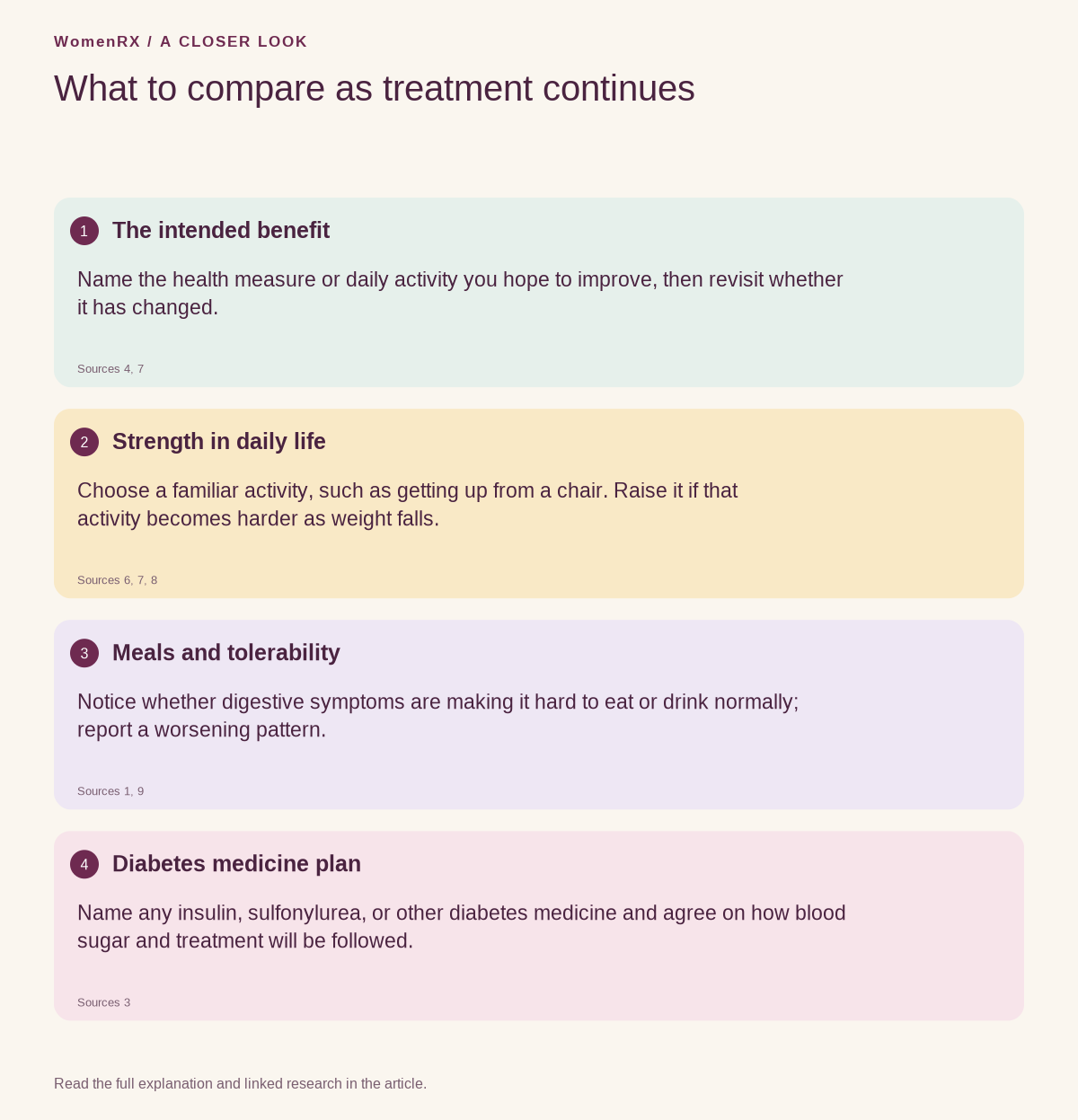
What to compare as treatment continues
The intended benefit: Name the health measure or daily activity you hope to improve, then revisit whether it has changed.47
Strength in daily life: Choose a familiar activity, such as getting up from a chair. Raise it if that activity becomes harder as weight falls.678
Meals and tolerability: Notice whether digestive symptoms are making it hard to eat or drink normally; report a worsening pattern.19
Diabetes medicine plan: Name any insulin, sulfonylurea, or other diabetes medicine and agree on how blood sugar and treatment will be followed.3
Read the figure as text
Use the same health and function questions before treatment and at review, so a changing scale number has context.- The intended benefit: Name the health measure or daily activity you hope to improve, then revisit whether it has changed.47
- Strength in daily life: Choose a familiar activity, such as getting up from a chair. Raise it if that activity becomes harder as weight falls.678
- Meals and tolerability: Notice whether digestive symptoms are making it hard to eat or drink normally; report a worsening pattern.19
- Diabetes medicine plan: Name any insulin, sulfonylurea, or other diabetes medicine and agree on how blood sugar and treatment will be followed.3
More questions, answered
Does menopause change how well semaglutide works?
The age-focused research discussed here does not report semaglutide outcomes by perimenopause or postmenopause, so it cannot answer whether response differs by menopause stage. Menopause can be part of your health context, but it is not by itself a reason to assume the medicine will or won’t work for you. 5 6 8
Should I track muscle as well as weight?
It can be useful to track strength and everyday function as well as weight. Body-composition measures distinguish lean mass from fat mass, while practical activities such as stairs or rising from a chair can help you discuss how you’re functioning. These are different kinds of information, not a single validated self-test. 4 8
Sources you can check
- Nutrition for Older Adults: MedlinePlusAccessed 2026-09-25Return to first citation
- WEGOVY (SEMAGLUTIDE) INJECTION, SOLUTION WEGOVY (SEMAGLUTIDE) TABLET [NOVO NORDISK PHARMACEUTICAL INDUSTRIES, LP] | US prescribing information and patient instructionsAccessed 2026-09-25Return to first citation
- OZEMPIC (ORAL SEMAGLUTIDE) TABLET RYBELSUS (ORAL SEMAGLUTIDE) TABLET [NOVO NORDISK PHARMACEUTICAL INDUSTRIES, LP] | US prescribing information and patient instructionsAccessed 2026-09-25Return to first citation
- Body Weight: MedlinePlusAccessed 2026-09-25Return to first citation
- Effect of Semaglutide on Physical Function, Body Composition, and Biomarkers of Aging in Older Adults With Overweight and Insulin Resistance: Protocol for an Open-Labeled Randomized Controlled Trial.Cortes TM, Vasquez L, Serra MC, Robbins R, Stepanenko A, Brown K, Barrus H, Campos A, Espinoza SE, Musi N. · JMIR research protocols · 2024Return to first citation
- Obesity pharmacotherapy in older adults: a narrative review of evidence.Henney AE, Wilding JPH, Alam U, Cuthbertson DJ. · International journal of obesity (2005) · 2025Return to first citation
- Swiss obesity clinical practice guidance.Gerber PA, Collet TH, Favre L, Bueter M, Ruiz Arana I, Durrer D, Seelig E, Schultes B, Pasi P, Konrad D, Bally L. · Swiss medical weekly · 2026Return to first citation
- Beyond Weight Loss: Skeletal Muscle Health During Incretin-Based Therapy in Patients with Diabesity.Mollero ELM, Dozzani I, Biamonte E, Bendotti G, Marzullo P, Aimaretti G, Gallo M. · Nutrients · 2026Return to first citation
- Integrating glucagon-like peptide-1 receptor agonists into dermatology practice: Safety and monitoring strategies.Narla S, Narla RR. · Clinics in dermatology · 2026Return to first citation