Does Losing Weight on Ozempic Mean Losing Muscle?
Lean mass can fall during semaglutide treatment, but that measurement alone can’t tell you how much skeletal muscle or strength you’ve lost.
Some weight lost during semaglutide treatment can come from lean mass. That isn’t the same as saying all of it is skeletal muscle: lean mass also includes organs, bone, and body fluids. Studies measure changes across groups, not what will happen to you individually. If muscle health concerns you, discuss your strength and daily function alongside your weight and eating habits. 3 4
What a lean-mass result actually measures
If the scale is dropping and you’re wondering whether you’re losing muscle too, the short answer is: possibly, but the scale can’t tell you. Even a body-composition result labeled lean mass needs interpretation. Lean mass includes skeletal muscle, but also organs, bone, and body fluids. Hydration can affect the estimate. A lower lean-mass reading doesn’t show exactly how much skeletal muscle changed or whether you’ve become weaker. 4
A review of seven randomized trials, involving 821 participants in total, compared GLP-1 medicines at obesity-management doses with placebo. Across the trials, absolute lean mass was lower by an average of 1.74 kg with treatment. Yet lean mass as a proportion of total body weight increased by 1.81%, as reported by the review. Both can be true when total weight falls: there can be less lean mass in kilograms while it makes up a larger share of the body weight that remains. There was substantial between-study variation in the absolute lean-mass result, so the average doesn’t predict your result. 4
Those pooled findings cover semaglutide and other medicines, not Ozempic alone. They also concern obesity-management doses, which matters when applying the numbers to your own treatment. 4
A semaglutide trial shows why the details matter
In a prespecified analysis of a randomized trial, 101 adults with chronic kidney disease and overweight or obesity, but without type 2 diabetes, received semaglutide or placebo for 24 weeks. Compared with placebo, the semaglutide group had a 9.1 kg greater reduction in total body weight and an estimated 2.5 kg greater reduction in lean body mass. The confidence interval for that lean-mass difference ran from a 6.6 kg reduction to a 1.6 kg increase, so the size and direction of the difference remain uncertain in this study. Researchers used bioimpedance spectroscopy and also found a reduction in extracellular water. 3
This is useful evidence that weight change, lean-mass estimates, and water change deserve separate attention. It isn’t a forecast for someone taking Ozempic, particularly if her health differs from that trial population. Neither this result nor the pooled findings presented in the review establish how changes differ by sex or menopause stage. 3 4
Put function beside the numbers
When you discuss muscle health, start with what you can do, not just what a device reports. For example, are stairs, carrying groceries, or getting up from a chair noticeably harder than before? These are ways to describe a change, not a home test that diagnoses muscle loss. A body-composition measurement and a conversation about strength answer different questions; a lean-mass estimate alone doesn’t measure muscle function. 4
If you have a body-composition result, ask what the test calls “lean mass” and whether repeating it would change your care plan. The review allowed several assessment methods, including DXA, CT, MRI, and bioimpedance; its list of eligible methods doesn’t mean every included trial used every method. 4
It’s also worth discussing whether reduced appetite is making it difficult to eat enough or include a variety of foods. A healthy eating pattern needs to provide energy and nutrients, including protein, and can be shaped around your preferences and budget. The review’s authors recommend pairing treatment with nutrition and physical activity to support muscle health, but these findings don’t identify one protein amount or exercise routine that fits everyone. 2 4
A few focused questions can help you make a plan that fits your starting point:
- “What changes in strength or everyday function should we pay attention to, given my current abilities?”
- “Would a body-composition measurement help us make a decision, or would it add a number without changing the plan?”
- “With my appetite and health needs, how can I keep meals nourishing and choose activity I can do consistently?”
If you’re in midlife or older adulthood, bring up any strength or mobility concerns you already had before treatment. That baseline helps make a change more meaningful than comparing yourself with someone else’s lean-mass average. If you’re pregnant or planning pregnancy, that calls for a separate conversation about the medication itself: Ozempic prescribing information describes limited human pregnancy data and potential fetal risk based on animal studies. 1
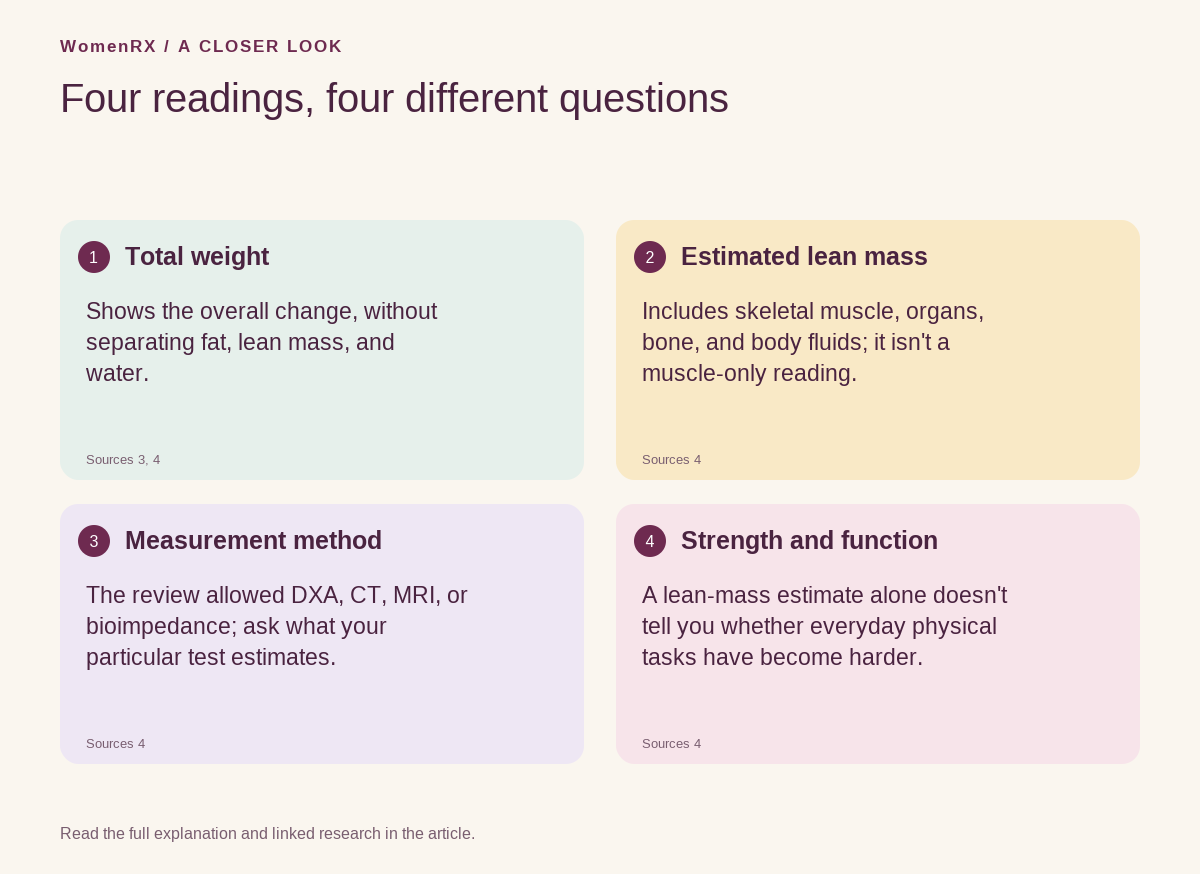
Four readings, four different questions
Total weight: Shows the overall change, without separating fat, lean mass, and water.34
Estimated lean mass: Includes skeletal muscle, organs, bone, and body fluids; it isn't a muscle-only reading.4
Measurement method: The review allowed DXA, CT, MRI, or bioimpedance; ask what your particular test estimates.4
Strength and function: A lean-mass estimate alone doesn't tell you whether everyday physical tasks have become harder.4
Read the figure as text
A falling weight and a lean-mass estimate offer context, but neither is a direct measurement of muscle strength.- Total weight: Shows the overall change, without separating fat, lean mass, and water.34
- Estimated lean mass: Includes skeletal muscle, organs, bone, and body fluids; it isn't a muscle-only reading.4
- Measurement method: The review allowed DXA, CT, MRI, or bioimpedance; ask what your particular test estimates.4
- Strength and function: A lean-mass estimate alone doesn't tell you whether everyday physical tasks have become harder.4
Sources you can check
- OZEMPIC (SEMAGLUTIDE) INJECTION, SOLUTION [A-S MEDICATION SOLUTIONS] | US prescribing information and patient instructionsAccessed 2026-09-25Return to first citation
- Nutrition: MedlinePlusAccessed 2026-09-25Return to first citation
- Effects of Semaglutide on Body Composition and GFR: A Prespecified Analysis of the SMART Trial.Heerspink HJL, Soler M, Beernink JM, Jongs N, Cigarran S, Cigarran S, Cruzado JM, Puchades MJ, López-Martínez M, López-Martínez M, Apperloo E, Waanders F, Laverman GD, van der Aart... · Clinical journal of the American Society of Nephrology : CJASN · 2026Return to first citation
- Effect of GLP-1 receptor agonists at doses for obesity management on muscle health: systematic review and meta-analysis of randomized controlled trials (RCTs).Laverde LP, Muñoz-Velandia OM, Alfonso D, Gómez Medina AM. · International journal of obesity (2005) · 2026Return to first citation