Ozempic and Muscle Loss: What the Evidence Shows
Some semaglutide studies find a drop in lean mass, but that measure isn’t the same as muscle strength or function.
The findings summarized here don’t establish how much lean mass people with type 2 diabetes lose specifically on Ozempic. A review of trials in adults with overweight or obesity found lower lean mass with semaglutide 1 mg, while a separate study of 2.4 mg in people with obesity found lean mass initially fell but grip strength improved. Those findings aren’t interchangeable with Ozempic use in diabetes. 1 3
What “lean mass loss” does, and doesn’t, mean
Lean mass is a body-composition measurement, not a direct reading of muscle strength or everyday function. A change in lean mass therefore doesn’t, by itself, tell you whether you’ve lost strength or become less able to do the things you normally do. 1
That distinction matters when interpreting semaglutide research. A person can lose some lean mass as weight falls and still maintain or improve strength. Conversely, new weakness or difficulty with usual activities deserves attention even if the scale is moving in a desired direction. 1
What the semaglutide studies actually tell us
A 2026 systematic review and network meta-analysis of 43 randomized trials, with 3,379 participants across 17 treatments or doses. The review included adults with overweight or obesity, with or without type 2 diabetes. It reported a significant decrease in lean mass from baseline with semaglutide 1.0 mg weekly. The abstract doesn’t identify an Ozempic-specific lean-mass result for people with type 2 diabetes, or a sex-specific result, so it can’t tell an individual woman how much lean mass she might lose. 3
A different study helps show why dose and population matter. In the prospective SEMALEAN study, 106 people with obesity completed a year of semaglutide 2.4 mg; about 69% were women. Lean mass fell by 3 kg at month seven and then stabilized, while average handgrip strength increased by 4.5 kg by month 12. The researchers reported greater weight and fat loss in women and attenuated responses among people with type 2 diabetes, but this was not an Ozempic-dose study designed to establish effects in women with diabetes. 1
Taken together, these findings support a careful conclusion: lean mass can decrease during semaglutide-associated weight loss, but the amount and functional meaning vary. Evidence from 2.4 mg semaglutide for obesity cannot simply be applied to Ozempic treatment for type 2 diabetes. Nor does a measured lean-mass change prove that a person has lost strength. 1 3
If you feel weaker, focus on function too
Notice what has changed, not only what the scale says. For example, are stairs, carrying groceries, getting up from a chair, or your usual exercise becoming harder? Tell your prescriber when the change began and what activities have become harder.
A useful conversation is: “I’m losing weight, but I’m also finding ___ harder. Could we review my strength, food intake, symptoms, and diabetes treatment?” You can also ask whether a body-composition measure or a simple strength and function assessment would change what you do next. A measurement is most useful when it answers a practical question, rather than becoming another number to worry about.
Resistance exercise and protein intake are being studied as ways to preserve lean tissue during semaglutide or tirzepatide treatment. One randomized trial protocol is testing these approaches, but a protocol is not a result: it doesn’t show yet that a particular program prevents muscle loss during semaglutide treatment. Ask your care team what activity and nutrition approach fits your health, appetite, and abilities rather than relying on a supplement or a one-size-fits-all target. 2
Age and menopause are useful context, not a proven semaglutide effect
The reported results of the 1 mg review and 2.4 mg study don’t provide an age- or menopause-specific estimate of lean-mass change. The 2.4 mg study reported some sex-based differences in weight and fat loss, but that doesn’t answer whether lean-mass changes differ by menopause status. If you’re older or postmenopausal, mention that context alongside any change in strength or daily function; these reported results can’t quantify an added risk. 1 3
The main next step is to raise a change in strength or function with your prescriber, not to assume that every lean-mass measurement means muscle damage or that weakness is an inevitable part of weight loss.
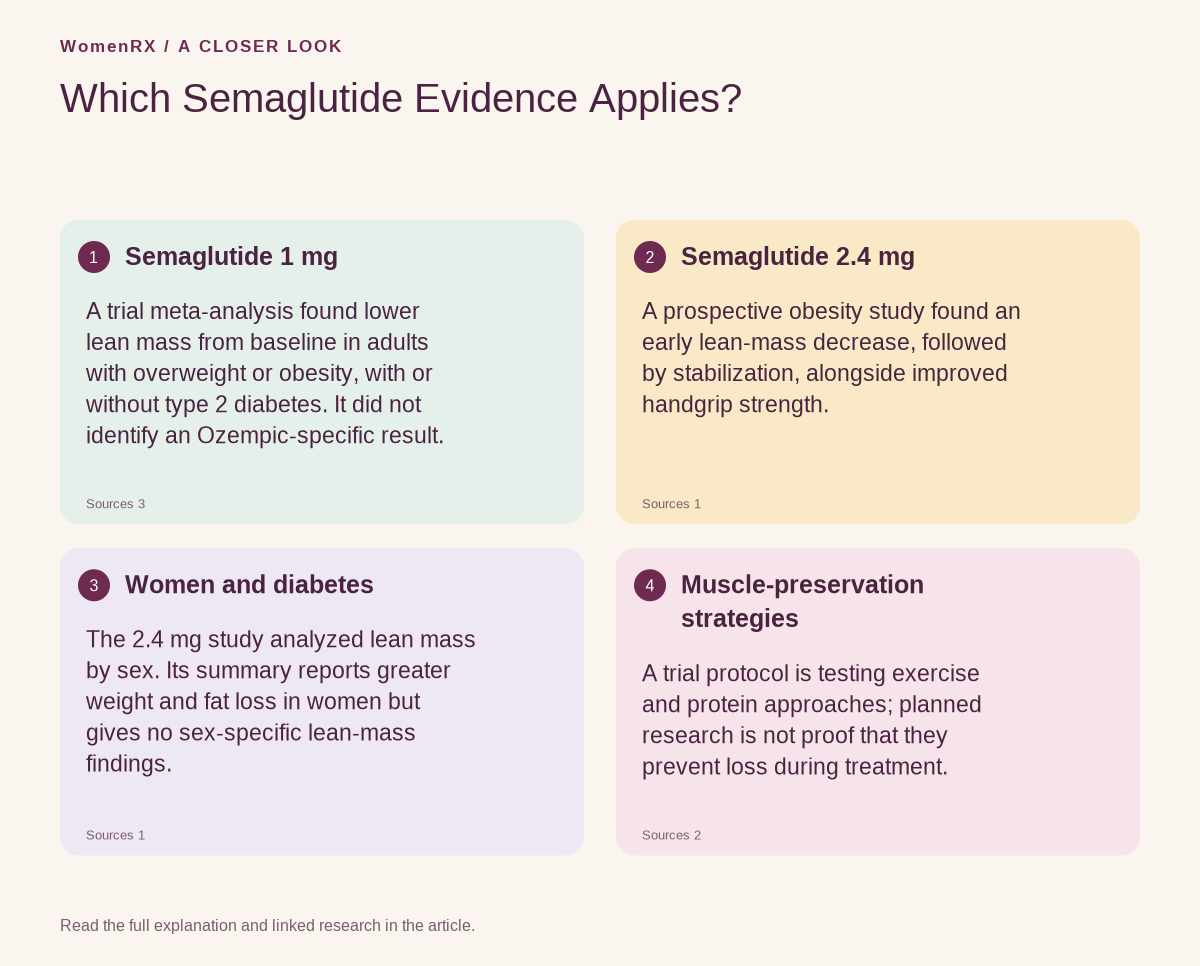
Which Semaglutide Evidence Applies?
Semaglutide 1 mg: A trial meta-analysis found lower lean mass from baseline in adults with overweight or obesity, with or without type 2 diabetes. It did not identify an Ozempic-specific result.3
Semaglutide 2.4 mg: A prospective obesity study found an early lean-mass decrease, followed by stabilization, alongside improved handgrip strength.1
Women and diabetes: The 2.4 mg study analyzed lean mass by sex. Its summary reports greater weight and fat loss in women but gives no sex-specific lean-mass findings.1
Muscle-preservation strategies: A trial protocol is testing exercise and protein approaches; planned research is not proof that they prevent loss during treatment.2
Read the figure as text
These findings differ by dose, population, and study design. None provides a precise estimate of muscle loss for an individual woman taking Ozempic for type 2 diabetes.- Semaglutide 1 mg: A trial meta-analysis found lower lean mass from baseline in adults with overweight or obesity, with or without type 2 diabetes. It did not identify an Ozempic-specific result.3
- Semaglutide 2.4 mg: A prospective obesity study found an early lean-mass decrease, followed by stabilization, alongside improved handgrip strength.1
- Women and diabetes: The 2.4 mg study analyzed lean mass by sex. Its summary reports greater weight and fat loss in women but gives no sex-specific lean-mass findings.1
- Muscle-preservation strategies: A trial protocol is testing exercise and protein approaches; planned research is not proof that they prevent loss during treatment.2
More questions, answered
Does a lean-mass reading measure muscle directly?
No. Lean mass is a body-composition measure; strength is assessed separately. In one study of 2.4 mg semaglutide in people with obesity, lean mass initially decreased while handgrip strength improved over 12 months. 1
Has resistance training been proven to prevent muscle loss on Ozempic?
A randomized trial protocol is testing resistance exercise and protein strategies during semaglutide or tirzepatide treatment, but a protocol describes a planned study, not its results. 2
Sources you can check
- Impact of Semaglutide on fat mass, lean mass and muscle function in patients with obesity: The SEMALEAN study.Alissou M, Demangeat T, Folope V, Van Elslande H, Lelandais H, Blanchemaison J, Cailleaux PE, Guney S, Aupetit A, Aubourg A, Rapp C, Petit A, Godin M, Vignal L, Grigioni S, Déchelo... · Diabetes, obesity & metabolism · 2026Return to first citation
- LEAN mass Preservation with Resistance Exercise and Protein during semaglutide and tirzepatide therapy (LEAN-PREP study): a protocol for a randomised controlled trial.Alawadhi AA, Alroudhan D, Alsaeed DJ, Almarshad BW, Alshehabi DH, Allahou BA, Mashankar A, Al Ozairi E, Gray S. · BMJ open · 2026Return to first citation
- Comparative Effects of Individual Glucagon-Like Peptide-1 Receptor Agonist-Based Medications on Direct Measurement of Body Composition Among Adults With Overweight or Obesity With or Without Type 2 Diabetes: A Systematic Review and Network Meta-Analysis of Randomised Controlled Trials.Wachiraphansakul N, Vongchaiudomchoke T, Manosroi W, Ruengorn C, Noppakun K, Ngamvichchukorn T, Sood MM, Thavorn K, Hutton B, Nochaiwong S. · Diabetes, obesity & metabolism · 2026Return to first citation