Zepbound and Muscle Loss: What the Evidence Shows
Tirzepatide-related weight loss includes some lean mass, but a body-composition reading alone can’t tell you whether your strength or function has declined.
Some lean mass tends to be lost as weight comes down with tirzepatide. In a 2026 meta-analysis of randomized trials involving adults with overweight or obesity, lean mass accounted for about one-quarter of total weight lost in tirzepatide groups. That measure isn’t the same as skeletal muscle or proof of weaker function, and the pooled result doesn’t distinguish people with diabetes from those without it. 3 5
What “lean mass loss” actually measures
Zepbound’s prescribing information says tirzepatide reduces body weight with greater loss of fat mass than lean mass. That’s a useful distinction, but it doesn’t mean lean mass is muscle alone. Body-composition measures such as DXA-derived lean mass and bioimpedance-derived fat-free mass include more than skeletal muscle, and they aren’t interchangeable. A decrease in one of these measures does not, by itself, establish muscle wasting or show that strength has fallen. 1 5
The more useful question is what happens to your ability to do things: for example, whether carrying groceries, getting up from a chair, climbing stairs, or completing your usual activities has become harder. Those changes deserve attention even if a scale or scan looks reassuring. They are practical signs to describe, not a diagnosis on their own.
What studies in adults with overweight or obesity show
A 2026 meta-analysis of randomized trials in adults with overweight or obesity estimated that lean mass made up 25.4% of total weight lost in tirzepatide groups (95% confidence interval, 22.8% to 28.0%). Put plainly, the analysis suggests most of the weight lost was not lean mass. The authors found a broadly similar proportion with lifestyle interventions alone. Their pooled estimate for lifestyle intervention combined with resistance training was lower, but that is not proof that adding a particular exercise program to Zepbound will produce the same result. 3
A separate 24-week randomized study enrolled 102 adults with overweight or obesity to test an investigational muscle-preservation drug alongside tirzepatide. Among the 51 assigned to tirzepatide plus placebo, the estimated losses were 12.5 kg of body weight and 3.5 kg of lean mass. Those are group-level, model-adjusted estimates, not a prediction for an individual. Because both study arms received tirzepatide, this trial did not compare tirzepatide with no tirzepatide. 2
These estimates describe changes in body composition, not a direct measure of muscle strength or physical ability. The pooled trials included adults with overweight or obesity, but the pooled tirzepatide result does not tell you whether the proportion differs for people with type 2 diabetes, women, or older women. 3
Why diabetes-trial findings need a separate reading
Tirzepatide has also been studied in people with type 2 diabetes. An account of one diabetes trial describes fat-free mass, while the pooled overweight-and-obesity estimate above concerns lean mass as measured in its included trials. Those measures cannot simply be treated as the same result. Nor can results from different study populations and timeframes establish that tirzepatide affects muscle differently when used for weight management rather than diabetes treatment. 6 3 5
A network meta-analysis of body-composition trials included adults with overweight or obesity, with and without type 2 diabetes. It found a decrease in lean mass from baseline for one tirzepatide treatment group, but its reported results do not give a separate tirzepatide estimate for participants with diabetes. That finding supports taking lean-mass change seriously; it does not supply a direct diabetes-versus-weight-management comparison or show a change in strength. 7 5
What women-specific evidence adds
One small real-world study followed 52 people with obesity for at least four months; 71.2% were women and the average age was about 47. Researchers measured body composition with bioimpedance and grip strength with a dynamometer. Average lean mass fell from 42.8 to 41.8 kg, but the difference did not reach statistical significance. Grip strength also showed no statistically significant change. These figures describe the full study group, not women or older women separately. A majority-women sample isn’t the same as a women-specific result. 4
That distinction matters. The large trial summaries provide a broader view of body-composition changes, while the small real-world study includes a majority of women and an actual strength measure. Neither establishes what will happen to an individual woman, and the reported figures don’t establish an effect for older women. 3 4
What to do with changes you notice
If your weight is falling but daily activities feel steady, a change in a body-composition estimate alone may not tell the whole story. If you’re noticing persistent loss of strength, unusual difficulty with everyday tasks, or trouble maintaining food and fluid intake, tell your prescriber. Be specific about what has changed and when. The goal is to consider function and nutrition alongside weight, rather than treating a scan or scale reading as the whole answer. 5
You can also ask whether your eating pattern is meeting your nutritional needs and whether resistance exercise is appropriate for you. A 2026 evidence review describes food-first nutrition support and structured resistance exercise as parts of supportive care, but the best way to preserve muscle specifically during tirzepatide treatment is not settled. A randomized trial protocol is testing resistance exercise and increased protein intake alongside semaglutide or tirzepatide; a protocol describes a study plan, not results showing that these strategies work during treatment. 5 6
For a useful check-in, try framing it around function: “I’m finding it harder to do ___ than before treatment. Could we review my strength, eating, and treatment progress?” That gives your clinician a concrete change to assess without assuming that every lean-mass decrease means muscle damage.
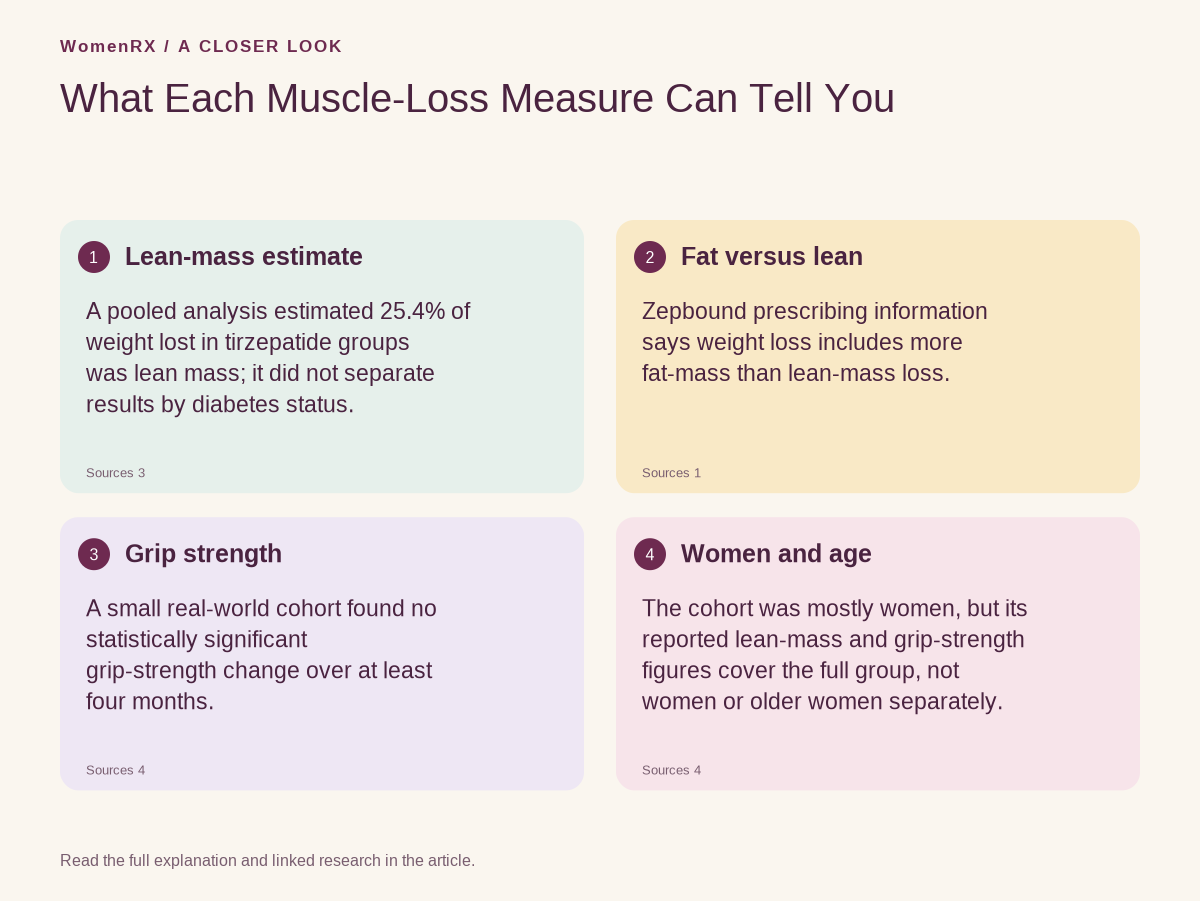
What Each Muscle-Loss Measure Can Tell You
Lean-mass estimate: A pooled analysis estimated 25.4% of weight lost in tirzepatide groups was lean mass; it did not separate results by diabetes status.3
Fat versus lean: Zepbound prescribing information says weight loss includes more fat-mass than lean-mass loss.1
Grip strength: A small real-world cohort found no statistically significant grip-strength change over at least four months.4
Women and age: The cohort was mostly women, but its reported lean-mass and grip-strength figures cover the full group, not women or older women separately.4
Read the figure as text
Body-composition readings, physical-function measures, and pooled trial estimates answer different questions. None alone predicts an individual woman’s outcome.- Lean-mass estimate: A pooled analysis estimated 25.4% of weight lost in tirzepatide groups was lean mass; it did not separate results by diabetes status.3
- Fat versus lean: Zepbound prescribing information says weight loss includes more fat-mass than lean-mass loss.1
- Grip strength: A small real-world cohort found no statistically significant grip-strength change over at least four months.4
- Women and age: The cohort was mostly women, but its reported lean-mass and grip-strength figures cover the full group, not women or older women separately.4
More questions, answered
Does a lower lean-mass reading mean I’m losing muscle?
Not necessarily. Lean-mass and fat-free-mass measures include tissue beyond skeletal muscle, and a change in the reading does not by itself show that strength or physical function has declined. 5
Do studies show a different muscle-loss effect in women?
The pooled estimates aren’t specific to women. A small real-world study included mostly women, but its lean-mass and grip-strength figures describe the full group. Those figures can’t establish a different effect for women or older women. 3 4
Sources you can check
- ZEPBOUND (TIRZEPATIDE) INJECTION, SOLUTION ZEPBOUND (TIRZEPATIDE) INJECTION, SOLUTION ZEPBOUND KWIKPEN (TIRZEPATIDE) INJECTION, SOLUTION [ELI LILLY AND COMPANY] | US prescribing information and patient instructionsAccessed 2026-09-25Return to first citation
- Apitegromab for lean mass preservation during tirzepatide-induced weight loss: a randomized, double-blind, placebo-controlled phase 2 trial.Pratley RE, Denham DS, Trivedi R, Watkins E, Connery L, Barnes J, Yu D, Hong J, Simard C, Umans K, Liu L, Tirucherai GS, Marantz JL. · Nature medicine · 2026Return to first citation
- Lean Mass Changes With Incretin Therapy Versus Lifestyle Intervention: A Systematic Review and Meta-Analysis of Randomised Controlled Trials.Eisa N, Barood O. · Diabetes, obesity & metabolism · 2026Return to first citation
- [Tirzepatide in real-world clinical practice: changes in body composition and muscle function in patients with obesity].Blanco Anesto J, Dotres Fallat KM, Nicolau J. · Nutricion hospitalaria · 2026Return to first citation
- Lean Mass and Musculoskeletal Preservation in GLP-1-Based Obesity Treatment: Nutrition, Exercise, Supplementation, and Monitoring Strategies.Šantić R, Martinović L, Pavlović N, Rušić D, Kumrić M, Martinović D, Tičinović Kurir T, Božić J. · Metabolites · 2026Return to first citation
- LEAN mass Preservation with Resistance Exercise and Protein during semaglutide and tirzepatide therapy (LEAN-PREP study): a protocol for a randomised controlled trial.Alawadhi AA, Alroudhan D, Alsaeed DJ, Almarshad BW, Alshehabi DH, Allahou BA, Mashankar A, Al Ozairi E, Gray S. · BMJ open · 2026Return to first citation
- Comparative Effects of Individual Glucagon-Like Peptide-1 Receptor Agonist-Based Medications on Direct Measurement of Body Composition Among Adults With Overweight or Obesity With or Without Type 2 Diabetes: A Systematic Review and Network Meta-Analysis of Randomised Controlled Trials.Wachiraphansakul N, Vongchaiudomchoke T, Manosroi W, Ruengorn C, Noppakun K, Ngamvichchukorn T, Sood MM, Thavorn K, Hutton B, Nochaiwong S. · Diabetes, obesity & metabolism · 2026Return to first citation