Tirzepatide and Muscle Loss: What the Measurements Show
Zepbound-related weight loss includes some measured lean-mass loss, but lean mass is not the same thing as muscle strength or everyday function.
Yes, some studies of tirzepatide find a decrease in lean mass as weight comes down, while fat loss is generally greater. But lean-mass measurements don’t directly tell you how much skeletal muscle changed or whether strength and function declined. One small real-world study found no statistically significant average change in grip strength over four months, though the measured mean dipped slightly, from 31.6 to 31.4 kg. 1 2 5
Lean mass is a measurement, not a strength test
When a body-composition report says “lean mass,” it is describing tissue categorized separately from fat and bone by the measurement method. It is not a direct count of skeletal muscle, and it does not tell you how well your muscles work. A scan or scale can estimate body composition; assessing strength or daily function requires different measures, such as a grip-strength test or noticing whether familiar tasks have become harder. 4 5
That distinction helps make sense of the headline: a lean-mass decrease does not automatically mean that you have lost the same amount of working muscle or that you are becoming weaker. It also does not make a persistent change in strength or function irrelevant.
What tirzepatide studies have found
The Zepbound prescribing information says tirzepatide reduces body weight with greater loss of fat mass than lean mass. A 2026 meta-analysis of randomized trials estimated that lean mass accounted for about 25.4% of total weight lost in tirzepatide groups (95% confidence interval 22.8% to 28.0%). In that analysis, the proportion was similar for lifestyle interventions, at 26.2% (24.1% to 28.3%). These are pooled averages across studies, not a prediction for one person or a measurement of muscle function. 1 2
Results can differ by study and how body composition is measured. For example, a small, 12-week real-world study of 51 adults with obesity used bioelectrical impedance analysis. Average weight fell by 8.75 kg, including a 1.73 kg decrease in soft lean mass; about 78% of the weight lost was fat mass. This study describes one group over a short period, not everyone taking Zepbound. 3
A separate four-month practice study followed 52 adults with obesity, 71.2% of them women, with a mean age of 47. It found no statistically significant average change in measured lean mass or hand-grip strength. That is a useful reminder that a change in a body-composition estimate and a change in function are not interchangeable. It is also a small, observational study, so it cannot establish that strength will be preserved for every person. 5
What can influence the balance
The amount of weight lost may matter. In a 12-month observational study of 70 people with obesity and type 1 diabetes treated with GLP-1 medicines, including tirzepatide, lean-mass loss was associated with weight loss. People who lost more than 10% of their weight had a measured decrease in lean mass, while the smaller-loss groups did not show a significant decrease. Because the study included different medicines and a specific population, it does not establish a universal threshold or prove that faster weight loss causes muscle loss. 4
Resistance training is a reasonable topic to raise if preserving strength matters to you. In a meta-analysis comparing weight-loss trials, the group combining lifestyle intervention with resistance training had a smaller share of total weight loss attributed to lean mass than the pooled tirzepatide group. The trials were not a guarantee of protection for an individual taking Zepbound, and the review does not show that one habit fully prevents lean-mass loss. The review also discusses adequate protein intake, but does not establish a personal target for you. 2
A practical way to use this evidence is to pay attention to function alongside weight or body-composition numbers. For example, if carrying groceries, climbing stairs, or getting up from a chair becomes noticeably harder, that is useful information to share with the clinician managing your treatment. Mention whether nausea, vomiting, diarrhea, or reduced eating is making it difficult to take in food or fluids; the Zepbound prescribing information notes that these gastrointestinal effects can lead to dehydration. 1
What the evidence says about women
The small four-month study included mostly women, but it does not establish different effects by sex. A separate one-year real-world study reported sex differences in fat-mass changes, but its abstract does not report sex-specific lean-mass or muscle-function results. The randomized-trial meta-analysis also reports pooled results rather than a clear women-specific estimate. 2 5 6
These studies do not establish whether body-composition or strength changes differ during pregnancy planning, postpartum, perimenopause, or after menopause. If one of those stages is relevant to you, share it when discussing weight-loss treatment and changes in strength; the available results do not tell us that tirzepatide has a different muscle effect at those stages.
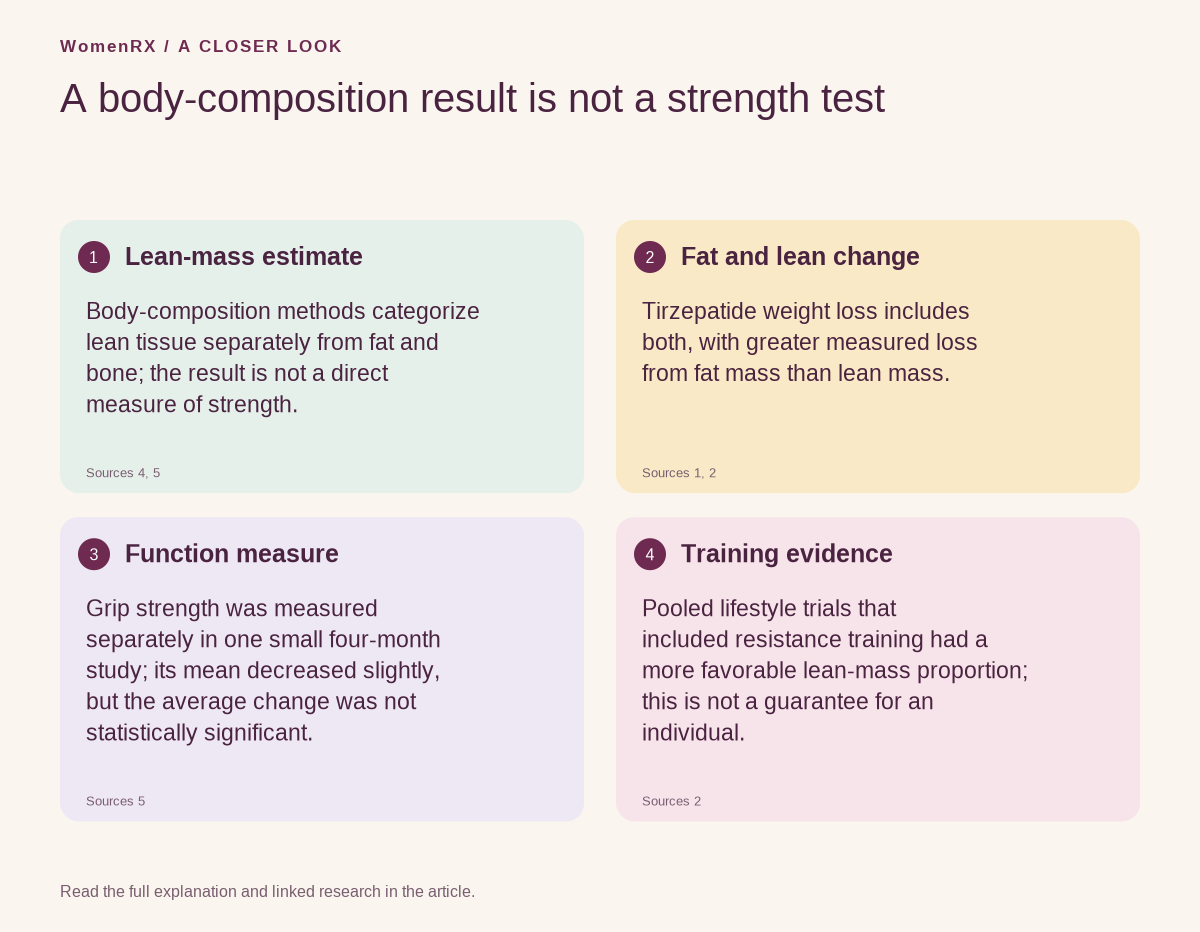
A body-composition result is not a strength test
Lean-mass estimate: Body-composition methods categorize lean tissue separately from fat and bone; the result is not a direct measure of strength.45
Fat and lean change: Tirzepatide weight loss includes both, with greater measured loss from fat mass than lean mass.12
Function measure: Grip strength was measured separately in one small four-month study; its mean decreased slightly, but the average change was not statistically significant.5
Training evidence: Pooled lifestyle trials that included resistance training had a more favorable lean-mass proportion; this is not a guarantee for an individual.2
Read the figure as text
These distinctions help put lean-mass readings in context and show what other evidence can, and cannot, tell you.- Lean-mass estimate: Body-composition methods categorize lean tissue separately from fat and bone; the result is not a direct measure of strength.45
- Fat and lean change: Tirzepatide weight loss includes both, with greater measured loss from fat mass than lean mass.12
- Function measure: Grip strength was measured separately in one small four-month study; its mean decreased slightly, but the average change was not statistically significant.5
- Training evidence: Pooled lifestyle trials that included resistance training had a more favorable lean-mass proportion; this is not a guarantee for an individual.2
More questions, answered
Does a lower lean-mass number mean I am losing strength?
Not necessarily. Lean mass is a body-composition measurement, while strength and function are assessed separately. One small four-month observational study found no statistically significant average change in grip strength, although the measured mean decreased slightly from 31.6 to 31.4 kg. That result cannot predict an individual response. 5
Does resistance training prevent lean-mass loss on Zepbound?
The evidence does not show that it fully prevents loss for an individual taking Zepbound. A meta-analysis found a more favorable proportion of lean-mass change in lifestyle programs that included resistance training, but that is not a guarantee or a Zepbound-specific prescription. 2
Sources you can check
- ZEPBOUND (TIRZEPATIDE) INJECTION, SOLUTION ZEPBOUND (TIRZEPATIDE) INJECTION, SOLUTION ZEPBOUND KWIKPEN (TIRZEPATIDE) INJECTION, SOLUTION [ELI LILLY AND COMPANY] | US prescribing information and patient instructionsAccessed 2026-09-25Return to first citation
- Lean Mass Changes With Incretin Therapy Versus Lifestyle Intervention: A Systematic Review and Meta-Analysis of Randomised Controlled Trials.Eisa N, Barood O. · Diabetes, obesity & metabolism · 2026Return to first citation
- Early changes in body composition with tirzepatide in adults with obesity: a real-world BIA study.Angelopoulos N, Rizoulis A, Boniakos A, Fousteris E, Mentzelopoulou V, Zianni D, Livadas S, Paparodis R. · Nutrition (Burbank, Los Angeles County, Calif.) · 2026Return to first citation
- Weight Loss-Dependent Changes in Body Composition and Bone Health in People With Obesity and Type 1 Diabetes Treated With Liraglutide, Semaglutide, or Tirzepatide.Al Ozairi E, Irshad M, Alkandri J, Mashankar A, Gray SR, le Roux CW. · Diabetes/metabolism research and reviews · 2026Return to first citation
- [Tirzepatide in real-world clinical practice: changes in body composition and muscle function in patients with obesity].Blanco Anesto J, Dotres Fallat KM, Nicolau J. · Nutricion hospitalaria · 2026Return to first citation
- Effects of Tirzepatide on Body Composition, Metabolic Parameters, and Sleep Outcomes: A Real-World One-Year Prospective Study.Adamidis N, Margariti T, Georgakopoulou VE, Adamidi S, Desalermos A, Kyventidou M, Koutrakos T, Bouros DE, Papadopoulou N, Adamidis S. · Cureus · 2026Return to first citation