Semaglutide and Muscle Loss: What the Measurements Mean
Lean mass can fall during Wegovy-related weight loss, but a change on a body-composition scan isn’t the same as proof that you’ve lost muscle strength.
Some lean-mass loss can occur as weight comes down on semaglutide, even when fat loss is greater. But “lean mass” includes more than skeletal muscle, and body-composition measurements don’t tell you by themselves whether your strength or daily function has changed. Tell your prescriber if you notice declining strength or difficulty with usual activities, and discuss nutrition and strength-focused activity that fit your situation. 1 4 5
Lean mass is not a muscle-only measurement
Wegovy’s prescribing information says semaglutide reduces body weight with greater loss of fat mass than lean mass. That describes the overall pattern, not a guarantee that every person will lose the same amounts. 1
“Lean mass” is a body-composition category, not a direct count of working muscle fibers. In the studies summarized here, researchers used methods such as bioimpedance, bioelectrical impedance, or DXA to estimate body compartments. One semaglutide trial also measured extracellular water, showing that fluid is another body component that can shift during treatment. A change in a lean-mass estimate alone cannot tell you exactly how much skeletal muscle changed or whether your strength declined. 2 3 4
That distinction matters in everyday life. A scan or scale may show less lean mass while a separate strength measure stays stable. Conversely, a number that seems reassuring cannot rule out a change in how you feel or function. Body composition and physical function are related questions, but they are not interchangeable measurements.
What studies have found, and what they can’t settle
A meta-analysis of seven randomized trials involving 821 people with obesity found that GLP-1 medicines used at obesity-management doses reduced absolute lean mass on average, while lean mass made up a larger share of the weight remaining. The studies varied considerably in their absolute and percentage estimates, so the pooled result is better read as evidence that lean mass can decrease, not as a prediction for one person taking Wegovy. The analysis included GLP-1 medicines as a group, not semaglutide alone. 5
A separate 12-month retrospective study compared routine-care groups receiving semaglutide plus lifestyle education or lifestyle education alone. In the semaglutide group, estimated skeletal muscle mass and fat-free mass fell, but absolute handgrip strength was preserved; relative handgrip strength improved. Because this was not a randomized trial, it cannot show that semaglutide caused those strength findings or that they will apply to everyone. It does show why measuring muscle-related outcomes and measuring function can tell different parts of the story. 4
A small randomized trial in 101 adults with chronic kidney disease, overweight or obesity, and no diabetes measured body composition over 24 weeks. The estimated semaglutide-versus-placebo difference in lean body mass was -2.5 kg, but its confidence interval ranged from -6.6 to 1.6 kg. That estimate is uncertain, and this specific population and timeframe don’t answer what will happen to every person using Wegovy. 2
Weight-loss amount may matter, too, but available research does not establish an ideal pace for protecting muscle. In a 70-person observational study of people with type 1 diabetes and obesity taking a mix of GLP-1 medicines and dual GLP-1/GIP treatment, greater weight loss was associated with greater lean-mass loss over 12 months. It cannot separate the effect of semaglutide from other treatments or prove that changing the pace would prevent muscle loss. 3
What to do if strength or function is changing
A body-composition result is only one clue. Notice whether you’re having more trouble with activities that are usually manageable, such as getting up from a chair, carrying routine items, or climbing stairs. These examples can help you describe what has changed; they are not a diagnostic test.
Tell your prescriber about a decline in strength or everyday function, especially if it is continuing. Discuss whether a body-composition result needs to be interpreted alongside a functional measure, such as grip strength, and whether your treatment, food intake, or activity plan needs review. The available studies do not establish a particular diet, protein target, or resistance-exercise program that prevents muscle loss for everyone taking semaglutide. They also do not show that a specific rate of weight loss is best for preserving strength. 3 4 5
What women should keep in view
The reported body-composition results don’t provide women-only estimates that show whether the average changes differ by sex. One study adjusted its analyses for age and sex, but that is not the same as reporting separate results for women. This evidence also does not settle how results vary across perimenopause, postmenopause, or later life. 3 4
If you’re planning a pregnancy, bring that into the treatment discussion before trying. Wegovy’s prescribing information says human pregnancy data are insufficient to establish the medicine’s risks, and describes reproductive findings in animal studies. Those findings do not establish what will happen in a human pregnancy, but they make pregnancy planning a separate question from muscle preservation. 1
The practical takeaway: take a measured lean-mass change seriously enough to put it in context, but don’t treat it as proof of muscle weakness. Your strength and daily function deserve attention alongside the number.
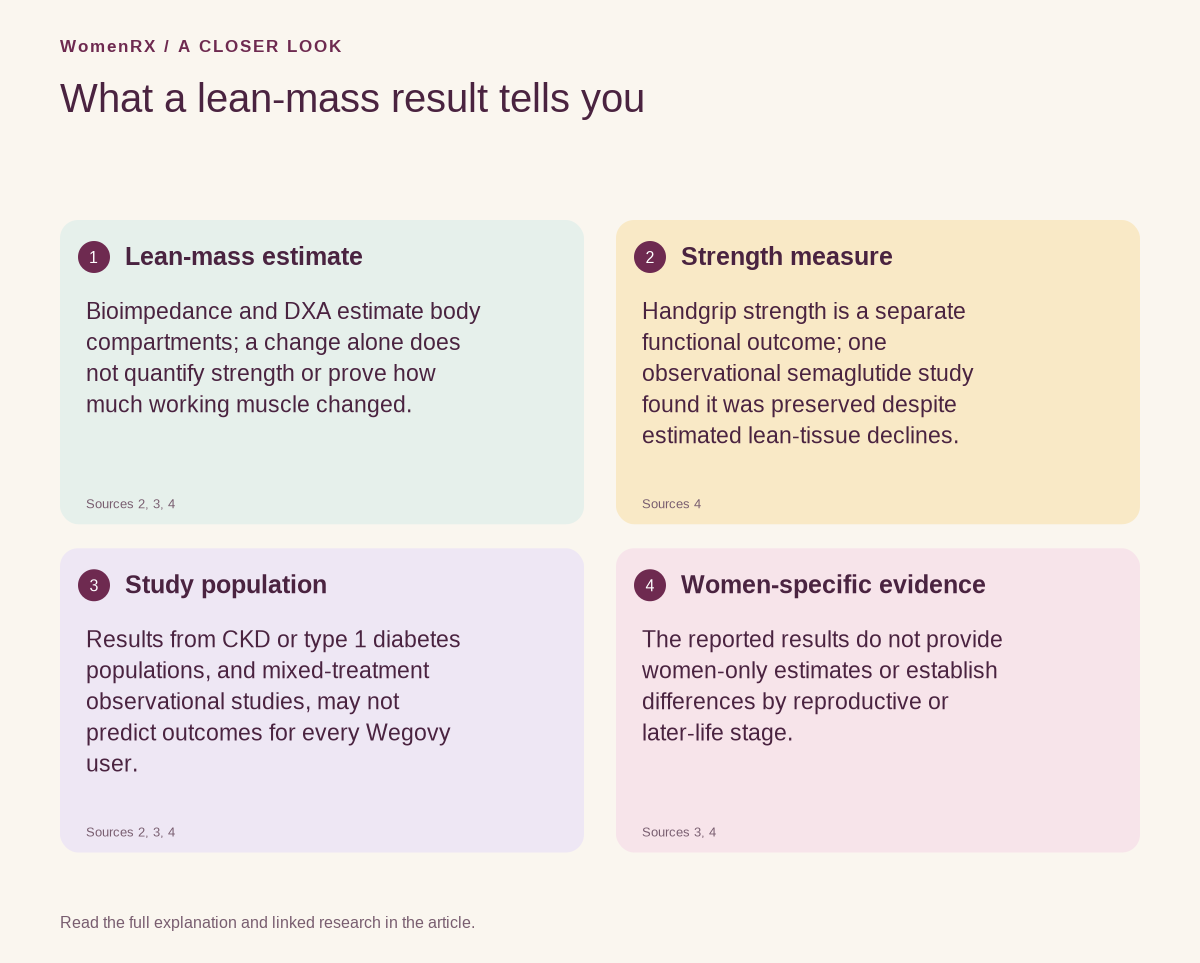
What a lean-mass result tells you
Lean-mass estimate: Bioimpedance and DXA estimate body compartments; a change alone does not quantify strength or prove how much working muscle changed.234
Strength measure: Handgrip strength is a separate functional outcome; one observational semaglutide study found it was preserved despite estimated lean-tissue declines.4
Study population: Results from CKD or type 1 diabetes populations, and mixed-treatment observational studies, may not predict outcomes for every Wegovy user.234
Women-specific evidence: The reported results do not provide women-only estimates or establish differences by reproductive or later-life stage.34
Read the figure as text
A body-composition estimate, a strength measure, and the treatment context each answer a different question.- Lean-mass estimate: Bioimpedance and DXA estimate body compartments; a change alone does not quantify strength or prove how much working muscle changed.234
- Strength measure: Handgrip strength is a separate functional outcome; one observational semaglutide study found it was preserved despite estimated lean-tissue declines.4
- Study population: Results from CKD or type 1 diabetes populations, and mixed-treatment observational studies, may not predict outcomes for every Wegovy user.234
- Women-specific evidence: The reported results do not provide women-only estimates or establish differences by reproductive or later-life stage.34
More questions, answered
Does a lower lean-mass reading mean I’ve lost strength?
Not necessarily. Lean-mass estimates and strength tests measure different things. In one observational semaglutide study, estimated skeletal muscle and fat-free mass decreased while absolute handgrip strength was preserved. That finding doesn’t predict an individual result, but it illustrates why function matters alongside a scan or scale reading. 4
Do the studies show that slowing weight loss prevents muscle loss?
No. The studies summarized here don’t establish a best rate of weight loss or show that slowing the rate prevents muscle loss. One observational study found that greater weight loss was associated with greater lean-mass loss in a mixed-treatment group, but that doesn’t prove that changing the pace would change the outcome. 3
Sources you can check
- WEGOVY (SEMAGLUTIDE) INJECTION, SOLUTION WEGOVY (SEMAGLUTIDE) TABLET [NOVO NORDISK PHARMACEUTICAL INDUSTRIES, LP] | US prescribing information and patient instructionsAccessed 2026-09-25Return to first citation
- Effects of Semaglutide on Body Composition and GFR: A Prespecified Analysis of the SMART Trial.Heerspink HJL, Soler M, Beernink JM, Jongs N, Cigarran S, Cigarran S, Cruzado JM, Puchades MJ, López-Martínez M, López-Martínez M, Apperloo E, Waanders F, Laverman GD, van der Aart... · Clinical journal of the American Society of Nephrology : CJASN · 2026Return to first citation
- Weight Loss-Dependent Changes in Body Composition and Bone Health in People With Obesity and Type 1 Diabetes Treated With Liraglutide, Semaglutide, or Tirzepatide.Al Ozairi E, Irshad M, Alkandri J, Mashankar A, Gray SR, le Roux CW. · Diabetes/metabolism research and reviews · 2026Return to first citation
- Longitudinal Changes in Body Composition, Adaptive Thermogenesis and Muscle Strength in Patients with Obesity Treated with Semaglutide.Filippi-Arriaga F, Comas M, Prats A, Juan A, Vidal E, Costa P, Flores V, Oliver-Vila C, Fidilio E, Ciudin A. · Obesity facts · 2026Return to first citation
- Effect of GLP-1 receptor agonists at doses for obesity management on muscle health: systematic review and meta-analysis of randomized controlled trials (RCTs).Laverde LP, Muñoz-Velandia OM, Alfonso D, Gómez Medina AM. · International journal of obesity (2005) · 2026Return to first citation