Tirzepatide and Muscle Loss: What the Numbers Mean
Fat accounts for more of the weight lost with tirzepatide, but a drop in lean mass still deserves a closer look if your strength changes.
Lean mass can decrease during weight loss with tirzepatide, even though fat accounts for more of the weight lost. A lean-mass measurement isn’t a direct measure of skeletal muscle or strength. If you’re finding everyday tasks harder, bring up that change separately from your body-composition result and discuss your food intake, activity and health context. 1 2 4 7
What a lean-mass reading can tell you
Tirzepatide-associated weight loss includes greater fat-mass loss than lean-mass loss. That doesn’t mean lean mass stays the same: both can go down while fat accounts for the larger share. 1
The distinction matters because lean mass is not another name for skeletal muscle. Body weight includes fat, muscle, bone and water. Body-composition assessments separate that weight into estimated categories, but a lean-mass result doesn’t tell you exactly how much skeletal muscle changed or whether you’ve become weaker. Researchers can measure strength separately, as one small tirzepatide study did with a handgrip test. 2 6 7
For example, a lower lean-mass reading and new difficulty carrying groceries are two pieces of information, not two ways of saying the same thing. If carrying groceries has become harder, the change in what you can do is worth describing even if you don’t have a body-composition test.
Put the percentages in perspective
A 2026 analysis of 20 randomized trials estimated that lean mass accounted for 25.4% of total weight lost in its tirzepatide results. That’s a pooled share of weight lost, not a prediction that you’ll lose 25.4% of your muscle. The analysis found variation across studies. 4
Individual studies offer a useful check on what that average can hide. In a 12-week study of 51 adults with obesity taking tirzepatide, bioelectrical impedance measurements showed decreases in both fat mass and soft lean mass; fat accounted for about 78% of the weight lost. In another study of 52 adults treated for at least four months, the average changes in measured lean mass and handgrip strength were not statistically significant. These were small studies with different follow-up periods, so neither result predicts an individual outcome. 5 7
A separate analysis of 43 randomized trials found no significant difference in its overall total lean tissue outcome, while reporting a decrease in lean mass from baseline for a specific tirzepatide dose group. Those are differently defined results, not a reason to treat a single percentage as a complete picture of muscle health. 3
Women made up 71.2% of participants in the 52-person study, but the figures presented here don’t establish whether body-composition or strength changes differ by sex or menopause status. If you’re comparing a study finding with your own result, one useful question is: Were body-composition results reported separately for women and men? Being included in a study is not the same as having a separately reported result. 7
When strength is changing, look beyond the scan
If you notice new difficulty getting out of a chair, carrying bags or completing a familiar workout, describe the task and how it has changed. Ask what your body-composition test measured and whether an assessment of strength or function would add information. A lean-mass percentage alone can’t answer those questions. 2 7
It’s also worth discussing whether reduced appetite has changed how much you’re eating, including protein-containing foods, and what kinds of activity fit your current abilities. Tirzepatide decreases calorie intake, likely through its effect on appetite. In the 20-trial analysis, lifestyle programs that included resistance training had a lower proportion of weight loss from lean mass than lifestyle interventions overall. That comparison supports a conversation about resistance exercise, but it does not establish a particular exercise routine or protein target for someone taking tirzepatide. 1 4
The practical goal is to interpret the number alongside what you can do, what you’re eating and your wider health, rather than treating every change in lean mass as proven muscle loss.
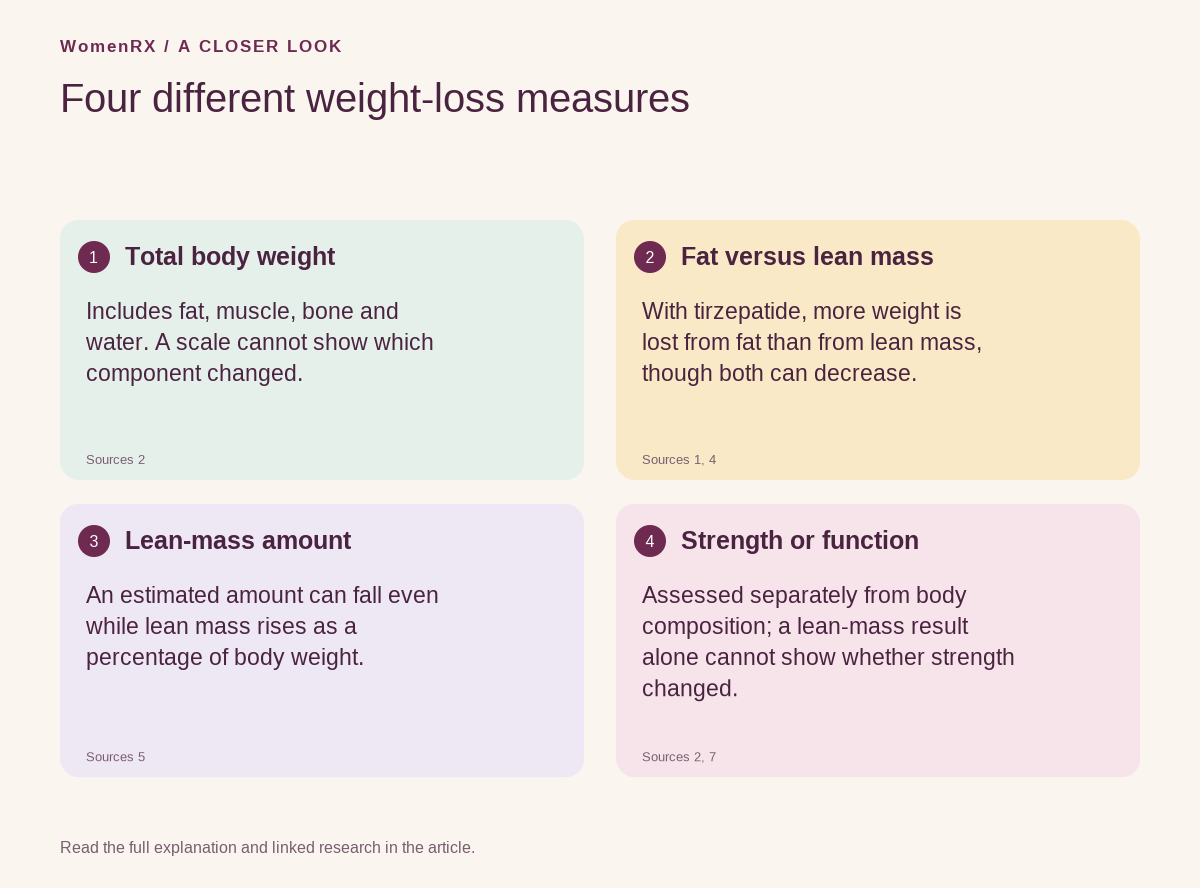
Four different weight-loss measures
Total body weight: Includes fat, muscle, bone and water. A scale cannot show which component changed.2
Fat versus lean mass: With tirzepatide, more weight is lost from fat than from lean mass, though both can decrease.14
Lean-mass amount: An estimated amount can fall even while lean mass rises as a percentage of body weight.5
Strength or function: Assessed separately from body composition; a lean-mass result alone cannot show whether strength changed.27
Read the figure as text
A scale reading, a body-composition estimate and a strength test answer different questions.- Total body weight: Includes fat, muscle, bone and water. A scale cannot show which component changed.2
- Fat versus lean mass: With tirzepatide, more weight is lost from fat than from lean mass, though both can decrease.14
- Lean-mass amount: An estimated amount can fall even while lean mass rises as a percentage of body weight.5
- Strength or function: Assessed separately from body composition; a lean-mass result alone cannot show whether strength changed.27
More questions, answered
Can my lean-mass percentage rise while my lean mass falls?
Yes. In a 12-week study of 51 adults taking tirzepatide, measured soft lean mass fell, but lean mass made up a larger percentage of body weight because fat mass fell more. Check whether a result shows an amount or a percentage before comparing it with an earlier reading. 5
Sources you can check
- ZEPBOUND (TIRZEPATIDE) INJECTION, SOLUTION ZEPBOUND (TIRZEPATIDE) INJECTION, SOLUTION ZEPBOUND KWIKPEN (TIRZEPATIDE) INJECTION, SOLUTION [ELI LILLY AND COMPANY] | US prescribing information and patient instructionsAccessed 2026-09-25Return to first citation
- Body Weight: MedlinePlusAccessed 2026-09-25Return to first citation
- Comparative Effects of Individual Glucagon-Like Peptide-1 Receptor Agonist-Based Medications on Direct Measurement of Body Composition Among Adults With Overweight or Obesity With or Without Type 2 Diabetes: A Systematic Review and Network Meta-Analysis of Randomised Controlled Trials.Wachiraphansakul N, Vongchaiudomchoke T, Manosroi W, Ruengorn C, Noppakun K, Ngamvichchukorn T, Sood MM, Thavorn K, Hutton B, Nochaiwong S. · Diabetes, obesity & metabolism · 2026Return to first citation
- Lean Mass Changes With Incretin Therapy Versus Lifestyle Intervention: A Systematic Review and Meta-Analysis of Randomised Controlled Trials.Eisa N, Barood O. · Diabetes, obesity & metabolism · 2026Return to first citation
- Early changes in body composition with tirzepatide in adults with obesity: a real-world BIA study.Angelopoulos N, Rizoulis A, Boniakos A, Fousteris E, Mentzelopoulou V, Zianni D, Livadas S, Paparodis R. · Nutrition (Burbank, Los Angeles County, Calif.) · 2026Return to first citation
- Weight Loss-Dependent Changes in Body Composition and Bone Health in People With Obesity and Type 1 Diabetes Treated With Liraglutide, Semaglutide, or Tirzepatide.Al Ozairi E, Irshad M, Alkandri J, Mashankar A, Gray SR, le Roux CW. · Diabetes/metabolism research and reviews · 2026Return to first citation
- [Tirzepatide in real-world clinical practice: changes in body composition and muscle function in patients with obesity].Blanco Anesto J, Dotres Fallat KM, Nicolau J. · Nutricion hospitalaria · 2026Return to first citation