Mounjaro and Muscle Loss: What to Monitor
A change in a body-composition reading doesn’t tell you by itself whether your strength or everyday function is declining.
Some studies report a decrease in lean mass during tirzepatide-associated weight loss, but lean mass is not the same as skeletal muscle, and a scan or scale can’t tell you on its own whether your strength has changed. Track your weight trend alongside practical signs of function, eating and drinking concerns, and any persistent stomach symptoms. Discuss meaningful changes with your prescriber. 3 5
Look beyond the number on the scale
Mounjaro (tirzepatide) can be part of type 2 diabetes treatment, and weight loss may be one of its effects. If you’re concerned about muscle, the useful question isn’t just how much weight you’ve lost. It’s whether your strength, mobility, or ability to manage everyday activities is changing too.
“Lean mass” is a body-composition category, not a direct measurement of muscle strength. It can include tissues other than skeletal muscle. In a small retrospective case series of men taking tirzepatide along with testosterone and lifestyle coaching, lean body mass fell even as estimated skeletal muscle mass and grip strength rose. Because the men received several interventions together, the study can’t show what tirzepatide alone did. Still, it illustrates why a lean-mass estimate and how you function are different pieces of information. 5
What the research can, and can’t, tell you
A 2026 network meta-analysis included 43 randomized trials and 3,379 adults with overweight or obesity, with or without type 2 diabetes. Across the treatments studied, results for total lean tissue weren’t significantly different from control overall; in analyses of particular treatments, tirzepatide at 15 mg weekly was associated with a decrease in lean mass from baseline. The review combined different populations and treatments, so its result isn’t a prediction of what will happen to you or a women-specific estimate. 3
A protocol for a planned trial describes earlier findings in people with type 2 diabetes, including a reported decrease in fat-free mass during tirzepatide treatment. But that paper is a trial protocol, not a report of results from its planned trial. It also describes a separate trial in people with obesity but not diabetes. Those details shouldn’t be treated as a personal forecast or blended into a single estimate of muscle loss. 2
These studies don’t report body-composition results separately for women. They also don’t establish whether menopause changes a woman’s muscle response to tirzepatide. A review raises muscle-health questions for older adults, but its discussion includes findings from semaglutide and other populations, not proof of a specific tirzepatide effect in older women with type 2 diabetes. If you’re older, already have difficulty with strength or mobility, or have noticed a change in what you can do, those are reasonable details to bring into your monitoring conversation. 6
Keep a simple, useful record
You don’t need a body-composition scan to notice whether daily function is changing. Make a brief note of your usual baseline, then update it when you notice a meaningful change or have a follow-up. Choose a few familiar activities rather than trying to test yourself: for example, carrying groceries, getting up from a chair, or walking your usual route. These are practical examples, not a validated muscle test.
Also note your weight trend, whether eating or drinking has become difficult, and any ongoing nausea, vomiting, or diarrhea. Mounjaro prescribing information warns that significant gastrointestinal reactions can lead to dehydration; it advises monitoring kidney function when reactions could cause volume depletion, especially during treatment initiation or dose escalation. Contact your prescriber about persistent symptoms or difficulty keeping up with fluids, rather than waiting for a body-composition measurement. 1
If a measurement is available, ask what it actually measures and whether it changes the plan. A lean-mass result alone doesn’t establish that you’ve lost skeletal muscle or that your strength has declined. 4 5
What to bring to your prescriber
A focused conversation can connect the number, how you feel, and your diabetes treatment. You might ask:
- “Could this reading reflect lean tissue other than muscle, or a measurement difference?”
- “Which change in strength or daily function would matter most to track in my situation?”
- “Could reduced eating, drinking, or stomach symptoms be affecting how I feel?”
- “Would a safe strength-building activity be appropriate for me?”
Resistance exercise is commonly considered as a way to support muscle, but the tirzepatide-and-exercise study is a trial protocol, not proof that a particular program prevents muscle loss during treatment. If you have other health conditions or limitations, ask for a plan suited to you rather than assuming one approach fits everyone. 2
The aim is not to label every change in lean mass as harmful. It’s to notice whether your ability to do the things that matter to you is changing, and bring that information into decisions about diabetes care.
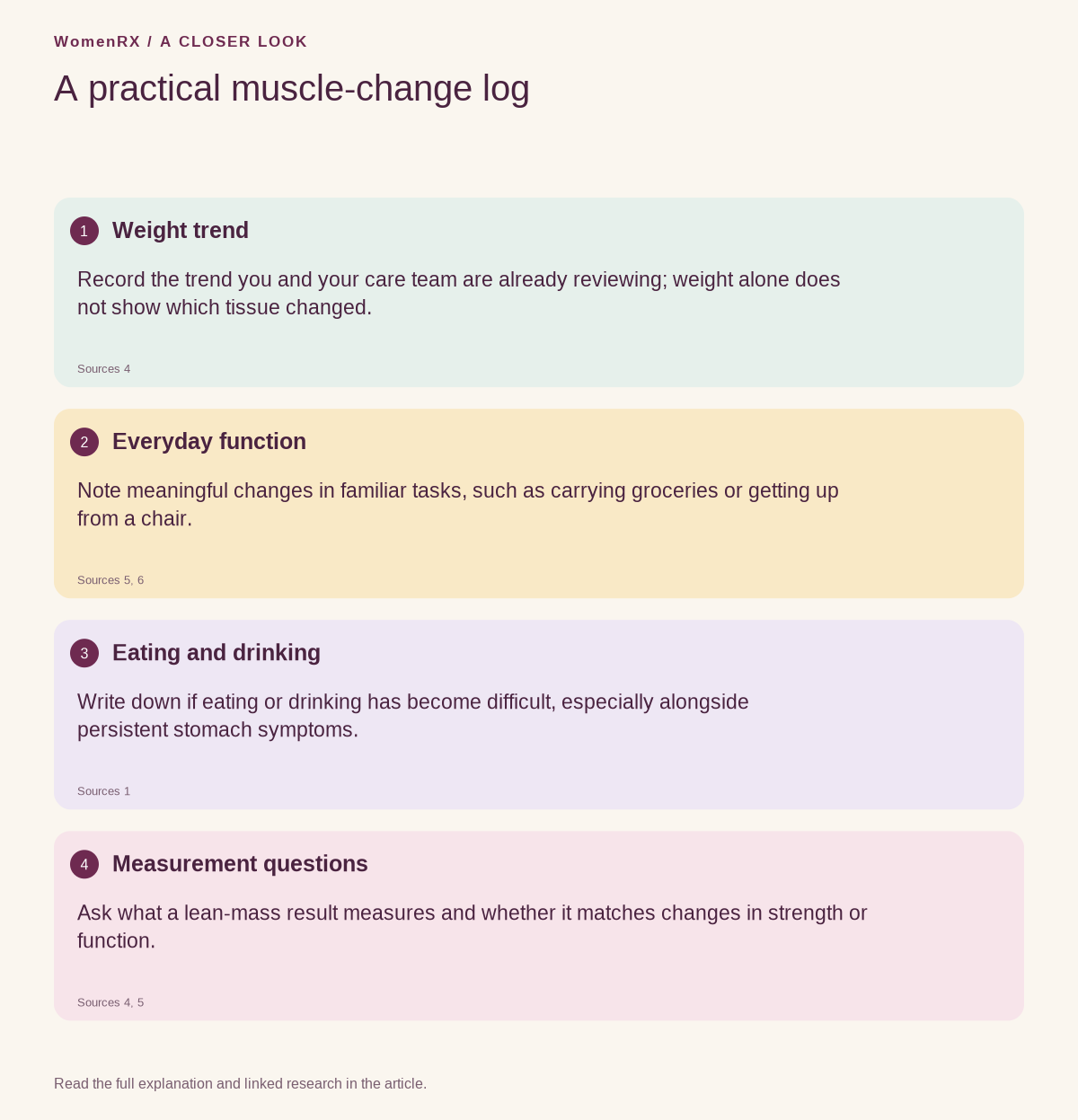
A practical muscle-change log
Weight trend: Record the trend you and your care team are already reviewing; weight alone does not show which tissue changed.4
Everyday function: Note meaningful changes in familiar tasks, such as carrying groceries or getting up from a chair.56
Eating and drinking: Write down if eating or drinking has become difficult, especially alongside persistent stomach symptoms.1
Measurement questions: Ask what a lean-mass result measures and whether it matches changes in strength or function.45
Read the figure as text
Use a few consistent observations to put a weight or body-composition reading in context. These notes are conversation aids, not a diagnostic test.- Weight trend: Record the trend you and your care team are already reviewing; weight alone does not show which tissue changed.4
- Everyday function: Note meaningful changes in familiar tasks, such as carrying groceries or getting up from a chair.56
- Eating and drinking: Write down if eating or drinking has become difficult, especially alongside persistent stomach symptoms.1
- Measurement questions: Ask what a lean-mass result measures and whether it matches changes in strength or function.45
Sources you can check
- MOUNJARO (TIRZEPATIDE) INJECTION, SOLUTION [A-S MEDICATION SOLUTIONS] | US prescribing information and patient instructionsAccessed 2026-09-25Return to first citation
- LEAN mass Preservation with Resistance Exercise and Protein during semaglutide and tirzepatide therapy (LEAN-PREP study): a protocol for a randomised controlled trial.Alawadhi AA, Alroudhan D, Alsaeed DJ, Almarshad BW, Alshehabi DH, Allahou BA, Mashankar A, Al Ozairi E, Gray S. · BMJ open · 2026Return to first citation
- Comparative Effects of Individual Glucagon-Like Peptide-1 Receptor Agonist-Based Medications on Direct Measurement of Body Composition Among Adults With Overweight or Obesity With or Without Type 2 Diabetes: A Systematic Review and Network Meta-Analysis of Randomised Controlled Trials.Wachiraphansakul N, Vongchaiudomchoke T, Manosroi W, Ruengorn C, Noppakun K, Ngamvichchukorn T, Sood MM, Thavorn K, Hutton B, Nochaiwong S. · Diabetes, obesity & metabolism · 2026Return to first citation
- Weight Loss-Dependent Changes in Body Composition and Bone Health in People With Obesity and Type 1 Diabetes Treated With Liraglutide, Semaglutide, or Tirzepatide.Al Ozairi E, Irshad M, Alkandri J, Mashankar A, Gray SR, le Roux CW. · Diabetes/metabolism research and reviews · 2026Return to first citation
- Increasing skeletal muscle mass and strength during incretin-based weight loss.Mendias CL, Awan TM. · Obesity pillars · 2026Return to first citation
- Glucagon-like peptide-1 receptor agonists and muscle strength changes in older adults: Risks beyond muscle mass reductions.Prokopidis K. · British journal of pharmacology · 2026Return to first citation