How to Monitor Muscle and Strength on Mounjaro
The scale can’t show whether your strength is changing, so pay attention to everyday function as well as weight.
Some loss of lean mass can accompany weight loss on tirzepatide, but lean mass measured by a scan isn’t the same as skeletal muscle or strength. Studies suggest the amount varies, and findings don’t promise that any routine will prevent loss. Track how you’re functioning, what you can comfortably eat, and your weight trend, then discuss meaningful changes with your care team. 3 5 7
Lean mass, muscle, and strength are different measures
Body weight tells you how much your body weighs, not what changed. A body-composition test estimates categories such as fat and lean tissue; it doesn’t directly measure how well your muscles work. In one real-world tirzepatide study, researchers measured body composition with bioelectrical impedance and muscle function with a hand-grip dynamometer. Those are related but distinct outcomes. 6 8
That distinction matters when you read about “muscle loss.” A finding about lean mass doesn’t automatically mean someone has become weaker or less able to do daily activities. Conversely, a stable scale reading doesn’t establish that strength is unchanged. For your own monitoring, keep weight, measured body composition, and function as separate pieces of information.
What research on tirzepatide can, and can’t, tell you
A 2026 network meta-analysis of randomized trials reported that tirzepatide was associated with reduced lean body mass as well as reduced fat mass. Another network meta-analysis reported a significant decrease in lean mass from baseline with tirzepatide 15 mg weekly. These analyses draw together trials, but their results don’t tell you exactly what will happen to one person’s muscle or strength. 3 4
A separate meta-analysis estimated that lean mass accounted for 25.4% of weight lost in the tirzepatide trials it included. That percentage is an average across studies, not a forecast for you. It also found a broadly comparable proportion with lifestyle interventions; the proportion was lower in the studies combining lifestyle intervention with resistance training. This is encouraging, but it does not prove that resistance exercise prevents all lean-mass loss during tirzepatide treatment. 5
Small real-world studies illustrate why it helps to distinguish measurement from function. In a 12-week study of 51 adults, body weight and soft lean mass both decreased, while most of the measured weight loss was attributable to fat mass. In a separate study of 52 people, most of them women, measured lean mass and grip strength did not significantly change over at least four months. These findings describe different groups and time periods; neither guarantees the same result for you. 6 8
A practical way to monitor what matters
Notice function in ordinary life. Keep an eye on changes that matter to you, such as getting up from a chair, climbing stairs, carrying groceries, or managing your usual activities. These examples are prompts for noticing change, not a validated test or a diagnosis. If an activity becomes clearly harder, mention what changed and when.
Keep weight in context. Look at the trend rather than treating one weigh-in as a measure of muscle. Weight includes several body components, and everyday factors can affect it. If you have a body-composition result, note which method was used and when; different measurements are not a direct readout of strength. 2 6 7
Notice whether eating and drinking are manageable. If treatment-related nausea, vomiting, or diarrhea makes it hard to keep up with food or fluids, tell your prescriber. The Mounjaro prescribing information warns that gastrointestinal reactions can lead to dehydration and says kidney function may need monitoring in people with relevant reactions, especially around starting or increasing treatment. 1
Discuss a plan that fits your starting point. Ask whether resistance exercise is appropriate for you and how to build it around your current ability, health conditions, and treatment. The pooled research supports resistance training as a promising part of weight-loss programs, but does not establish a guaranteed prevention plan for every person taking tirzepatide. Your provider may refer you to a dietician for support; the research here does not establish a specific protein target for you. 2 5
Make the plan personal, not one-size-fits-all
Age, menopause status, baseline strength, and other health conditions may shape which functional changes matter most to you. However, the studies summarized here don’t provide a clear comparison of muscle or strength outcomes by menopause stage, and they don’t report enough sex-specific results to show how those outcomes differ for women. One small real-world study included mostly women, but that alone can’t answer the comparison. 7 8
If you’re older, in perimenopause or menopause, or starting with limited strength, make your current abilities and goals part of the conversation rather than assuming that a study average applies to you. You might ask: “Which changes in my strength or daily function should prompt a check-in?” and “Would an exercise or nutrition plan be useful for my situation?” If you’re having trouble maintaining food or fluids, bring that up promptly rather than waiting for a scale or body-composition measurement to explain it.
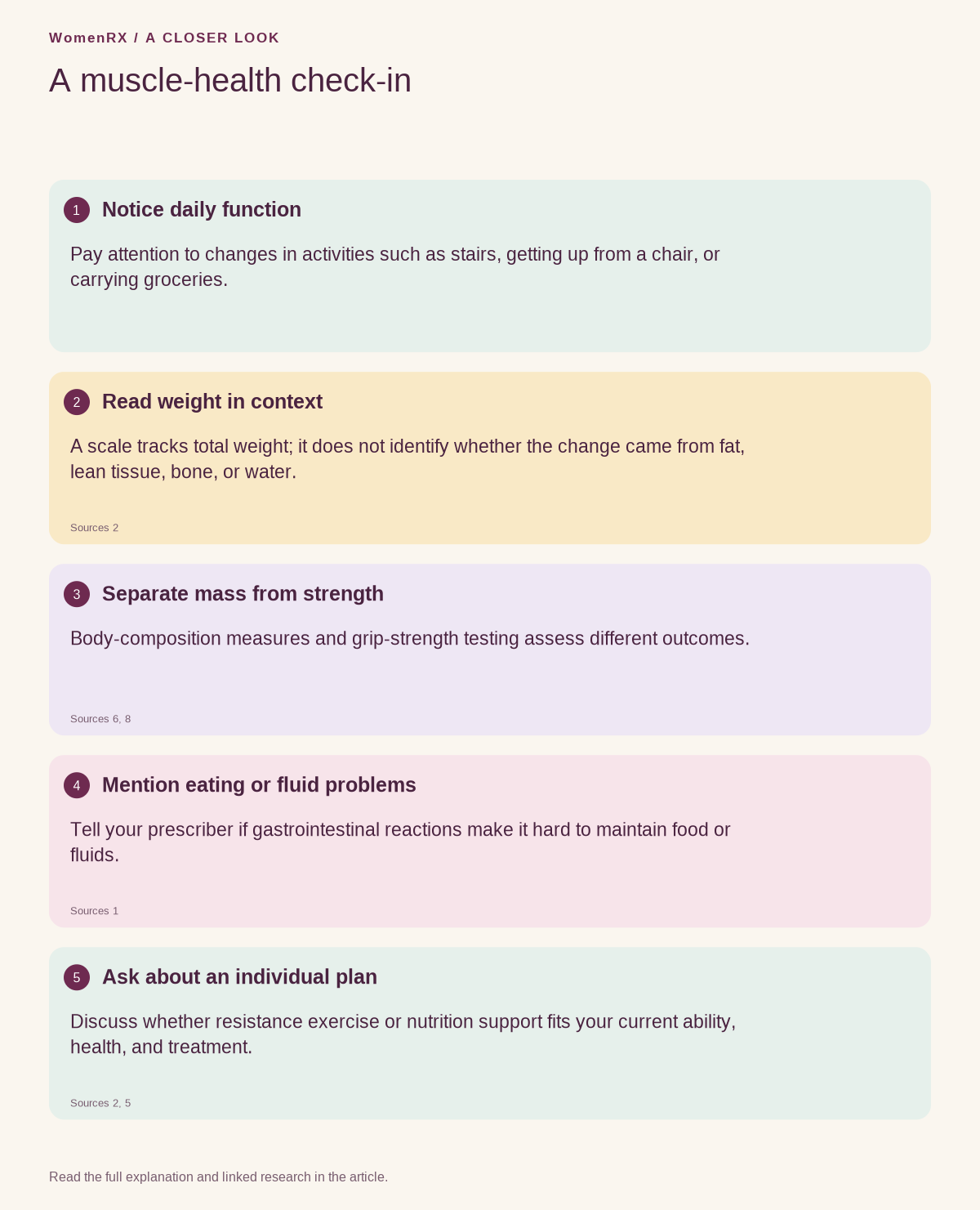
A muscle-health check-in
Notice daily function: Pay attention to changes in activities such as stairs, getting up from a chair, or carrying groceries.
Read weight in context: A scale tracks total weight; it does not identify whether the change came from fat, lean tissue, bone, or water.2
Separate mass from strength: Body-composition measures and grip-strength testing assess different outcomes.68
Mention eating or fluid problems: Tell your prescriber if gastrointestinal reactions make it hard to maintain food or fluids.1
Ask about an individual plan: Discuss whether resistance exercise or nutrition support fits your current ability, health, and treatment.25
Read the figure as text
Keep weight, daily function, intake, and any body-composition results distinct so one measure doesn’t stand in for all the others.- Notice daily function: Pay attention to changes in activities such as stairs, getting up from a chair, or carrying groceries.
- Read weight in context: A scale tracks total weight; it does not identify whether the change came from fat, lean tissue, bone, or water.2
- Separate mass from strength: Body-composition measures and grip-strength testing assess different outcomes.68
- Mention eating or fluid problems: Tell your prescriber if gastrointestinal reactions make it hard to maintain food or fluids.1
- Ask about an individual plan: Discuss whether resistance exercise or nutrition support fits your current ability, health, and treatment.25
More questions, answered
Should I get a body-composition scan?
A scan or other body-composition measure can add information that the scale can’t provide, but it isn’t a direct measure of strength and may not be needed for everyone. Ask your care team whether the result would change your plan and how it will be interpreted. 2 7
Does taking Mounjaro mean I will lose strength?
Not necessarily. Lean-mass findings and strength findings are not interchangeable, and a small real-world study found no significant change in grip strength over its follow-up. That result is reassuring but too limited to predict what will happen to each person. 8
Sources you can check
- MOUNJARO (TIRZEPATIDE) INJECTION, SOLUTION [A-S MEDICATION SOLUTIONS] | US prescribing information and patient instructionsAccessed 2026-09-25Return to first citation
- Body Weight: MedlinePlusAccessed 2026-09-25Return to first citation
- Comparative Effects of Antidiabetic Drugs on Body Composition: A Systematic Review and Network Meta-Analysis.Rakhsha SS, Shahinfar H, Ebrahimi-Mousavi S, Kosari A, Aali Y, Mirzababaei A, Hosseini SA, Jadidi P, Shafiee G, MansourZadeh MJ, Heshmat R, Mastouri D. · Diabetes, obesity & metabolism · 2026Return to first citation
- Comparative Effects of Individual Glucagon-Like Peptide-1 Receptor Agonist-Based Medications on Direct Measurement of Body Composition Among Adults With Overweight or Obesity With or Without Type 2 Diabetes: A Systematic Review and Network Meta-Analysis of Randomised Controlled Trials.Wachiraphansakul N, Vongchaiudomchoke T, Manosroi W, Ruengorn C, Noppakun K, Ngamvichchukorn T, Sood MM, Thavorn K, Hutton B, Nochaiwong S. · Diabetes, obesity & metabolism · 2026Return to first citation
- Lean Mass Changes With Incretin Therapy Versus Lifestyle Intervention: A Systematic Review and Meta-Analysis of Randomised Controlled Trials.Eisa N, Barood O. · Diabetes, obesity & metabolism · 2026Return to first citation
- Early changes in body composition with tirzepatide in adults with obesity: a real-world BIA study.Angelopoulos N, Rizoulis A, Boniakos A, Fousteris E, Mentzelopoulou V, Zianni D, Livadas S, Paparodis R. · Nutrition (Burbank, Los Angeles County, Calif.) · 2026Return to first citation
- Weight Loss-Dependent Changes in Body Composition and Bone Health in People With Obesity and Type 1 Diabetes Treated With Liraglutide, Semaglutide, or Tirzepatide.Al Ozairi E, Irshad M, Alkandri J, Mashankar A, Gray SR, le Roux CW. · Diabetes/metabolism research and reviews · 2026Return to first citation
- [Tirzepatide in real-world clinical practice: changes in body composition and muscle function in patients with obesity].Blanco Anesto J, Dotres Fallat KM, Nicolau J. · Nutricion hospitalaria · 2026Return to first citation