How to Monitor Strength While Taking Zepbound
The scale can’t tell you whether everyday strength is changing, so pair weight trends with simple, repeatable checks of what your body can do.
Some lean tissue is commonly lost during substantial weight loss with tirzepatide, but a change in measured lean mass doesn’t tell you exactly how your muscle strength or daily function has changed. Track a few familiar tasks, such as getting up from a chair or carrying groceries, and raise persistent changes, low food intake, and your activity plan at treatment reviews. 1 3 5
Why the scale can’t answer the muscle question
Weight loss with Zepbound (tirzepatide) can include a reduction in lean mass. In a meta-analysis of randomized trials, lean mass accounted for an estimated 25.4% of the total weight lost in tirzepatide trials. That is a group-level estimate, not a prediction for you. The review also found a broadly similar proportion in lifestyle-only trials. 3
“Lean mass” is not the same thing as muscle strength. Body weight includes fat, muscle, bone, and water, and a body-composition measurement of lean tissue doesn’t directly show whether you can climb stairs, rise from a chair, or carry what you usually carry. 1 5
That distinction matters: a measurement can change without answering whether your everyday function has changed. In the 24-week EMBRAZE trial, adults received tirzepatide with either apitegromab, an investigational myostatin inhibitor, or placebo. The study tested the effect of adding apitegromab on lean mass. Most participants were women, but the reported results did not provide outcomes separately by sex. The study measured lean mass, not a personal at-home way to judge strength. 2
Make your own function checks
Choose two or three ordinary tasks that matter to you. For example, you might notice how getting up from your usual chair feels, whether you can manage your usual flight of stairs, or whether carrying groceries has become harder. These are practical observations, not validated tests or a diagnosis.
Try to compare like with like: the same task in similar circumstances, rather than judging strength by a single unusually tiring day. Notice whether the change is persistent and whether it affects activities you need or value. You don’t need to turn daily life into a scorecard.
A brief note can help you explain a change clearly: “Stairs feel harder than they did before treatment,” or “I’m struggling to carry my usual bags.” Pair that observation with your weight trend, changes in appetite or eating, and what activity you’ve been able to do. Weight alone can’t show what is happening to muscle or function. 1
What to raise at a treatment review
Bring the specific change you’ve noticed, when it began, and whether it is getting in the way of normal activities. If eating has become difficult or your intake has dropped substantially, say so. Ask whether your current nutrition plan is meeting your needs and whether a registered dietitian could help adapt it to your preferences and health situation.
Also ask what kind of resistance exercise is suitable for your current ability and health. A 2026 meta-analysis found the most favorable lean-mass proportion in lifestyle interventions that included resistance training, but that finding doesn’t guarantee the same result for an individual taking Zepbound. Research testing exercise and nutrition strategies specifically alongside these medicines is still developing. 3 4
Don’t assume menopause calls for a particular muscle target while taking Zepbound. Set goals with your age, starting strength and function, and any mobility concerns in mind; age, baseline muscle reserve, nutrition, and activity can all matter to muscle health during incretin treatment. 5
When a body-composition scan may help
Ask whether a body-composition measurement would answer a specific clinical question for you. A scan may estimate lean tissue, but that number is not a direct measure of strength or daily function. It should be interpreted alongside how you are doing physically, not as a stand-alone verdict on whether you have lost “too much muscle.” 2 5
The most useful monitoring plan is one you can actually use: a few familiar tasks, an honest account of eating and activity, and a focused conversation if your function changes. The goal isn’t to make every lean-mass change alarming. It’s to notice whether your weight-loss treatment is working alongside the strength and independence you want to maintain.
A simple strength-and-function check-in
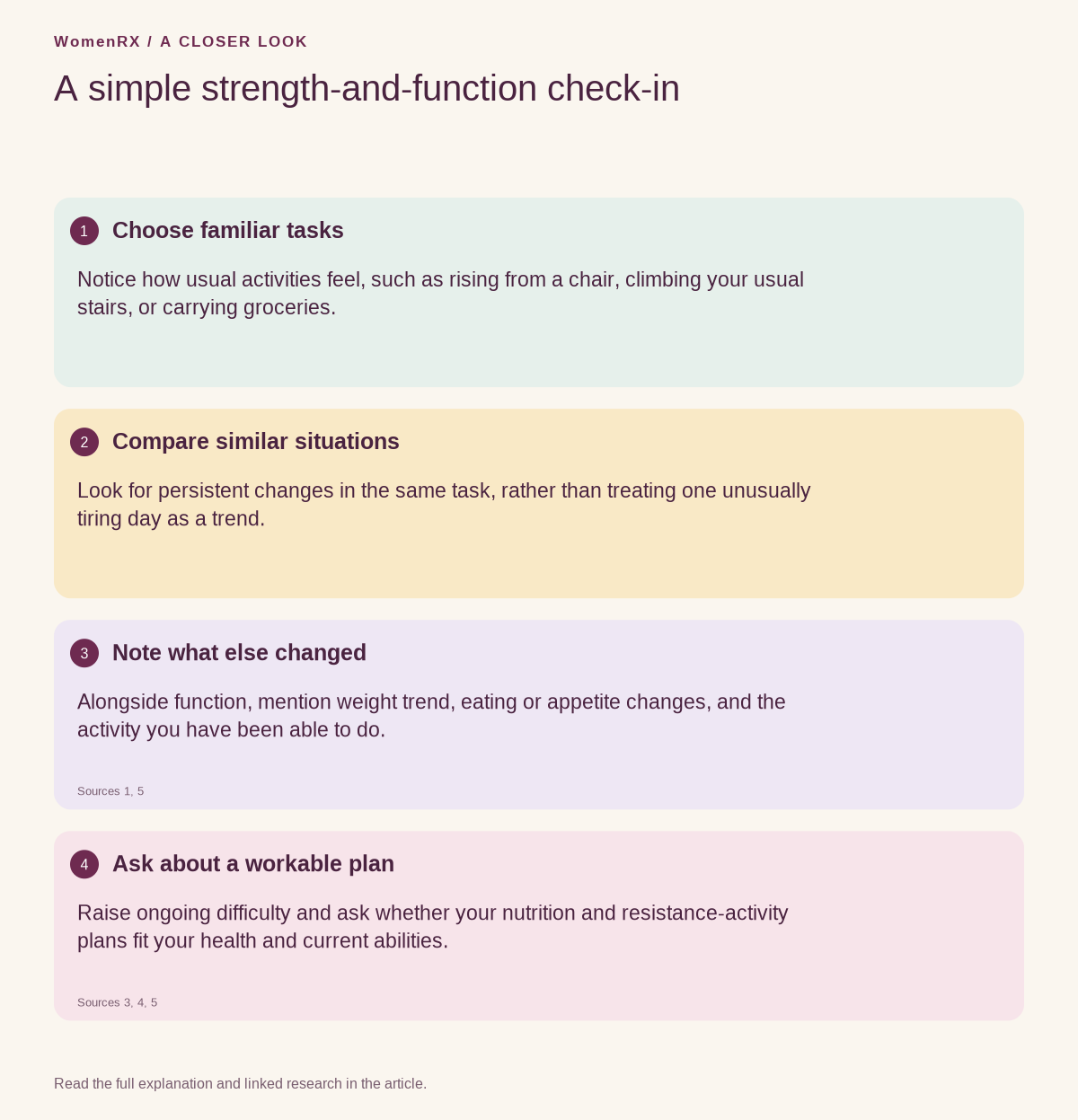
Choose familiar tasks: Notice how usual activities feel, such as rising from a chair, climbing your usual stairs, or carrying groceries.
Compare similar situations: Look for persistent changes in the same task, rather than treating one unusually tiring day as a trend.
Note what else changed: Alongside function, mention weight trend, eating or appetite changes, and the activity you have been able to do.15
Ask about a workable plan: Raise ongoing difficulty and ask whether your nutrition and resistance-activity plans fit your health and current abilities.345
Read the figure as text
Use familiar tasks to notice changes, then connect them with eating and activity when you discuss treatment. These observations are not a diagnostic test.- Choose familiar tasks: Notice how usual activities feel, such as rising from a chair, climbing your usual stairs, or carrying groceries.
- Compare similar situations: Look for persistent changes in the same task, rather than treating one unusually tiring day as a trend.
- Note what else changed: Alongside function, mention weight trend, eating or appetite changes, and the activity you have been able to do.15
- Ask about a workable plan: Raise ongoing difficulty and ask whether your nutrition and resistance-activity plans fit your health and current abilities.345
More questions, answered
Does losing lean mass mean I’m losing strength?
Not necessarily. Lean-mass measurements don’t directly tell you how strong you are or how well you’re managing daily activities. Pay attention to function as well as any body-composition results. 1 5
Should I get a body-composition scan?
It may be useful if your clinician has a specific question the result could help answer. A scan estimates lean tissue; it doesn’t replace checking strength and daily function. 2 5
Sources you can check
- Body Weight: MedlinePlusAccessed 2026-09-25Return to first citation
- Apitegromab for lean mass preservation during tirzepatide-induced weight loss: a randomized, double-blind, placebo-controlled phase 2 trial.Pratley RE, Denham DS, Trivedi R, Watkins E, Connery L, Barnes J, Yu D, Hong J, Simard C, Umans K, Liu L, Tirucherai GS, Marantz JL. · Nature medicine · 2026Return to first citation
- Lean Mass Changes With Incretin Therapy Versus Lifestyle Intervention: A Systematic Review and Meta-Analysis of Randomised Controlled Trials.Eisa N, Barood O. · Diabetes, obesity & metabolism · 2026Return to first citation
- LEAN mass Preservation with Resistance Exercise and Protein during semaglutide and tirzepatide therapy (LEAN-PREP study): a protocol for a randomised controlled trial.Alawadhi AA, Alroudhan D, Alsaeed DJ, Almarshad BW, Alshehabi DH, Allahou BA, Mashankar A, Al Ozairi E, Gray S. · BMJ open · 2026Return to first citation
- Beyond Weight Loss: Skeletal Muscle Health During Incretin-Based Therapy in Patients with Diabesity.Mollero ELM, Dozzani I, Biamonte E, Bendotti G, Marzullo P, Aimaretti G, Gallo M. · Nutrients · 2026Return to first citation