Zepbound While Breastfeeding: What the Evidence Shows
A small study found very little tirzepatide in breast milk after one dose, but infant and milk-supply outcomes haven’t been studied.
The available human-milk study is reassuring about measured transfer, but it can’t establish whether Zepbound is safe for a breastfed baby or affects milk production. After one 5 mg dose in 11 lactating adults, most milk samples had no detectable tirzepatide; the label reports no infant-outcome or milk-production data. The decision calls for weighing your treatment needs against these unanswered questions. 1
What the human-milk study found
The best direct evidence is a single-dose study in 11 healthy lactating adults. Each received one 5 mg dose of tirzepatide. Researchers tested 171 breast-milk samples collected over 28 days: 164 had no detectable drug, while the seven remaining samples contained a cumulative amount equivalent to less than 0.02% of the maternal dose. The last measurable levels were found five days after dosing. 1
That’s a finding about how much drug was measured in milk, not proof of what happens to a nursing infant. Because most samples were below the test’s detection limit, researchers couldn’t calculate the amount of tirzepatide in milk over time. The study also involved a single dose, so it doesn’t answer what happens with ongoing treatment. 1
What remains unknown for babies and milk supply
The prescribing information says there are no available data on effects in breastfed infants or on milk production. In practical terms, the study didn’t establish whether exposed babies have any effects, or whether tirzepatide changes how much milk a parent makes. Low measured transfer alone can’t settle either question. 1
A drug-and-lactation review suggests that an infant may absorb little tirzepatide by mouth because it may be partly broken down in the gut and is thought to be poorly absorbed orally. That’s a proposed explanation, not an observed finding about infant blood levels or health outcomes. The review advises particular caution when nursing a newborn or preterm infant, where evidence is especially limited. 2
How to think through the decision
The U.S. prescribing information doesn’t give a universal yes-or-no answer. It says to consider the benefits of breastfeeding alongside the mother’s clinical need for Zepbound and potential effects on the infant, including effects related to the mother’s underlying condition. 1
If you’re considering treatment or already taking it, a useful discussion is specific to your situation: What is the reason for treatment, how old is your baby, and was your baby born prematurely? Ask what is known and unknown for your feeding situation, and how you and your care team would keep an eye on your baby’s growth and feeding and on your milk supply. A lactation professional can help assess feeding or supply concerns; that assessment doesn’t answer the medication question by itself.
The central distinction is simple: the measured amount in milk after one dose was very low, but infant safety and milk-production effects have not been established. That leaves room for an individualized decision rather than a blanket conclusion that Zepbound is either safe or unsafe during breastfeeding. 12
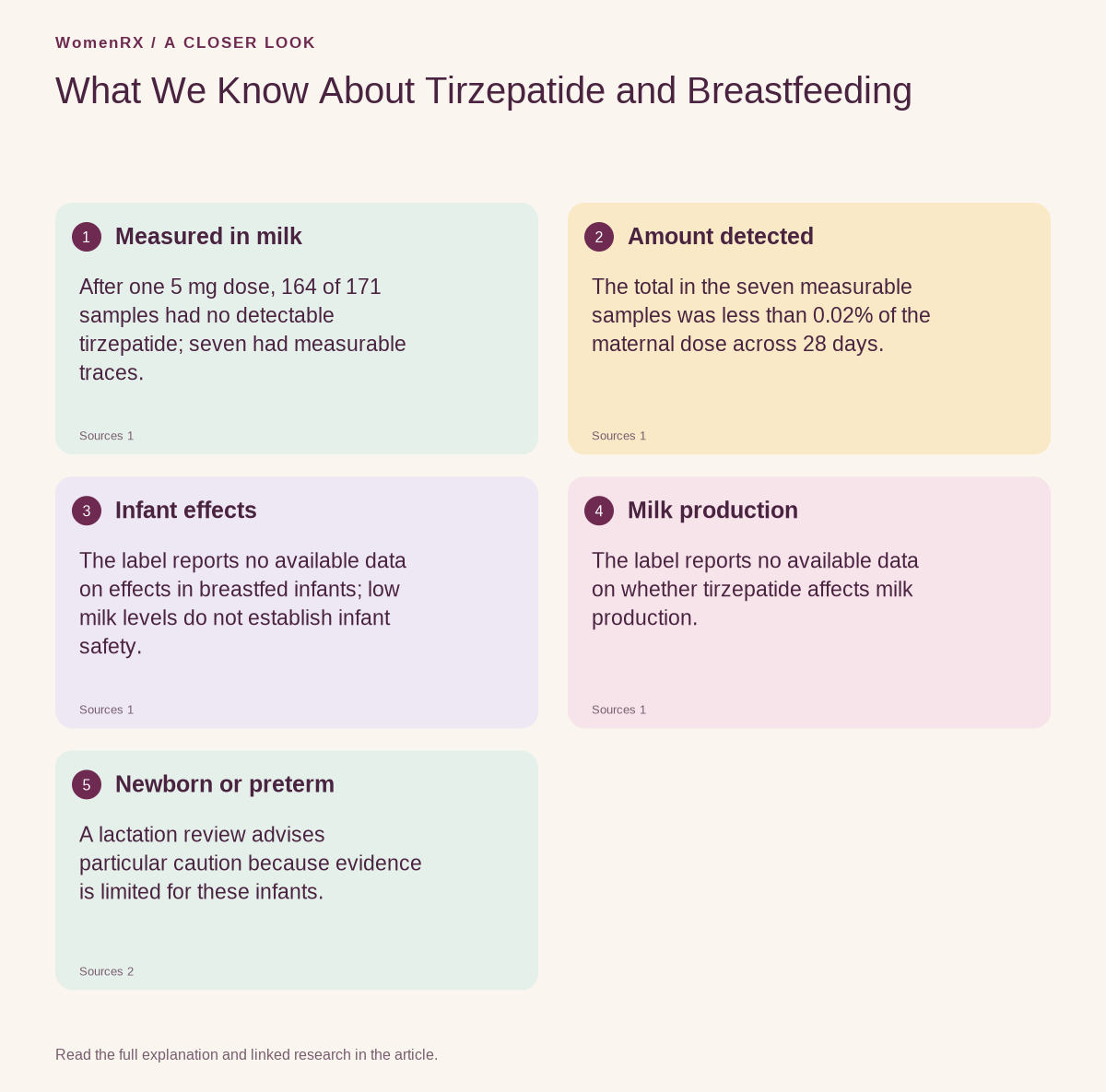
What We Know About Tirzepatide and Breastfeeding
Measured in milk: After one 5 mg dose, 164 of 171 samples had no detectable tirzepatide; seven had measurable traces.1
Amount detected: The total in the seven measurable samples was less than 0.02% of the maternal dose across 28 days.1
Infant effects: The label reports no available data on effects in breastfed infants; low milk levels do not establish infant safety.1
Milk production: The label reports no available data on whether tirzepatide affects milk production.1
Newborn or preterm: A lactation review advises particular caution because evidence is limited for these infants.2
Read the figure as text
The evidence is strongest for the amount measured in milk after one dose; infant and milk-supply outcomes remain unanswered.- Measured in milk: After one 5 mg dose, 164 of 171 samples had no detectable tirzepatide; seven had measurable traces.1
- Amount detected: The total in the seven measurable samples was less than 0.02% of the maternal dose across 28 days.1
- Infant effects: The label reports no available data on effects in breastfed infants; low milk levels do not establish infant safety.1
- Milk production: The label reports no available data on whether tirzepatide affects milk production.1
- Newborn or preterm: A lactation review advises particular caution because evidence is limited for these infants.2
More questions, answered
Does the milk study mean my baby would receive no tirzepatide?
No. Most samples had no detectable drug, but seven samples did contain measurable amounts. The study measured drug in milk, not the amount an infant would ingest or absorb, and it didn’t report infant outcomes. 1
Does the evidence apply to a newborn or premature baby?
The small milk study doesn’t establish outcomes for newborns or premature infants. A lactation review recommends particular caution in those situations because information is limited. 12