GLP-1 Medicines While Breastfeeding: What We Know
A small study found no detectable injectable semaglutide in milk, but that finding does not answer questions about newborns, longer-term effects, or other GLP-1 medicines.
The clearest human milk evidence is for injectable semaglutide: in a study of eight women, the medicine was not detected in sampled milk, but the infants were 7 to 23 months old and the study was small and brief. Oral semaglutide is a different question because SNAC and/or its metabolites have been found in milk. Evidence for other GLP-1 medicines remains limited. 1 3 4
If you’re breastfeeding and weighing a GLP-1 medicine, the answer depends on the specific medicine and formulation. A small study offers an early look at injectable semaglutide in human milk. It does not establish safety for all breastfed babies, especially newborns, or for other medicines in the class.
Injectable semaglutide: encouraging milk results, narrow evidence
In a 2024 study, researchers tested milk samples from eight women using subcutaneous semaglutide. They collected samples at 0, 12, and 24 hours after administration and did not detect semaglutide in any of them. The study’s assay could reliably measure the drug at concentrations of 5.7 ng/mL and above, so “not detected” means below that limit, not proof that the milk contained absolutely none. 4
The researchers estimated a maximum relative infant dose of 1.26% using the assay’s measurement limit and assumptions about infant exposure. That was a modeled estimate, not a measured amount taken up by infants. Relative infant dose is one way to estimate exposure; it cannot by itself show whether a medicine is safe. 4
The limits matter. The study included only eight women, and their infants were 7 to 23 months old. Mothers reported that infants were meeting or exceeding expected milestones during at least three weeks of exposure, but these reports cannot establish longer-term outcomes. The study offers no direct evidence about milk exposure or effects in newborns or younger infants. 4
A tablet is not the same formulation
Oral semaglutide tablets include SNAC, an absorption enhancer. In the lactation study cited in US prescribing information, semaglutide was below the limit of quantification in milk, but SNAC and/or its metabolites were detected. The labeling advises against breastfeeding during treatment with oral semaglutide because of concern about possible SNAC accumulation in infants, particularly neonates and infants. 1 2
That is a different concern from the small study of injected semaglutide, which does not contain SNAC. But the injection is not proven safe by that distinction: Wegovy’s prescribing information says there are no data on injected semaglutide in human milk, effects on a breastfed infant, or effects on milk production. The small published study adds some milk measurements, but leaves those broader questions open. 1 4
Don’t carry semaglutide findings across the class
The evidence does not support treating GLP-1 medicines as interchangeable during lactation. A 2026 systematic review of medicines used for type 2 diabetes reported human plasma-to-milk transfer data for five of 20 drugs it considered, including semaglutide. Its searches covered published evidence through March 2025. Those findings do not establish milk transfer or infant effects for other GLP-1 medicines, such as liraglutide or tirzepatide. 3
A lack of comparable evidence is uncertainty, not proof that another medicine does or does not enter milk. If you’re considering a different GLP-1 medicine, ask about that specific ingredient and formulation rather than relying on semaglutide results.
Infant age and maternal nutrition still matter
The available injectable semaglutide study is about older infants, not early newborn feeding. It also does not answer whether semaglutide affects milk production or milk nutrient content. The authors identify maternal nutrient intake and longer-term infant outcomes as unresolved questions; those weren’t established by the study. 1 4
If the medicine is affecting your eating or causing gastrointestinal symptoms, that experience is worth discussing as part of the decision. The study included a mother who reported gastrointestinal effects and concern about temporary infant symptoms, but one report cannot show that the medicine caused the infant symptoms. 4
A practical conversation can stay specific: Which exact ingredient and formulation are you taking or considering? How old is your baby, and is your baby exclusively breastfed or also eating other foods? What is known about that formulation’s presence in milk, and what remains unknown about your baby’s age group? How will you address concerns about your own food intake, milk production, or your baby’s growth? The answers may differ for an oral tablet and an injection, and for a newborn and an older infant.
For now, the most useful distinction is this: injectable semaglutide has a small human milk study with no detectable drug in sampled milk, while oral semaglutide has a separate SNAC-related concern in product labeling. Neither finding settles the safety question for every breastfeeding parent and baby, and neither can stand in for evidence about another GLP-1 medicine.
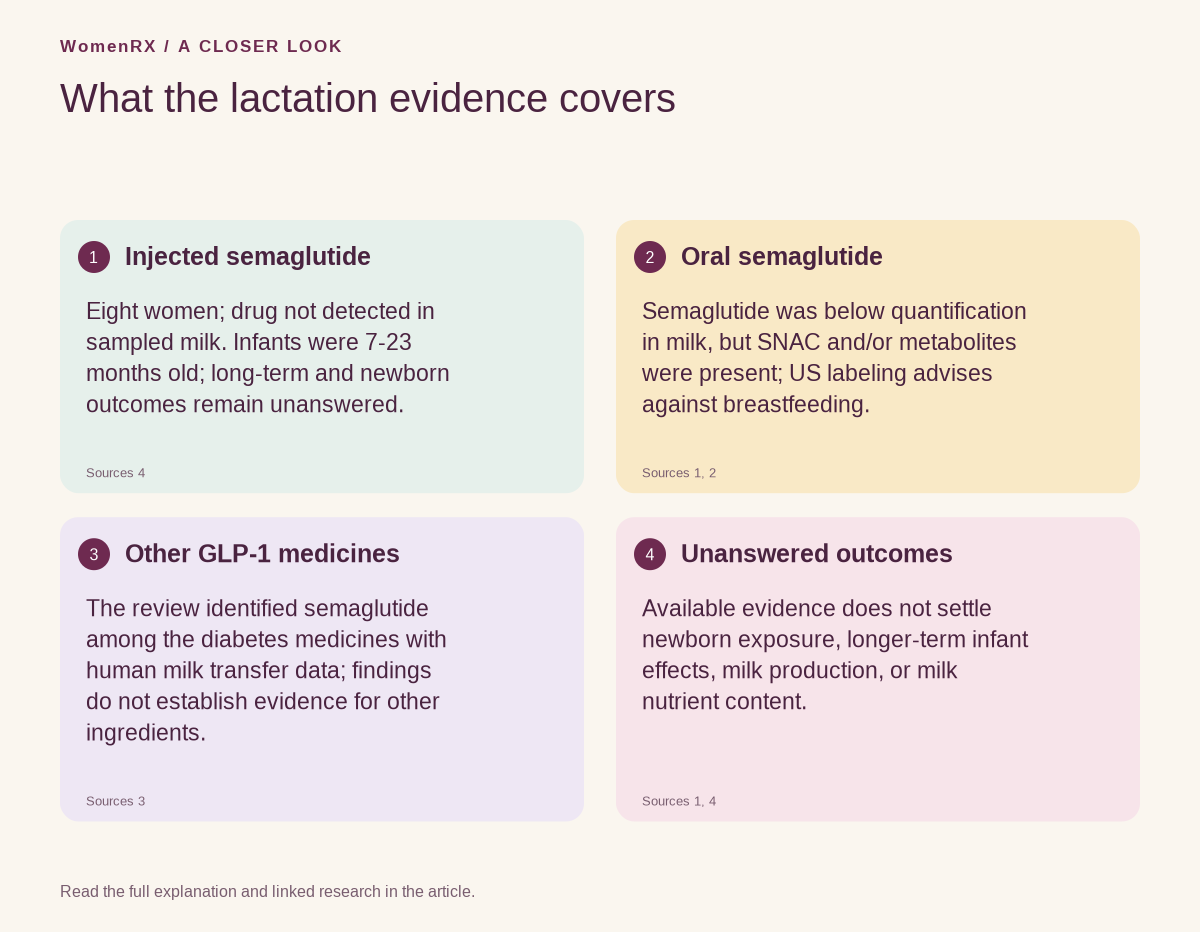
What the lactation evidence covers
Injected semaglutide: Eight women; drug not detected in sampled milk. Infants were 7-23 months old; long-term and newborn outcomes remain unanswered.4
Oral semaglutide: Semaglutide was below quantification in milk, but SNAC and/or metabolites were present; US labeling advises against breastfeeding.12
Other GLP-1 medicines: The review identified semaglutide among the diabetes medicines with human milk transfer data; findings do not establish evidence for other ingredients.3
Unanswered outcomes: Available evidence does not settle newborn exposure, longer-term infant effects, milk production, or milk nutrient content.14
Read the figure as text
The findings differ by formulation and by what researchers actually measured; a milk result is not the same as proof of infant safety.- Injected semaglutide: Eight women; drug not detected in sampled milk. Infants were 7-23 months old; long-term and newborn outcomes remain unanswered.4
- Oral semaglutide: Semaglutide was below quantification in milk, but SNAC and/or metabolites were present; US labeling advises against breastfeeding.12
- Other GLP-1 medicines: The review identified semaglutide among the diabetes medicines with human milk transfer data; findings do not establish evidence for other ingredients.3
- Unanswered outcomes: Available evidence does not settle newborn exposure, longer-term infant effects, milk production, or milk nutrient content.14
More questions, answered
Does “not detected” mean there was no semaglutide in the milk?
No. It means the study’s test did not measure semaglutide at or above its quantification limit of 5.7 ng/mL. The researchers used that limit in a modeled exposure estimate; it was not a direct measurement of what infants absorbed. 4
Does the injectable semaglutide study answer the question for a newborn?
No. The infants in the study were 7 to 23 months old. It did not establish milk exposure or effects in newborns or younger infants. 4
Sources you can check
- WEGOVY (SEMAGLUTIDE) INJECTION, SOLUTION WEGOVY (SEMAGLUTIDE) TABLET [NOVO NORDISK PHARMACEUTICAL INDUSTRIES, LP] | US prescribing information and patient instructionsAccessed 2026-09-25Return to first citation
- OZEMPIC (ORAL SEMAGLUTIDE) TABLET RYBELSUS (ORAL SEMAGLUTIDE) TABLET [NOVO NORDISK PHARMACEUTICAL INDUSTRIES, LP] | US prescribing information and patient instructionsAccessed 2026-09-25Return to first citation
- Maternal-to-Infant Transfer of Medications for Type 2 Diabetes Mellitus Via Breastmilk: A Systematic Review of Available Evidence and Clinical Guidelines.Richardson K, Kiptoo J, Mpora Odongkara B, Ojara FW, Waitt C. · Clinical pharmacology and therapeutics · 2026Return to first citation
- Subcutaneous Semaglutide during Breastfeeding: Infant Safety Regarding Drug Transfer into Human Milk.Diab H, Fuquay T, Datta P, Bickel U, Thompson J, Krutsch K. · Nutrients · 2024Return to first citation