Wegovy While Breastfeeding: What the Evidence Shows
A small study found no measurable injectable semaglutide in milk, but it cannot answer whether use affects a younger infant or milk supply.
For Wegovy injections, a study of milk from eight women found semaglutide below the test’s detection limit, but it did not establish infant safety or measure milk production. The US prescribing information says injection data on milk, infant effects, and milk production are lacking. Wegovy tablets are different: they contain SNAC, which has been found in milk, and breastfeeding is not recommended with the tablets. 1 2
The answer depends on the Wegovy formulation
Wegovy is available as an injection and, according to current US prescribing information, as tablets. The lactation evidence and labeling differ, so the formulation matters.
For the injection, a small human study offers an early answer about drug transfer: researchers did not detect semaglutide in milk samples from eight women. But that finding does not establish that use is safe for every breastfeeding infant, and it says little about milk production or longer-term outcomes. The product information still describes data on injected semaglutide in milk, effects on a breastfed infant, and effects on milk production as unavailable. 1 2
For Wegovy tablets, the concern is not just semaglutide. The tablets contain the absorption enhancer SNAC. The prescribing information says semaglutide levels were below the measurement limit in a clinical lactation study, but SNAC or its metabolites were present in milk; it advises that breastfeeding is not recommended during treatment with the tablets. 1
What the injection study did, and didn’t, find
The 2024 study tested milk samples from eight women using subcutaneous semaglutide. Samples were collected before dosing and at 12 and 24 hours afterward. Semaglutide was not detected; the test could quantify it at concentrations of 5.7 ng/mL and above. “Not detected” means the samples were below that test’s limit, not that there could not have been any drug in the milk. 2
The researchers also calculated a modelled, worst-case relative infant dose of up to 1.26%. That was an estimate based on assumptions, not a measurement of how much drug infants actually absorbed. A later systematic review notes that relative-infant-dose cutoffs, including the often-used 10% benchmark, are imperfect measures and do not by themselves establish infant safety. 2 3
The study’s infant observations were limited too. The infants were 7 to 23 months old, and the mothers had used semaglutide for at least three weeks during dose titration. Mothers reported that the infants were meeting or exceeding expected milestones. One mother reported temporary diarrhea and reduced appetite in her infant during a period when she herself had gastrointestinal symptoms; the study cannot show whether semaglutide caused those infant symptoms. These observations cannot tell us what exposure might mean for a newborn, a younger infant, or an infant who gets nearly all their nutrition from breast milk. 2
Milk supply and nutrition are separate questions
Finding little or no measurable drug in milk does not answer whether treatment affects milk production. The Wegovy injection labeling says this effect is unknown, and the systematic review found that the included studies did not evaluate milk production or composition. 1 3
The injection study also did not settle questions about longer-term infant outcomes, maternal nutrient intake, or the nutrient content of milk. Those are meaningful gaps, especially when considering someone early postpartum or breastfeeding an infant who depends heavily on breast milk. There is no evidence here to say that semaglutide lowers supply, but there is also not enough evidence to rule out an effect. 2 3
What to weigh for your situation
A useful discussion with the prescriber and your baby’s care team can be specific rather than framed as a blanket yes or no. The relevant details include:
- Which product you mean: injection or tablet, since tablet labeling specifically advises against breastfeeding during treatment. 1
- Your baby’s age and feeding pattern: the injection study involved older infants, from 7 to 23 months, so its findings do not directly answer questions about newborns or younger infants. 2
- Why you’re taking semaglutide and what alternatives fit your health needs: the prescribing information says to consider the mother’s clinical need alongside breastfeeding’s benefits and potential effects on the infant. 1
- How feeding and growth are going: the study was too small and brief to establish longer-term effects or determine whether milk supply changes. 1 2 3
If you’re already using the injection, don’t treat the small study as proof of safety or as proof of harm. Share the exact formulation with your prescriber and the infant-care team, and make the decision in light of your treatment needs, your baby’s age and feeding, and what remains unknown. For Wegovy tablets, the product information is clearer: it advises against breastfeeding during treatment. 1
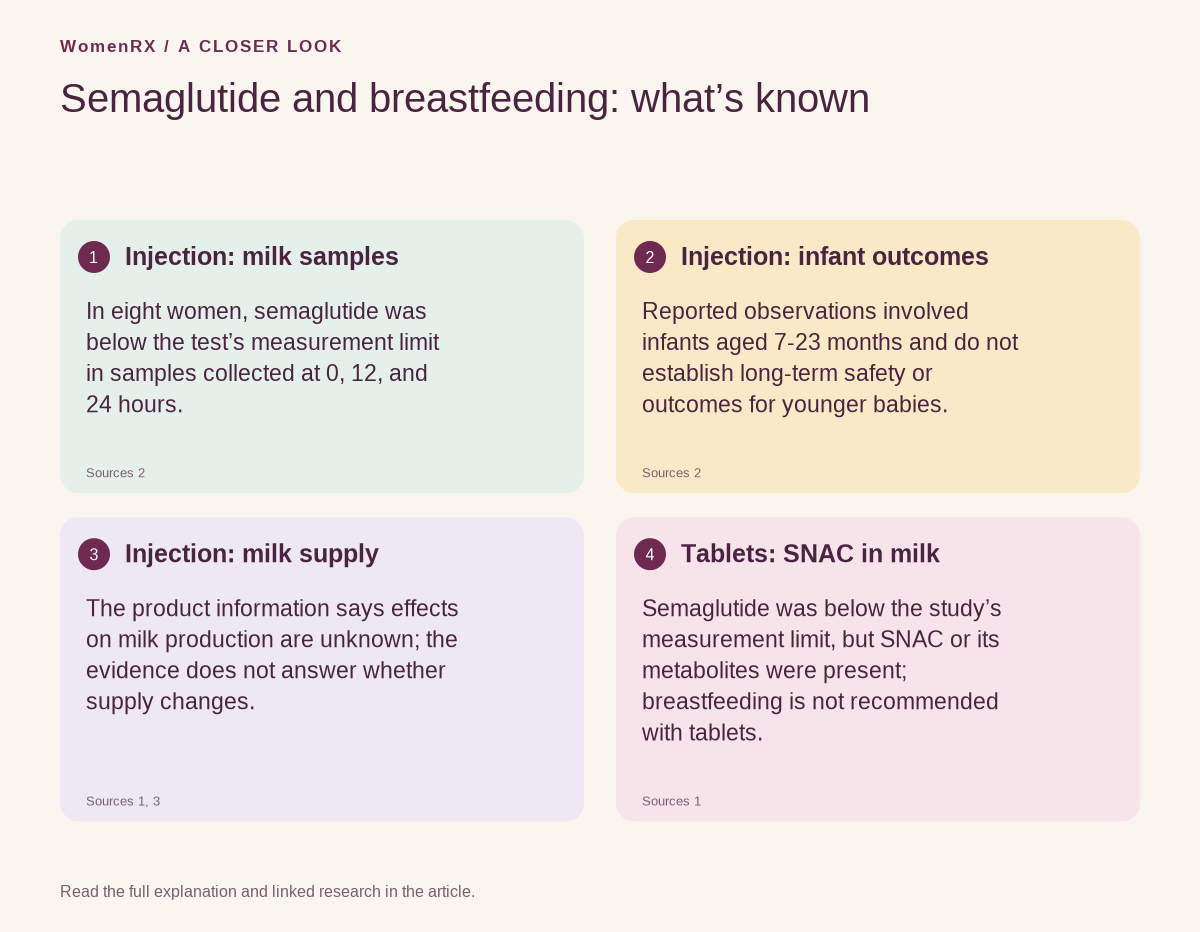
Semaglutide and breastfeeding: what’s known
Injection: milk samples: In eight women, semaglutide was below the test’s measurement limit in samples collected at 0, 12, and 24 hours.2
Injection: infant outcomes: Reported observations involved infants aged 7-23 months and do not establish long-term safety or outcomes for younger babies.2
Injection: milk supply: The product information says effects on milk production are unknown; the evidence does not answer whether supply changes.13
Tablets: SNAC in milk: Semaglutide was below the study’s measurement limit, but SNAC or its metabolites were present; breastfeeding is not recommended with tablets.1
Read the figure as text
The evidence differs by formulation, and a milk-transfer result is not the same as proof about infant outcomes or milk supply.- Injection: milk samples: In eight women, semaglutide was below the test’s measurement limit in samples collected at 0, 12, and 24 hours.2
- Injection: infant outcomes: Reported observations involved infants aged 7-23 months and do not establish long-term safety or outcomes for younger babies.2
- Injection: milk supply: The product information says effects on milk production are unknown; the evidence does not answer whether supply changes.13
- Tablets: SNAC in milk: Semaglutide was below the study’s measurement limit, but SNAC or its metabolites were present; breastfeeding is not recommended with tablets.1
More questions, answered
Does the small milk study prove injectable Wegovy is safe while breastfeeding?
No. It found semaglutide below the test’s measurement limit in samples from eight women, but it did not establish safety, assess milk production, or provide long-term infant outcomes. Its infant observations were in babies aged 7 to 23 months. 2
Sources you can check
- WEGOVY (SEMAGLUTIDE) INJECTION, SOLUTION WEGOVY (SEMAGLUTIDE) TABLET [NOVO NORDISK PHARMACEUTICAL INDUSTRIES, LP] | US prescribing information and patient instructionsAccessed 2026-09-25Return to first citation
- Subcutaneous Semaglutide during Breastfeeding: Infant Safety Regarding Drug Transfer into Human Milk.Diab H, Fuquay T, Datta P, Bickel U, Thompson J, Krutsch K. · Nutrients · 2024Return to first citation
- Maternal-to-Infant Transfer of Medications for Type 2 Diabetes Mellitus Via Breastmilk: A Systematic Review of Available Evidence and Clinical Guidelines.Richardson K, Kiptoo J, Mpora Odongkara B, Ojara FW, Waitt C. · Clinical pharmacology and therapeutics · 2026Return to first citation