Ozempic and Breastfeeding: What the Evidence Can Tell You
A small study found injectable semaglutide below the test’s measurement limits in milk, but it did not establish effects on breastfed infants.
The answer depends on the formulation. For Ozempic injection, the U.S. prescribing information says human data on milk, infant effects, and milk production are lacking. In a small study, semaglutide was not detected in milk from eight women, but that finding does not establish infant safety. The cited oral-tablet label gives different guidance because those tablets contain SNAC. 123
Check the route and ingredients first
Breastfeeding guidance for semaglutide isn’t interchangeable across formulations. The prescribing information for Ozempic injection says there are no human data on semaglutide in breast milk, effects on a breastfed infant, or effects on milk production. It reports that semaglutide was found in milk from lactating rats, but says the relevance to people is unclear because lactation physiology differs between species. 2
The cited prescribing information for oral semaglutide tablets describes a separate concern: SNAC, an absorption enhancer in those tablets, and/or its metabolites are present in human milk. The label notes a potential for SNAC to accumulate in infants and advises against breastfeeding during treatment with those tablets. That product-specific advice should not be treated as evidence about injectable Ozempic, or vice versa. 12
If the package or medication list doesn’t make the route clear, check whether the product is an injection or a tablet and review its ingredients with your prescriber or pharmacist.
What the injection study measured
A 2024 study tested milk samples from eight women using subcutaneous semaglutide. Samples were collected at 0, 12, and 24 hours after administration. The researchers did not detect semaglutide in the samples. 3
“Not detected” has a specific meaning: the test did not measure semaglutide at or above its detection limit. In this study, the detection limit was 1.7 ng/mL, while the lower limit of quantification (LLOQ), the lowest level the method could reliably quantify, was 5.7 ng/mL. These are different thresholds. 3
The study used the higher LLOQ, not the detection limit, as a worst-case assumed milk concentration to calculate a projected maximum relative infant dose of 1.26%. That is an estimate of possible exposure through milk, not a measured dose absorbed by an infant and not a safety threshold or proof of safety. 3
The study was small and focused on transfer into milk. It did not establish effects on infant health, milk production, milk composition, or how much milk infants consumed. A systematic review likewise reported that the studies it included did not assess milk production or composition or measure infant milk intake. The available findings also don’t establish whether results differ by infant age or by exclusive versus partial breastfeeding. 34
Put the evidence beside the reason for treatment
The Ozempic injection label says to weigh the benefits of breastfeeding against the mother’s clinical need for treatment and possible effects on the infant or on the underlying maternal condition. 2 That means the decision involves more than whether the drug was detected in milk.
For example, if you take semaglutide for diabetes, discuss how your blood sugar would be managed if your treatment plan changed. If it’s being considered for weight management, you might also discuss whether reduced appetite could make it harder to eat enough while lactating. The study raises questions about maternal nutrient intake, but it did not measure nutrition or establish effects on milk or infants. 3
A useful discussion can start with three specifics: the exact product and route; why treatment is needed and what alternatives or tradeoffs apply; and what is known versus unknown about milk transfer and infant outcomes. Your feeding pattern and your baby’s age can be part of that conversation, but current evidence here does not show how either changes the findings.
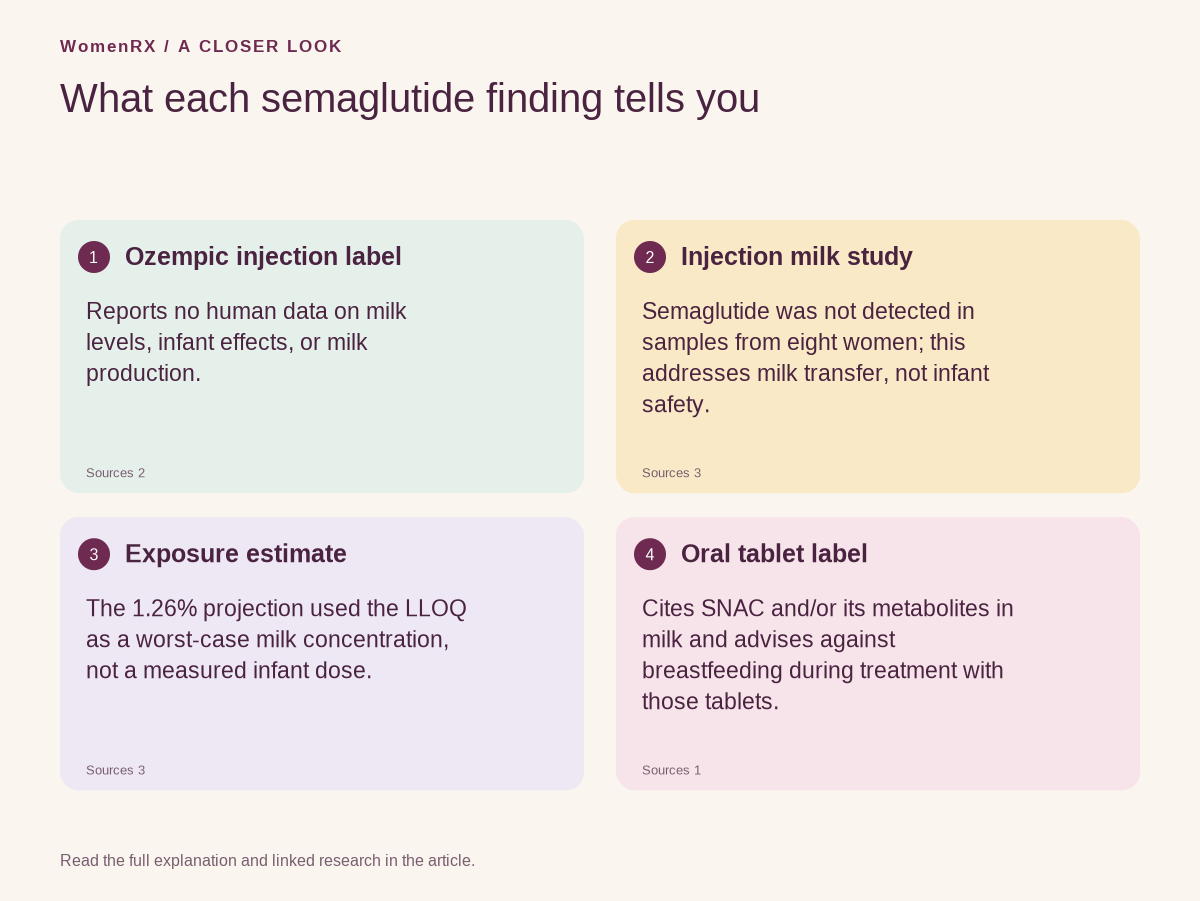
What each semaglutide finding tells you
Ozempic injection label: Reports no human data on milk levels, infant effects, or milk production.2
Injection milk study: Semaglutide was not detected in samples from eight women; this addresses milk transfer, not infant safety.3
Exposure estimate: The 1.26% projection used the LLOQ as a worst-case milk concentration, not a measured infant dose.3
Oral tablet label: Cites SNAC and/or its metabolites in milk and advises against breastfeeding during treatment with those tablets.1
Read the figure as text
Milk measurements, product guidance, and infant outcomes are different kinds of evidence.- Ozempic injection label: Reports no human data on milk levels, infant effects, or milk production.2
- Injection milk study: Semaglutide was not detected in samples from eight women; this addresses milk transfer, not infant safety.3
- Exposure estimate: The 1.26% projection used the LLOQ as a worst-case milk concentration, not a measured infant dose.3
- Oral tablet label: Cites SNAC and/or its metabolites in milk and advises against breastfeeding during treatment with those tablets.1
More questions, answered
Is the breastfeeding advice the same for oral semaglutide tablets?
No. The cited tablet prescribing information says SNAC and/or its metabolites are present in human milk and advises against breastfeeding during treatment with those tablets. That guidance concerns the tablet formulation and should not be substituted for the separate evidence about injectable semaglutide. 123
Sources you can check
- OZEMPIC (ORAL SEMAGLUTIDE) TABLET RYBELSUS (ORAL SEMAGLUTIDE) TABLET [NOVO NORDISK PHARMACEUTICAL INDUSTRIES, LP] | US prescribing information and patient instructionsAccessed 2026-09-25Return to first citation
- OZEMPIC (SEMAGLUTIDE) INJECTION, SOLUTION [A-S MEDICATION SOLUTIONS] | US prescribing information and patient instructionsAccessed 2026-09-25Return to first citation
- Subcutaneous Semaglutide during Breastfeeding: Infant Safety Regarding Drug Transfer into Human Milk.Diab H, Fuquay T, Datta P, Bickel U, Thompson J, Krutsch K. · Nutrients · 2024Return to first citation
- Maternal-to-Infant Transfer of Medications for Type 2 Diabetes Mellitus Via Breastmilk: A Systematic Review of Available Evidence and Clinical Guidelines.Richardson K, Kiptoo J, Mpora Odongkara B, Ojara FW, Waitt C. · Clinical pharmacology and therapeutics · 2026Return to first citation