What Long-Term Ozempic Use Can and Can’t Tell You
Semaglutide has been studied for months and, in some settings, up to two years, but those findings don’t establish unlimited safety or apply equally to every use.
Long-term Ozempic safety isn’t a simple yes or no. In pooled type 2 diabetes trials, the mean treatment duration was 44.9 weeks. A small 24-month study of oral semaglutide in people with type 2 diabetes reported lower HbA1c and body weight, but it doesn’t establish the same benefits or safety for Ozempic injection. Weight-management research also reports digestive side effects, while longer-term safety remains an open question. 1 2 4
Semaglutide can be a continuing treatment, but “safe long term” doesn’t mean the same thing as proven safe for every person, every reason for taking it, or a lifetime. The best answer comes from separating what has been studied by indication and duration, then reviewing whether the benefits and side effects still fit your situation.
What the diabetes evidence can tell you
In a pooled safety analysis of seven Ozempic trials in adults with type 2 diabetes, 3,150 participants received Ozempic for an average of 44.9 weeks. The group was mixed-sex, with 57% men; the information reported here doesn’t give women-specific results. That’s meaningful evidence about treatment over roughly a year, but it can’t settle questions about use over many years. 1
A separate real-world study followed 232 adults with type 2 diabetes who started oral semaglutide. Over 24 months, HbA1c decreased by 0.8% and body weight by 5.7 kg; 68.5% remained on treatment at 24 months, and the researchers reported that no safety concerns emerged. These are findings from a retrospective study at one Italian diabetes clinic, not proof of long-term benefit from Ozempic injection or in other patient groups. The results offer a longer view of semaglutide use in diabetes, but the formulation and study design matter when applying them to your own medication review. 4
What weight-management studies add
Weight-management evidence comes from a different population: adults with overweight or obesity who did not have diabetes. One review pooled four randomized trials with 3,613 participants. Digestive effects, including nausea, vomiting, diarrhea, and constipation, were common; stopping treatment because of side effects was more frequent with semaglutide than placebo. The review also found that longer-term trials are still needed to understand durability and safety. These findings help describe semaglutide used for weight reduction, but they don’t replace evidence for Ozempic in diabetes. 2
Another review included nine trials and 6,239 participants without diabetes. Serious adverse events weren’t significantly different between semaglutide and placebo in the pooled analysis. That result does not prove there is no risk: the confidence interval was compatible with both lower and higher risk, and the review also called for longer-term research. 3
Known effects and unresolved risks
Digestive symptoms are a practical part of the safety picture. In weight-management trials, nausea, vomiting, diarrhea, and constipation were among the most frequently reported effects. Ozempic’s prescribing information also lists postmarketing reports of pancreatitis, ileus, intestinal obstruction, and severe constipation. Because these reports are voluntary, they can’t reliably show how often an event happens or, by themselves, prove that semaglutide caused it. 1 2
The prescribing information also warns about possible thyroid tumors. The warning is based on tumors seen in rodents; whether Ozempic causes a particular thyroid cancer in people is not known. The information says not to use it if you or a family member has had medullary thyroid carcinoma, or if you have multiple endocrine neoplasia syndrome type 2. 1
Taken together, the evidence supports neither “it’s unsafe after a set time” nor “it’s proven safe indefinitely.” It shows what happened in studied groups over specific periods, while leaving longer-term and less common outcomes less certain.
Make your medication review specific
Bring the review back to the reason you take semaglutide. If it’s for type 2 diabetes, consider the benefit you’re seeing in your diabetes care alongside any side effects. A small retrospective study found lower HbA1c and body weight over 24 months with oral semaglutide, but it doesn’t establish those outcomes for Ozempic injection or for you personally. If the goal is weight management, ask how your experience compares with the expected benefits and what the plan is if side effects make treatment hard to continue. Don’t assume that results from diabetes trials answer the same question as weight-management trials. 4
A few questions can keep the conversation focused:
- What benefit are we aiming for in my case, and how will we judge whether it’s still worth continuing?
- Which side effects should prompt me to contact you, and what should I do if digestive symptoms persist?
- Do my pregnancy plans affect the timing of treatment? The Ozempic prescribing information says to stop it at least two months before a planned pregnancy. 1
- If I’m breastfeeding, how should that be considered separately? Pregnancy guidance alone doesn’t answer a breastfeeding question.
The useful decision isn’t simply whether semaglutide is “safe long term” in general. It’s whether the evidence for your indication, the benefit you’re getting, and the effects you’re experiencing support continuing treatment in your circumstances.
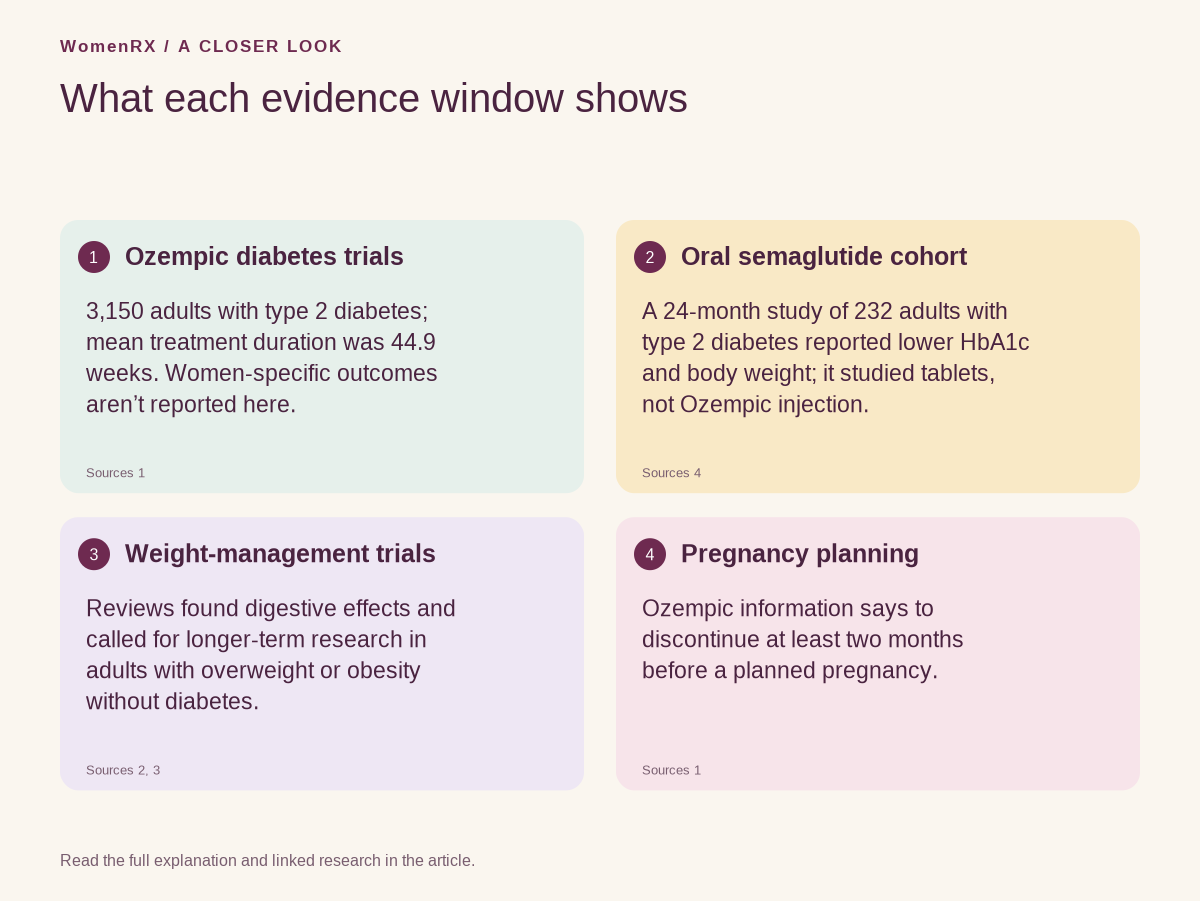
What each evidence window shows
Ozempic diabetes trials: 3,150 adults with type 2 diabetes; mean treatment duration was 44.9 weeks. Women-specific outcomes aren’t reported here.1
Oral semaglutide cohort: A 24-month study of 232 adults with type 2 diabetes reported lower HbA1c and body weight; it studied tablets, not Ozempic injection.4
Weight-management trials: Reviews found digestive effects and called for longer-term research in adults with overweight or obesity without diabetes.23
Pregnancy planning: Ozempic information says to discontinue at least two months before a planned pregnancy.1
Read the figure as text
These findings answer different questions because they involve different durations, formulations, and treatment populations.- Ozempic diabetes trials: 3,150 adults with type 2 diabetes; mean treatment duration was 44.9 weeks. Women-specific outcomes aren’t reported here.1
- Oral semaglutide cohort: A 24-month study of 232 adults with type 2 diabetes reported lower HbA1c and body weight; it studied tablets, not Ozempic injection.4
- Weight-management trials: Reviews found digestive effects and called for longer-term research in adults with overweight or obesity without diabetes.23
- Pregnancy planning: Ozempic information says to discontinue at least two months before a planned pregnancy.1
More questions, answered
How far ahead should I plan if I want to become pregnant?
Ozempic’s prescribing information says to discontinue it at least two months before a planned pregnancy because semaglutide takes time to clear from the body. Discuss timing with the prescriber managing your treatment. 1
Does the long-term diabetes evidence apply to weight management?
Not directly. Diabetes trials and weight-management trials study different populations and treatment purposes. Results from one group can inform the discussion, but they don’t establish the same benefits or risks for the other. 1 2
Sources you can check
- OZEMPIC (SEMAGLUTIDE) INJECTION, SOLUTION [A-S MEDICATION SOLUTIONS] | US prescribing information and patient instructionsAccessed 2026-09-25Return to first citation
- Effectiveness & safety of semaglutide in weight reduction in obese nondiabetic patients: A systematic review and meta-analysis.Naz F, Qaiser F, Mumtaz A, Din SU, Mustafa A, Ullah A, Perveen A, Malik J. · Medicine · 2026Return to first citation
- Effects of subcutaneous semaglutide on weight loss and inflammatory markers in adults with overweight or obesity without diabetes: a systematic review and meta-analysis.Milluzzo A, Oteri V, Manuella L, Pulvirenti A, Frittitta L. · International journal of obesity (2005) · 2026Return to first citation
- Oral Semaglutide in Routine Clinical Practice: 24-Month Real-World Effectiveness, Persistence and Safety in Adults With Type 2 Diabetes.Baldassarre MPA, Di Dalmazi G, Carrieri F, Centorame G, Piacentino L, Coluzzi S, Formoso G. · Diabetes, obesity & metabolism · 2026Return to first citation