What Long-Term Wegovy Use Can and Can’t Tell You
Weight-management studies show benefits during treatment, but their follow-up cannot establish lifetime safety.
Semaglutide studies in adults with overweight or obesity show weight loss during treatment, alongside more gastrointestinal side effects and, in some analyses, more stopping treatment because of side effects. One review found no statistically significant difference in serious adverse events, but that doesn’t prove the risks are identical. Trial follow-up can inform continued-use decisions; it can’t guarantee lifetime safety. 2 3
What the longer studies actually show
“Long term” can mean different things: a year or more in a clinical trial, several years of continued treatment, or lifelong use. Those aren’t interchangeable. A network meta-analysis of phase 3 weight-management trials included studies lasting at least 52 weeks, but it combined several medications and doesn’t establish what happens over a lifetime of Wegovy use. 4
Reviews focused on subcutaneous semaglutide in adults with overweight or obesity without diabetes found greater weight reduction than placebo. In one review of nine trials and 6,239 participants, serious adverse events did not differ significantly between groups. The confidence interval was wide, however, so “no significant difference” is not the same as proof of equal risk. The review also says longer studies are needed to better define safety over time. 3
A separate review of four trials in adults without diabetes found gastrointestinal side effects were more frequent with semaglutide, and stopping treatment because of side effects was more common than with placebo. Serious events, including pancreatitis and gallstones, were described as uncommon in those trials. These findings help set expectations, but they don’t settle how every individual will tolerate treatment or what risks look like beyond studied follow-up. 2
Make the decision about your own tradeoffs
The useful question isn’t simply whether Wegovy is “safe long term.” It’s whether its benefits for you still justify its burdens and risks, based on how you’re doing now. Consider what has changed since starting: your weight-management goals, day-to-day tolerability, health priorities, and any new medicines or plans for pregnancy.
Gastrointestinal effects matter because they may influence whether you want to continue treatment. Tell your prescriber what symptoms you’re having and how they affect your life, rather than describing them only as “mild” or “bad.” The trial reviews identify nausea, vomiting, diarrhea, and constipation among the common side effects. 2
Don’t assume these overall trial findings show a women-specific safety difference. 2 3 Pregnancy planning does affect the decision: US Wegovy prescribing information says to stop semaglutide at least two months before a planned pregnancy because of its potential for fetal harm. 1 If you’re pregnant or breastfeeding, bring that up explicitly when discussing whether to continue treatment.
What monitoring can look like
A useful follow-up discussion covers both benefit and tolerability: what has changed in your health or weight-management goals, which side effects are affecting daily life, and whether the treatment still fits. This is a review of your individual course, not a guarantee that a particular set of checks can prove indefinite safety.
Also mention changes to your other medicines. Wegovy can delay stomach emptying and may affect how oral medicines are absorbed. The prescribing information advises monitoring the effects of oral medicines taken with Wegovy, with extra clinical or lab monitoring considered for medicines with a narrow therapeutic index or that require monitoring. 1
Before the conversation, it may help to jot down three specifics: the benefit you most want to preserve, the side effect or burden you most want to change, and any new medication or pregnancy or breastfeeding plans. Then ask what would lead you and your prescriber to continue, adjust the plan, or reconsider treatment. The answer should reflect your goals and experience, not an assumption that everyone should take Wegovy for the same length of time.
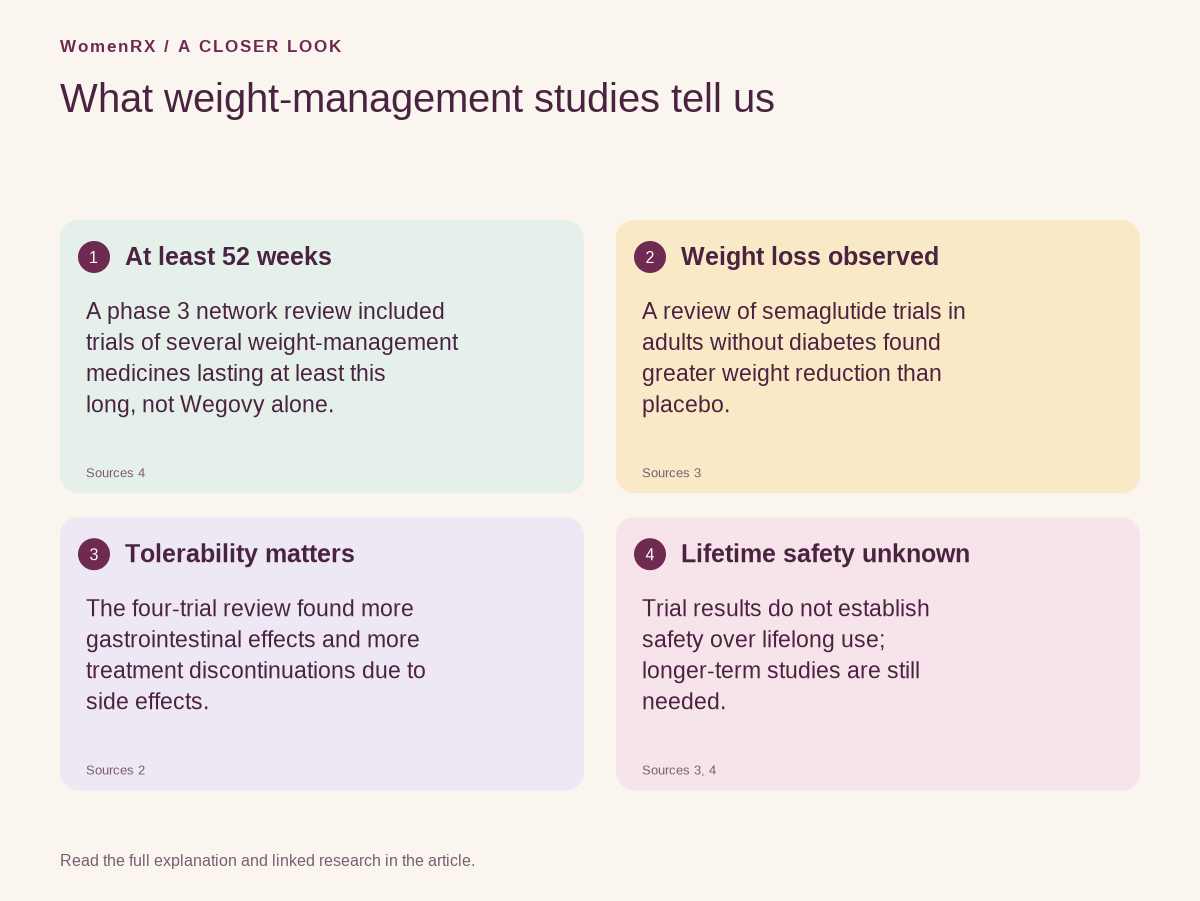
What weight-management studies tell us
At least 52 weeks: A phase 3 network review included trials of several weight-management medicines lasting at least this long, not Wegovy alone.4
Weight loss observed: A review of semaglutide trials in adults without diabetes found greater weight reduction than placebo.3
Tolerability matters: The four-trial review found more gastrointestinal effects and more treatment discontinuations due to side effects.2
Lifetime safety unknown: Trial results do not establish safety over lifelong use; longer-term studies are still needed.34
Read the figure as text
Separate observed weight-management trial findings from questions that need longer or more specific follow-up.- At least 52 weeks: A phase 3 network review included trials of several weight-management medicines lasting at least this long, not Wegovy alone.4
- Weight loss observed: A review of semaglutide trials in adults without diabetes found greater weight reduction than placebo.3
- Tolerability matters: The four-trial review found more gastrointestinal effects and more treatment discontinuations due to side effects.2
- Lifetime safety unknown: Trial results do not establish safety over lifelong use; longer-term studies are still needed.34
More questions, answered
Does a year or more of trial follow-up prove Wegovy is safe for life?
No. Weight-management trials lasting at least 52 weeks provide evidence about treatment over that studied period, but they do not establish lifetime safety. 4
How far ahead should I stop before a planned pregnancy?
US Wegovy prescribing information says to discontinue semaglutide at least two months before a planned pregnancy because of the potential for fetal harm. 1
Sources you can check
- WEGOVY (SEMAGLUTIDE) INJECTION, SOLUTION WEGOVY (SEMAGLUTIDE) TABLET [NOVO NORDISK PHARMACEUTICAL INDUSTRIES, LP] | US prescribing information and patient instructionsAccessed 2026-09-25Return to first citation
- Effectiveness & safety of semaglutide in weight reduction in obese nondiabetic patients: A systematic review and meta-analysis.Naz F, Qaiser F, Mumtaz A, Din SU, Mustafa A, Ullah A, Perveen A, Malik J. · Medicine · 2026Return to first citation
- Effects of subcutaneous semaglutide on weight loss and inflammatory markers in adults with overweight or obesity without diabetes: a systematic review and meta-analysis.Milluzzo A, Oteri V, Manuella L, Pulvirenti A, Frittitta L. · International journal of obesity (2005) · 2026Return to first citation
- Analysis of the efficacy and safety of liraglutide, semaglutide, and tirzepatide for the treatment of overweight and obesity: a systematic review and network meta-analysis.Pałka W, Moćko P, Śladowska K, Holko P, Kawalec P. · Journal of endocrinological investigation · 2026Return to first citation