Berberine Long-Term Use: What Safety Evidence Can Tell You
Human studies offer some short-term safety information, but they don’t establish what years of berberine use or combining it with glucose-lowering medicines means for you.
Berberine has been studied in human trials, including a six-month trial in adults with obesity and fatty liver disease who did not have diabetes. But participants first had to complete a 30-day berberine run-in; people who couldn’t tolerate it or had low adherence were excluded before randomization. A review reported side effects but didn’t establish risks with particular diabetes medicines or safety over years. Pregnancy and breastfeeding outcomes aren’t established by these findings. 4 5

A trial lasting months isn’t proof of safety for years
The clearest duration example here is a randomized trial in China: 337 adults with obesity and metabolic dysfunction-associated steatotic liver disease, all without diabetes, received berberine or placebo for six months. Before randomization, participants completed a 30-day berberine run-in. People who couldn’t tolerate berberine or whose adherence was below 80% were excluded. The similar adverse-event finding therefore applies to the selected participants who made it through that run-in, not everyone starting berberine. It offers some reassurance for those participants and that timeframe, but can’t settle what happens with use over several years or in people taking diabetes medication. 4
A separate review pooled 12 placebo-controlled trials involving 889 participants in trials evaluating components of metabolic syndrome. Ten trials reported safety information; two did not. The review found no significant difference in safety between berberine and placebo. That result is not the same as proving there are no risks: reporting was incomplete in some trials, and the review itself called for more rigorous research. 5
The practical distinction is simple: evidence from trials lasting months can describe what happened during those trials. It cannot establish a safe duration for ongoing use.
What side effects have been reported?
In the review, reported adverse events included hypoglycemia, nausea, constipation, and mild abdominal discomfort. The authors described the overall incidence as generally low. That description doesn’t tell you whether a particular symptom will occur for you. 5
Hypoglycemia means blood glucose that is too low. In people with diabetes, symptoms can include hunger and may come on quickly; severe episodes can cause serious complications. These findings don’t tell you how often low blood sugar occurred alongside a specific medicine. 1 5
If you take medicine for blood sugar
The medication question deserves a review before you add berberine. In the trials summarized in the review, berberine was associated with lower fasting blood glucose, and hypoglycemia appeared among the reported adverse events. That makes a possible additive effect with glucose-lowering treatment a reasonable concern, but these findings don’t establish the size of that risk or prove an interaction with a particular prescription. 5
Bring the exact supplement label and your full medication list to a pharmacist or prescriber. Ask specifically whether your regimen could make low blood sugar more likely and what to do if your readings or symptoms change. Don’t reduce or stop a prescribed diabetes medicine to make room for a supplement; changes to diabetes treatment can affect glucose control. 2 3
Pregnancy and breastfeeding are separate questions
The clinical findings described above don’t establish berberine’s safety during pregnancy or breastfeeding. The six-month trial involved people without diabetes and does not provide pregnancy or nursing outcomes in its summary; the trial review also doesn’t answer those questions. If you’re pregnant, trying to become pregnant, or breastfeeding, don’t treat these adult trial results as evidence that berberine is safe for that situation. 4 5
A focused review before ongoing use
For a useful medication review, have these details ready:
- The exact product: Bring the label, including the listed ingredients and amount per serving. Products can differ, and research findings may not apply to every formulation.
- Your medicines: Include prescriptions and other supplements, especially medicines used to lower blood glucose.
- Your reason for taking it: A result reported for one group or health measure doesn’t establish benefit for another purpose. In the six-month trial, for example, berberine did not significantly reduce visceral fat area or liver fat compared with placebo. 4
- Your plan for duration: Ask what evidence supports the intended period of use. A six-month trial is not a validated long-term schedule.
The useful takeaway isn’t that berberine is proven unsafe, or proven safe for ongoing use. It’s that some human safety data exist, but they leave important individual questions unanswered, especially when glucose-lowering medicines, pregnancy, or breastfeeding are involved.
What the duration evidence does and doesn’t answer
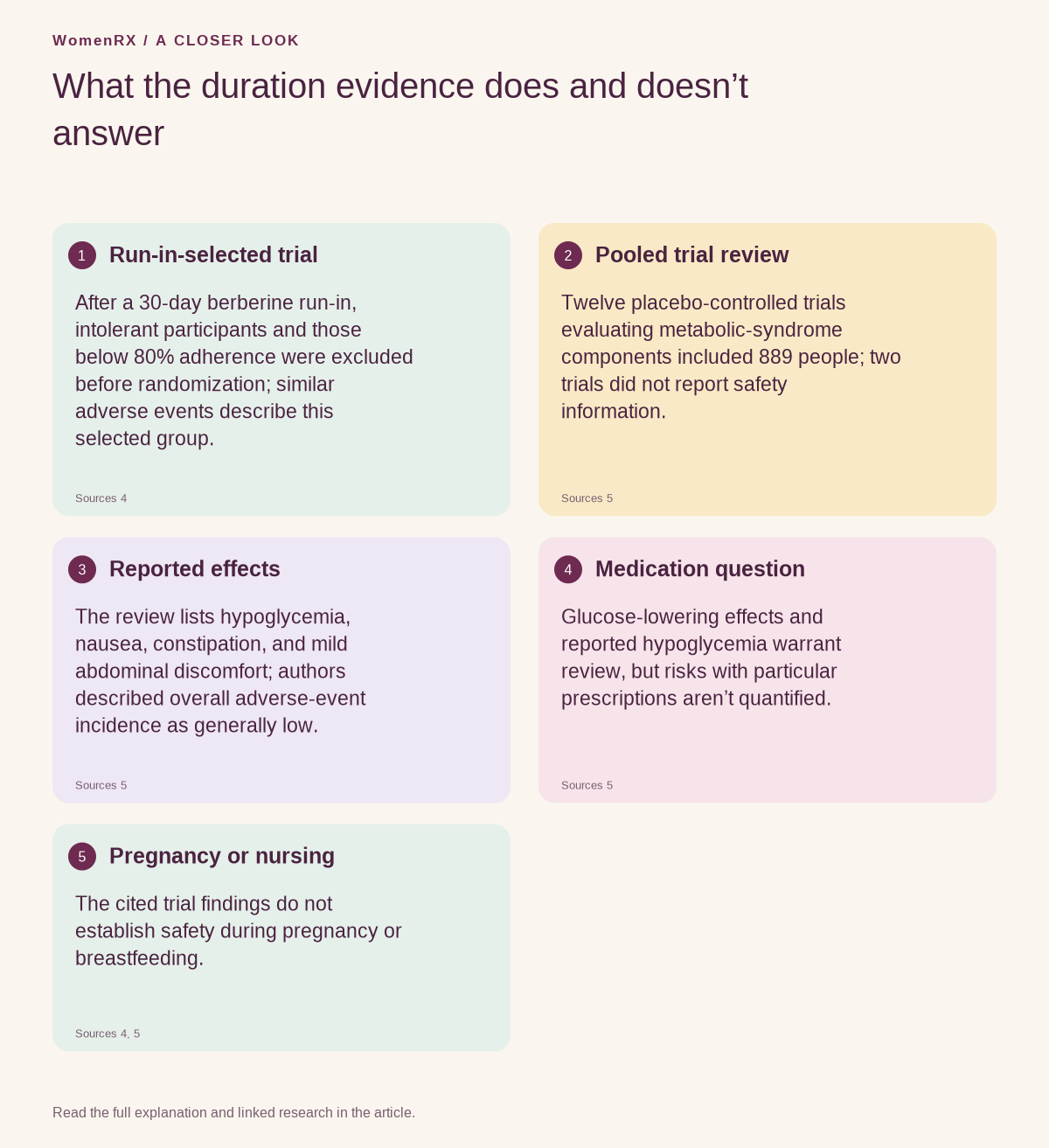
Run-in-selected trial: After a 30-day berberine run-in, intolerant participants and those below 80% adherence were excluded before randomization; similar adverse events describe this selected group.4
Pooled trial review: Twelve placebo-controlled trials evaluating metabolic-syndrome components included 889 people; two trials did not report safety information.5
Reported effects: The review lists hypoglycemia, nausea, constipation, and mild abdominal discomfort; authors described overall adverse-event incidence as generally low.5
Medication question: Glucose-lowering effects and reported hypoglycemia warrant review, but risks with particular prescriptions aren’t quantified.5
Pregnancy or nursing: The cited trial findings do not establish safety during pregnancy or breastfeeding.45
Read the figure as text
Compare the human trial findings with the safety questions that still need an individual medication review.- Run-in-selected trial: After a 30-day berberine run-in, intolerant participants and those below 80% adherence were excluded before randomization; similar adverse events describe this selected group.4
- Pooled trial review: Twelve placebo-controlled trials evaluating metabolic-syndrome components included 889 people; two trials did not report safety information.5
- Reported effects: The review lists hypoglycemia, nausea, constipation, and mild abdominal discomfort; authors described overall adverse-event incidence as generally low.5
- Medication question: Glucose-lowering effects and reported hypoglycemia warrant review, but risks with particular prescriptions aren’t quantified.5
- Pregnancy or nursing: The cited trial findings do not establish safety during pregnancy or breastfeeding.45
More questions, answered
Does similar safety between berberine and placebo mean there were no side effects?
No. The review found no significant difference in overall safety between groups, while also reporting events including hypoglycemia, nausea, constipation, and mild abdominal discomfort. Two of the 12 trials didn’t provide safety information, so the result doesn’t mean side effects never occurred. 5
Can the six-month study establish whether berberine is safe for years?
No. The trial reports what happened during six months in adults with obesity and fatty liver disease who did not have diabetes, after a 30-day berberine run-in that excluded people who couldn’t tolerate it or had adherence below 80%. It doesn’t establish safety over years or answer the question for people taking glucose-lowering medicines. 4
Sources you can check
- Hypoglycemia: MedlinePlusAccessed 2026-09-25Return to first citation
- GLIPIZIDE AND METFORMIN HYDROCHLORIDE TABLET, FILM COATED [REMEDYREPACK INC.] | US prescribing information and patient instructionsAccessed 2026-09-25Return to first citation
- DAPAGLIFLOZIN AND METFORMIN HYDROCHLORIDE TABLET, FILM COATED, EXTENDED RELEASE [SUN PHARMACEUTICAL INDUSTRIES, INC.] | US prescribing information and patient instructionsAccessed 2026-09-25Return to first citation
- Berberine and Adiposity in Diabetes-Free Individuals With Obesity and MASLD: A Randomized Clinical Trial.Lei L, Wang B, Zhao L, Li J, Yan X, Jiang J, Wang L, Ren G, Li Y, Cheng X, Yan X, Zhu Y, Guo Y, Zhong H, Zhang H, Li J, BRAVO Collaborative Group. · JAMA network open · 2026Return to first citation
- Efficacy and safety of berberine on the components of metabolic syndrome: a systematic review and meta-analysis of randomized placebo-controlled trials.Liu D, Zhao H, Zhang Y, Hu J, Xu H. · Frontiers in pharmacology · 2025Return to first citation