Berberine: Evidence, Safety, and What Women Should Know
Berberine has been studied for specific metabolic and reproductive-health outcomes, but results from those studies don’t establish a general benefit or safety for every woman.
Berberine has been studied as an add-on for metabolic measures and for some outcomes in women with PCOS and reduced fertility potential. Those findings are specific to the groups and outcomes studied; they don’t prove it treats a condition or benefits women generally. Human safety during pregnancy and breastfeeding isn’t established by the findings discussed here, and potential medicine interactions deserve an individual review. 1 3 6

What the research has actually tested
Berberine is a plant-derived compound studied in several different settings. The results are not one unified answer about whether it “works”: studies examine different populations, use it alongside different treatments, and measure different outcomes.
For women’s reproductive health, a 2024 meta-analysis combined 10 randomized trials involving 713 women with PCOS and reduced fertility potential. In those trials, berberine added to Western medicine was associated with higher ovulation and clinical pregnancy rates than Western medicine alone. These are promising findings for that particular treatment context, not proof that berberine improves fertility for all women or works on its own. The review also says further trials are needed. 1
Other research concerns metabolic markers, not reproductive health. In a meta-analysis of three randomized trials involving 233 people with schizophrenia and metabolic syndrome, add-on berberine was associated with improvements in some measures, including fasting glucose and triglycerides, compared with controls. It did not significantly improve every measure assessed, including HbA1c or blood pressure. These results are specific to people with schizophrenia taking antipsychotic treatment; they don’t establish the same effects in other groups. 6
A network meta-analysis of trials in adults with fatty liver disease reported changes in some liver-enzyme measures with berberine. Liver enzymes are laboratory markers, and this analysis does not establish that berberine prevents disease progression or improves how people feel. 5
Taken together, these studies offer reasons for further research, not a single established use. An outcome in one group, such as a change in a blood test or a clinical pregnancy rate, shouldn’t be treated as evidence for a different goal.
Safety means looking at the whole medication picture
Some human research reports berberine was generally tolerated, with side effects described as predominantly mild and gastrointestinal. That doesn’t settle long-term safety for everyone: tolerability findings from particular trials and treatment settings may not apply to a different person, product, or combination of medicines. 4 6
Interaction risk is also not captured by a simple list of medicines to avoid. A toxicology review of Berberis plants and their alkaloids identifies drug interactions involving CYP450 enzymes and P-glycoprotein as factors that can affect safety. It does not provide a reliable, medication-by-medication interaction list for every berberine supplement. 3
Before considering it, bring a clinician or pharmacist the actual product label and a complete list of prescription medicines, over-the-counter medicines, and other supplements. Ask whether the product could affect any of your medicines or monitoring, and what benefit the evidence supports for your specific reason for considering it. Don’t assume that taking it as an add-on in a trial means it is safe to add to your own treatment.
Pregnancy, breastfeeding, and PCOS are different questions
The PCOS meta-analysis concerns women with reduced fertility potential and reports clinical pregnancy outcomes. It does not establish berberine as a stand-alone fertility treatment, or show that its use is safe during pregnancy. 1
A laboratory study exposed rat embryos to berberine and observed a slowed embryonic heart rate. This is preclinical evidence, not a human pregnancy study, and it cannot tell us what a person’s risk would be. 2 The human findings discussed here do not establish safety during pregnancy or breastfeeding. If either applies, or could apply, treat that as a separate safety question before considering a supplement rather than relying on results from PCOS or metabolic studies.
For PCOS, ask what outcome is being targeted: ovulation, clinical pregnancy, a blood test, or something else. The answer matters because evidence for one outcome does not automatically establish another. The available meta-analysis assessed berberine as an addition to Western medicine, so ask how its findings relate to the treatment you’re already using. 1
A useful decision check
Before deciding, get clear on four points: the specific outcome you want; whether research measured that outcome in people like you; how your medicines and supplements factor into potential interactions; and whether pregnancy or breastfeeding changes the decision. If those questions do not have clear answers, that uncertainty is part of the decision, not a reason to treat the supplement as proven.
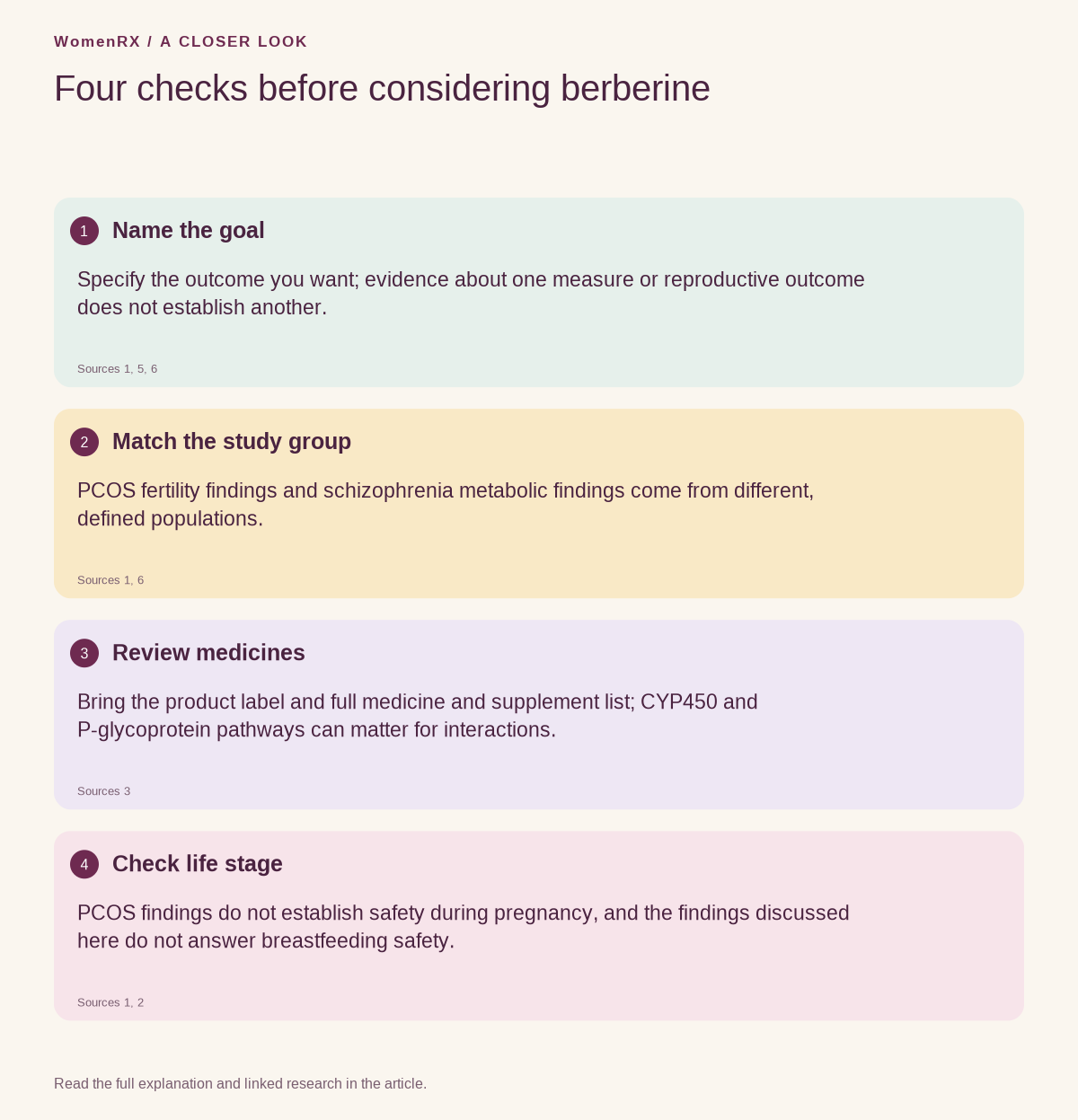
Four checks before considering berberine
Name the goal: Specify the outcome you want; evidence about one measure or reproductive outcome does not establish another.156
Match the study group: PCOS fertility findings and schizophrenia metabolic findings come from different, defined populations.16
Review medicines: Bring the product label and full medicine and supplement list; CYP450 and P-glycoprotein pathways can matter for interactions.3
Check life stage: PCOS findings do not establish safety during pregnancy, and the findings discussed here do not answer breastfeeding safety.12
Read the figure as text
Use these questions to separate the reason for considering berberine from the evidence and safety questions that still need individual attention.- Name the goal: Specify the outcome you want; evidence about one measure or reproductive outcome does not establish another.156
- Match the study group: PCOS fertility findings and schizophrenia metabolic findings come from different, defined populations.16
- Review medicines: Bring the product label and full medicine and supplement list; CYP450 and P-glycoprotein pathways can matter for interactions.3
- Check life stage: PCOS findings do not establish safety during pregnancy, and the findings discussed here do not answer breastfeeding safety.12
More questions, answered
Does berberine have evidence for PCOS?
A meta-analysis of 10 randomized trials in 713 women with PCOS and reduced fertility potential found higher ovulation and clinical pregnancy rates when berberine was added to Western medicine than with Western medicine alone. The authors say further trials are needed, so this does not establish berberine as a stand-alone treatment or show that it is right for every person with PCOS. 1
Do the studies establish that berberine is safe during pregnancy or breastfeeding?
No. The PCOS findings do not establish pregnancy safety, and a rat-embryo laboratory study cannot determine human risk. The human findings discussed here do not answer breastfeeding safety either. 1 2
Sources you can check
- Berberine as adjuvant therapy for treating reduced fertility potential in women with polycystic ovary syndrome: A meta-analysis of randomized controlled trials.Ha S, Song X. · Explore (New York, N.Y.) · 2024Return to first citation
- The Effect of Some Complementary Medicine Active Components on Rat Embryonic Heart Rate In Vitro.Ritchie HE, Xia A, Polson JW. · Birth defects research · 2026Return to first citation
- Balancing efficacy and risk: A toxicological review and safety transformation of Berberis plants and their alkaloids.Ma J, Lan X, Luo X, Jing Y, Yin Y, Du H, Li Q, Fan G. · Phytomedicine : international journal of phytotherapy and phytopharmacology · 2026Return to first citation
- Berberine as a Promising Antifungal Agent: Insights into Molecular Mechanisms and Therapeutic Potential.He J, Wang Q, Sun B, Velkov T, Shen J, Jiang H, Dai C. · ACS omega · 2026Return to first citation
- Comparative Efficacy of Herbal Products for Improving Liver Enzymes and Inflammation in Metabolic Dysfunction-Associated Steatotic Liver Disease: A Systematic Review and Network Meta-Analysis.Chen Liang A, Cruz Castillo Y, Fermin Madera MD, Sairaj RT, Medina J, Moreno Díaz TA, Chintamaneni S, Flores Monar G, Sanchez Cruz C, Advani R, Guha S, Calderón-Martinez E. · Gastro hep advances · 2026Return to first citation
- Adjunctive berberine for schizophrenia with metabolic syndrome: a systematic review and meta-analysis.Xie K, Tian W, Zhang Y, Zhang Y, Li J, Cao D, Pan W. · Frontiers in psychiatry · 2026Return to first citation