Berberine and Digestive Health: What the Evidence Shows
Berberine can change gut microbes, but that isn’t the same as proving it relieves digestive symptoms.
The human evidence described here doesn’t establish berberine as a treatment for common digestive symptoms or a general gut-health supplement. A small COVID-19 trial found no improvement in diarrhea or stomachache, while other human studies measured metabolic or thyroid outcomes alongside microbiome changes. Berberine can also cause gastrointestinal symptoms and interact with some medicines. 1234
A gut-microbe change isn’t a symptom benefit
A supplement claim may point to changes in gut bacteria and suggest that those changes improve digestion. Those are separate steps: a study can measure microbiome changes without showing that people feel less bloated, have less diarrhea, or improve in another digestive way.
That distinction matters in the human studies described here. A randomized trial involving 365 people with type 2 diabetes found that berberine combined with a probiotic improved certain post-meal blood lipid measures over three months. The study also examined gut microbes, but its outcome was blood lipids, not relief of digestive symptoms. It doesn’t show that berberine treats a digestive condition. 3
A small trial in 18 people with Graves’ disease compared methimazole alone with methimazole plus berberine. It reported changes in thyroid measures and gut microbiota, not improvement in digestive symptoms. These results cannot establish berberine as a gut treatment. 4
What was measured in a symptom trial?
One placebo-controlled trial did ask about diarrhea and stomachache, among other symptoms. It enrolled 40 outpatients being treated for COVID-19, not people recruited to test berberine for a digestive disorder. The trial found no significant difference between berberine and placebo in improvement of the reported symptoms, including diarrhea and stomachache. That is a limited finding in a specific illness, not a test of berberine for ongoing digestive symptoms. 2
So, when assessing a claim, check what the researchers actually measured:
- Digestive symptoms: Were symptoms such as diarrhea, constipation, or abdominal pain a main outcome, and did they improve compared with a control group?
- Microbiome: Did the study measure bacterial changes only, or connect those changes to a meaningful symptom improvement?
- Other health outcomes: Was the study about blood sugar, blood fats, or thyroid measures rather than digestion?
- The product tested: Was it berberine alone, or a combination with a probiotic or medicine? A combination result doesn’t show berberine alone had the same effect.
This is a more useful way to read “gut health” claims than treating any microbiome change as proof of better digestion.
Digestive side effects are part of the tradeoff
Berberine itself can cause nausea, diarrhea, constipation, gas, abdominal discomfort, or pain. In other words, a product taken for digestion may cause symptoms that overlap with the problem you’re trying to address. 1
Medication interactions matter too. A study in 17 healthy people found that berberine inhibited the drug-metabolizing enzymes CYP2D6, CYP2C9, and CYP3A4. A review also reports increased cyclosporine blood levels when it was taken with berberine. If you take cyclosporine or a medicine whose handling depends on these pathways, check the specific combination with your prescriber or pharmacist before using berberine. 1
These studies don’t establish whether berberine is safe during pregnancy or breastfeeding. They also don’t report enough information to tell whether women respond differently. A digestive or microbiome result in a mixed or unreported-sex group shouldn’t be presented as a benefit specific to women. 234
A practical way to weigh a berberine claim
Before treating a label or post as evidence, ask three things: Does a human study test the digestive symptom you have? Does it show symptom improvement, rather than only a change in bacteria or a lab measure? And does the study test the same ingredients as the product being promoted?
The human findings described here don’t answer those questions for a general digestive-health benefit. They show why the distinction matters: microbiome findings can accompany changes in other health measures, while a trial that measured diarrhea and stomachache in a different illness did not find symptom improvement. Meanwhile, gastrointestinal side effects and specific medication interactions are real considerations. 1234
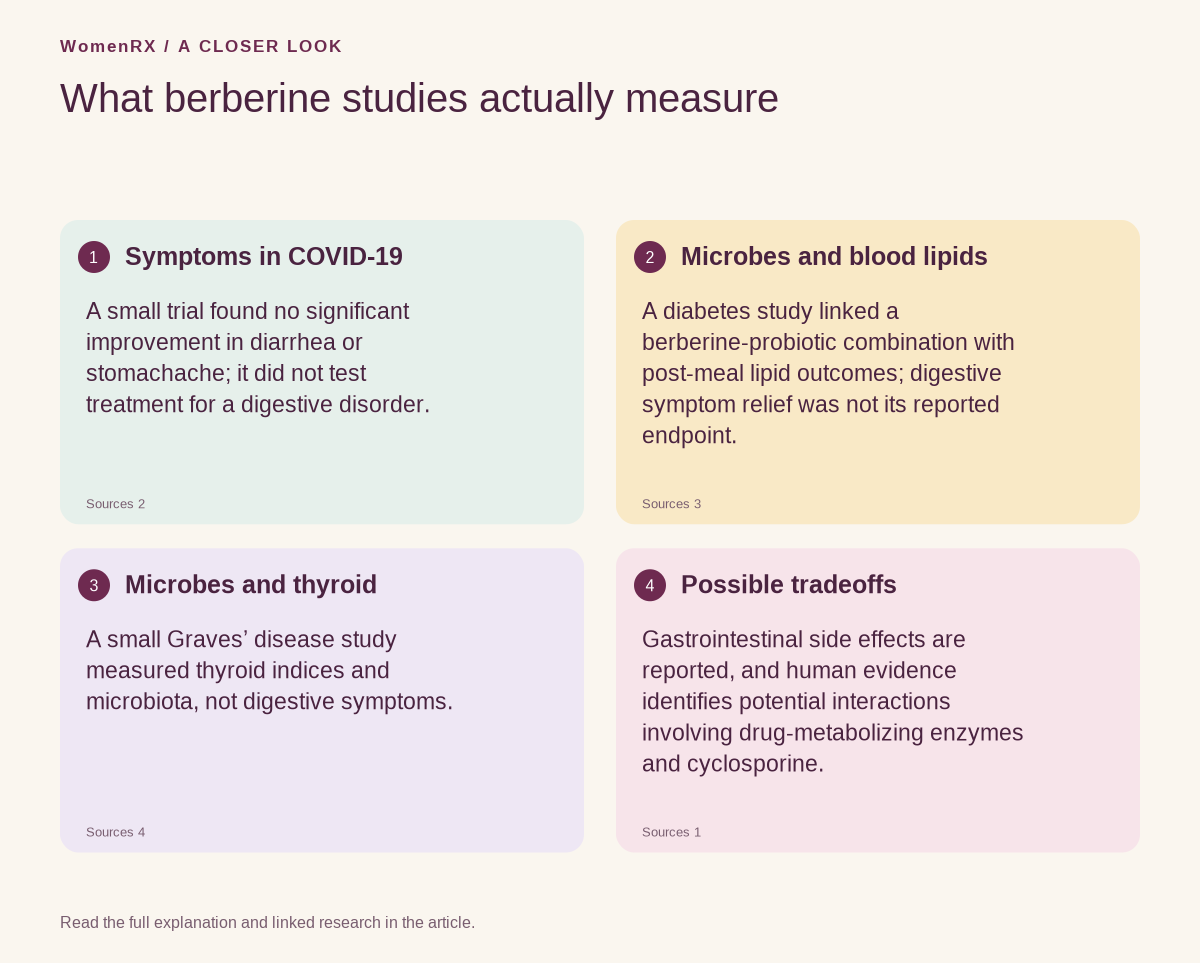
What berberine studies actually measure
Symptoms in COVID-19: A small trial found no significant improvement in diarrhea or stomachache; it did not test treatment for a digestive disorder.2
Microbes and blood lipids: A diabetes study linked a berberine-probiotic combination with post-meal lipid outcomes; digestive symptom relief was not its reported endpoint.3
Microbes and thyroid: A small Graves’ disease study measured thyroid indices and microbiota, not digestive symptoms.4
Possible tradeoffs: Gastrointestinal side effects are reported, and human evidence identifies potential interactions involving drug-metabolizing enzymes and cyclosporine.1
Read the figure as text
These study findings separate digestive symptoms from microbiome changes and outcomes that are not digestive treatment evidence.- Symptoms in COVID-19: A small trial found no significant improvement in diarrhea or stomachache; it did not test treatment for a digestive disorder.2
- Microbes and blood lipids: A diabetes study linked a berberine-probiotic combination with post-meal lipid outcomes; digestive symptom relief was not its reported endpoint.3
- Microbes and thyroid: A small Graves’ disease study measured thyroid indices and microbiota, not digestive symptoms.4
- Possible tradeoffs: Gastrointestinal side effects are reported, and human evidence identifies potential interactions involving drug-metabolizing enzymes and cyclosporine.1
More questions, answered
Does changing gut bacteria mean berberine improves digestion?
No. A measured microbiome change does not by itself show that symptoms improve. In the diabetes trial, the clinical outcome described was post-meal blood lipids, not digestive relief. 3
What should I check if I take prescription medicine?
Ask specifically about cyclosporine and medicines affected by CYP2D6, CYP2C9, or CYP3A4. Berberine inhibited these enzymes in a study of 17 healthy people, and a review reports increased cyclosporine blood levels with berberine. 1
Sources you can check
- Berberine's impact on health: Comprehensive biological, pharmacological, and nutritional perspectives.Asghari P, Babaei A, Zamanian N, Eshtivani EN. · Metabolism open · 2025Return to first citation
- Evaluation of berberine pellet effect on clinical recovery time in COVID-19 outpatients: A pilot clinical trial.Omidvar Tehrani S, Ghasemzadeh Rahbardar M, Shoorgashti K, Dehghan Nayeri MJ, Mohammadpour AH, Hosseinzadeh H. · Avicenna journal of phytomedicine · 2023Return to first citation
- Combined berberine and probiotic treatment as an effective regimen for improving postprandial hyperlipidemia in type 2 diabetes patients: a double blinded placebo controlled randomized study.Wang S, Ren H, Zhong H, Zhao X, Li C, Ma J, Gu X, Xue Y, Huang S, Yang J, Chen L, Chen G, Qu S, Liang J, Qin L, Huang Q, Peng Y, Li Q, Wang X, Zou Y, Shi Z, Li X, Li T, Yang H, Lai... · Gut microbes · 2022Return to first citation
- The Potential Prebiotic Berberine Combined With Methimazole Improved the Therapeutic Effect of Graves' Disease Patients Through Regulating the Intestinal Microbiome.Han Z, Cen C, Ou Q, Pan Y, Zhang J, Huo D, Chen K. · Frontiers in immunology · 2021Return to first citation