When to Take Berberine: Meals, Timing, and Safety
The human studies discussed here used particular berberine schedules, but didn’t compare meals or times of day to identify a preferable routine.
The human studies discussed here don’t compare berberine with versus without food or test one time of day against another, so they don’t identify a preferable schedule. One trial used a divided daily dose, but that doesn’t show divided dosing or a particular meal schedule is superior. Ask about the exact product and your medicines before settling on a routine. 12
What timing studies can, and can’t, tell you
If you’re trying to decide whether to take berberine with breakfast, before a meal, or at night, the short answer is that the human studies described here don’t test those options against each other. They therefore can’t establish an ideal time of day or whether food improves absorption, effectiveness, or stomach comfort.
In one 12-week randomized trial in people with type 2 diabetes, participants took berberine together with cinnamon in a divided daily dose. The study compared the supplement combination with placebo, not one dosing time or meal schedule with another. Its design can’t tell us whether taking berberine with meals matters. 1
A separate 30-day crossover study tested a particular micellar berberine product in 19 healthy participants. Participants took two capsules daily, but the reported study details don’t compare meal timing or morning versus evening use. Results for that specialized formulation also shouldn’t be assumed to apply to every berberine product. 2
What this means in practice: don’t treat a study schedule as proof of an optimal routine. If you and your clinician decide to use berberine, ask whether the directions for the specific product fit your situation. Don’t change a prescribed medicine’s timing, or assume that separating it from berberine by a few hours prevents an interaction.
Timing doesn’t remove interaction concerns
A review describes berberine’s effects on several cytochrome P450 enzymes, including CYP3A4/5 and CYP2D6, which help the body process medicines. That raises the possibility of interactions, but the review doesn’t test whether taking berberine at a different time from a medicine changes that risk. Have a clinician or pharmacist review your medication and supplement list before you start. The review raises a general interaction concern rather than verifying specific medicine-by-medicine combinations. 3
Pregnancy and breastfeeding call for extra care
A study of berberine in gestational diabetes used pregnant rats, not pregnant people. It can’t establish whether berberine is safe or effective during human pregnancy. 4 The human studies discussed here also don’t establish safety while breastfeeding. 12 If you’re pregnant or breastfeeding, get individualized advice before using berberine rather than relying on a dosing schedule from a non-pregnancy study.
A useful question to ask
You might ask: “For this exact berberine product, is there a reason I should take it with food, and could it interact with anything I use?” That keeps the discussion focused on your product and medicines without assuming that a popular timing routine has been tested.
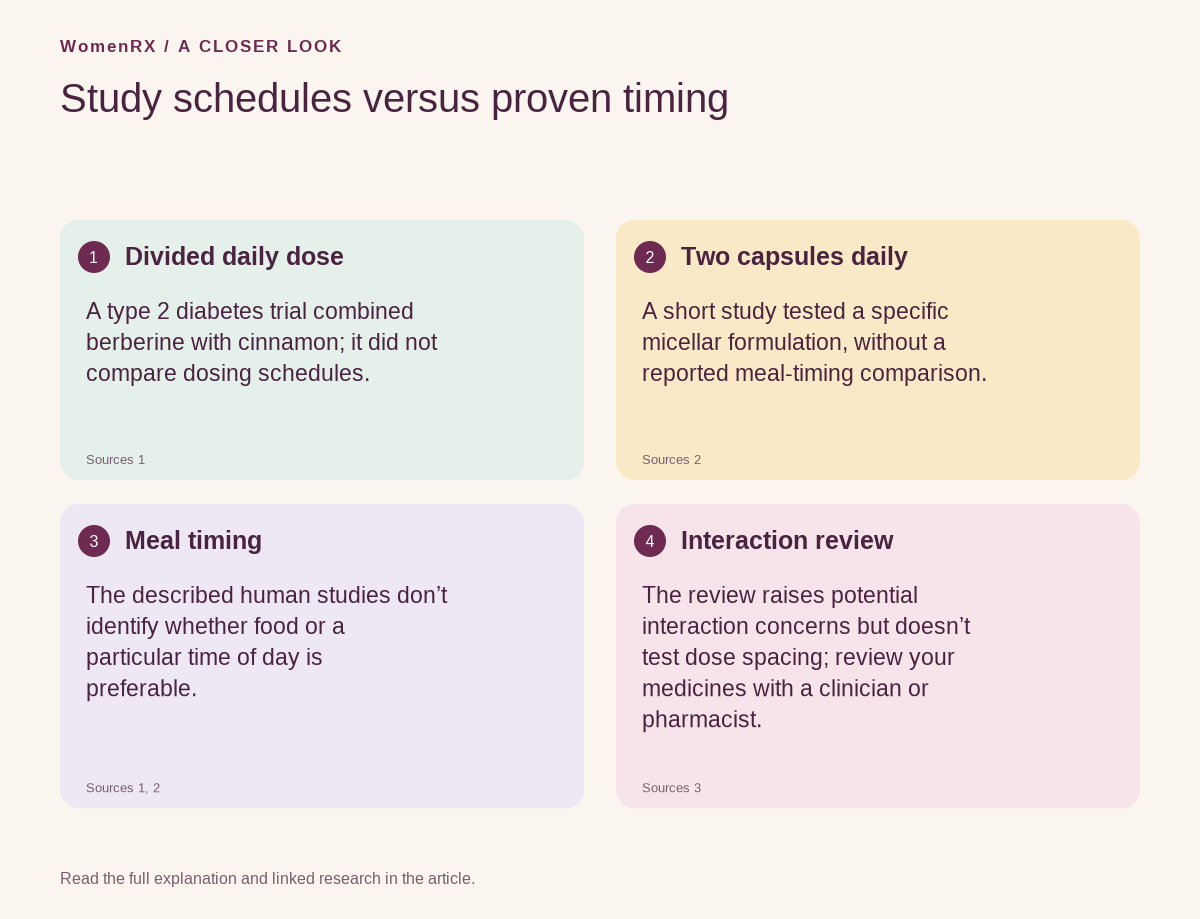
Study schedules versus proven timing
Divided daily dose: A type 2 diabetes trial combined berberine with cinnamon; it did not compare dosing schedules.1
Two capsules daily: A short study tested a specific micellar formulation, without a reported meal-timing comparison.2
Meal timing: The described human studies don’t identify whether food or a particular time of day is preferable.12
Interaction review: The review raises potential interaction concerns but doesn’t test dose spacing; review your medicines with a clinician or pharmacist.3
Read the figure as text
The reported study routines show what participants used, not which meal schedule or time of day works best.- Divided daily dose: A type 2 diabetes trial combined berberine with cinnamon; it did not compare dosing schedules.1
- Two capsules daily: A short study tested a specific micellar formulation, without a reported meal-timing comparison.2
- Meal timing: The described human studies don’t identify whether food or a particular time of day is preferable.12
- Interaction review: The review raises potential interaction concerns but doesn’t test dose spacing; review your medicines with a clinician or pharmacist.3
More questions, answered
Does taking berberine with food prevent side effects?
The human studies discussed here don’t compare side effects when berberine is taken with food versus without food, so they can’t show that meals prevent stomach problems. Ask about the directions for the specific product you’re considering. 12
Can I take berberine at a different time from my medicines?
The review that raises potential interaction concerns doesn’t test whether spacing doses changes the risk. Because berberine may affect enzymes involved in processing medicines, have a clinician or pharmacist review your medication list rather than relying on timing alone. 3
Sources you can check
- The efficacy and safety of berberine in combination with cinnamon supplementation in patients with type 2 diabetes: a randomized clinical trial.Mansour A, Sajjadi-Jazi SM, Gerami H, Khorasanian AS, Moalemzadeh B, Karimi S, Afrakoti NM, Mofid V, Mohajeri-Tehrani MR, Hekmatdoost A. · European journal of nutrition · 2025Return to first citation
- A 30-Day Randomized Crossover Human Study on the Safety and Tolerability of a New Micellar Berberine Formulation with Improved Bioavailability.Ibi A, Chang C, Kuo YC, Zhang Y, Du M, Roh YS, Gahler R, Hardy M, Solnier J. · Metabolites · 2025Return to first citation
- Effects of Berberis vulgaris, and its active constituent berberine on cytochrome P450: a review.Bathaei P, Imenshahidi M, Hosseinzadeh H. · Naunyn-Schmiedeberg's archives of pharmacology · 2025Return to first citation
- Protective effects of berberine-loaded chitosan/solid lipid nanoparticles in streptozotocin-induced gestational diabetes mellitus rats.Liu Y, Hussain SA, Yue H. · Experimental biology and medicine (Maywood, N.J.) · 2025Return to first citation