When to Take Berberine for Weight Loss
One combination trial used berberine before meals, but it didn’t compare that schedule with another.
The reported evidence doesn’t establish a best time to take berberine for weight loss. A 12-week trial used a combination containing berberine in two daily doses before main meals, but it did not compare schedules or test berberine by itself. A meta-analysis found a small average weight difference versus control, but its reported results don’t give a timing-specific finding. 1 3
If you’re weighing whether to take berberine before a meal, with food, or at another time, the reported evidence doesn’t establish which schedule is better for weight loss. A trial using one schedule can’t show that timing caused a difference, and the meta-analysis discussed below doesn’t report a timing-specific result. 1 3
What weight-loss studies suggest
A systematic review and meta-analysis of 23 articles reporting randomized trials in adults found that berberine was associated with an average body-weight difference of 0.88 kg less than control groups. The same analysis found a small average reduction in BMI. These are pooled results across trials, not a promise of what one person will lose. The reported results don’t identify an ideal time of day. The review also called for better reporting and noted limitations in trial methods. 3
One newer 12-week trial offers an example of why timing claims are hard to interpret. Adults with obesity took a combination of berberine, white mulberry leaf extract, and chromium in two daily doses before main meals. The combination group had greater reductions in BMI and body fat than the placebo group, but the study had no berberine-only group. It also didn’t compare before-meal use with taking the product during or after meals. So the findings can’t tell us whether berberine alone affected weight, or whether that schedule mattered. 1
“Before meals” isn’t proof of better timing
A study can use a particular schedule without testing whether that schedule is better. To show that meal timing changes weight outcomes, researchers would need to compare different schedules while keeping the treatment otherwise comparable. The cited trial didn’t do that.
So, “taken before meals” describes how the combination was used in that trial. It isn’t evidence that taking berberine before food, with food, or at a certain hour will produce more weight loss. Although men and women took part, the reported results aren’t broken out by sex for weight or timing. 1
Pregnancy and breastfeeding are separate questions
Weight-loss findings don’t establish safety during pregnancy or while breastfeeding. The trial described above excluded people who were pregnant or breastfeeding, so it can’t answer those safety questions. 1
For breastfeeding, there is a specific concern in a review of goldenseal, a plant that contains berberine: berberine can displace bilirubin from blood proteins, raising a concern about possible exposure for a newborn. The amount that could pass from a mother to an infant is unknown, and this information is about goldenseal rather than a trial of berberine supplements in breastfeeding women. It’s a reason not to assume these products are safe for a nursing parent or newborn. 2
The useful takeaway
Pooled adult trials found a small average weight difference, but the results reported in the meta-analysis don’t establish a preferred time to take berberine. One combination-product trial used a before-meal schedule, but didn’t compare timing or isolate berberine. Treat that schedule as a description of the trial, not as proof that it improves weight loss. 1 3
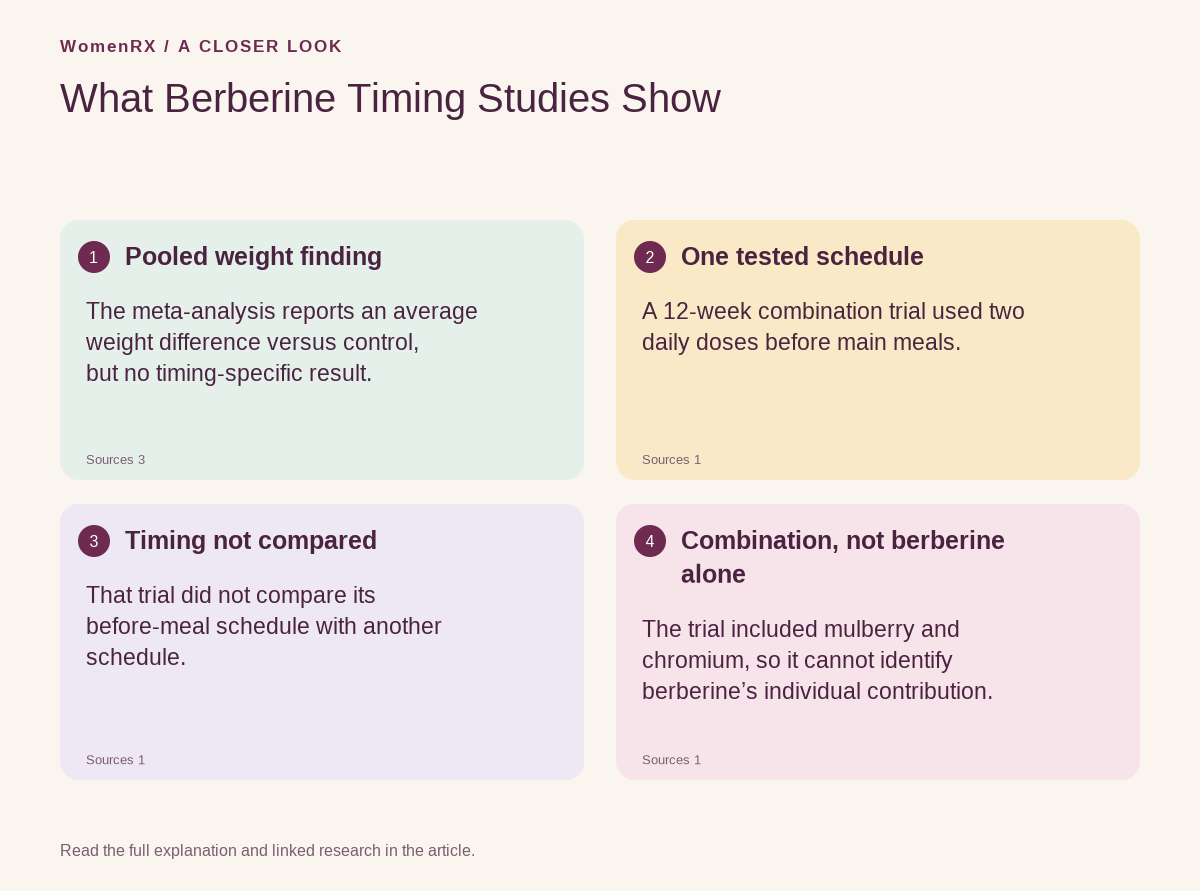
What Berberine Timing Studies Show
Pooled weight finding: The meta-analysis reports an average weight difference versus control, but no timing-specific result.3
One tested schedule: A 12-week combination trial used two daily doses before main meals.1
Timing not compared: That trial did not compare its before-meal schedule with another schedule.1
Combination, not berberine alone: The trial included mulberry and chromium, so it cannot identify berberine’s individual contribution.1
Read the figure as text
These distinctions separate weight findings from the question of whether meal timing changes them.- Pooled weight finding: The meta-analysis reports an average weight difference versus control, but no timing-specific result.3
- One tested schedule: A 12-week combination trial used two daily doses before main meals.1
- Timing not compared: That trial did not compare its before-meal schedule with another schedule.1
- Combination, not berberine alone: The trial included mulberry and chromium, so it cannot identify berberine’s individual contribution.1
More questions, answered
Does taking berberine with meals help with weight loss?
The reported trial used two daily doses of a combination product before main meals, but it didn’t compare that schedule with taking it at another time. Its results can’t show whether meal timing improves weight loss. 1
Sources you can check
- Effects of Berberine, White Mulberry Leaf Extract and Chromium Picolinate on Body Composition and Insulin Resistance in Adults with Obesity: A Randomized Controlled Trial.Xenos K, Chalkias K, Chryssou G, Alexandrou E, Vassilopoulou E. · Nutrients · 2026Return to first citation
- Goldenseal2006Return to first citation
- The effect of berberine on obesity indices: a systematic review and meta-analysis.Elahi Vahed I, Shahir-Roudi E, Nojumi S, Golmohammadi S, Moradi Shahrebabak M, Sharafi Tafreshi Moghadam N, Bagheryan AS, Moftakhar M, Shamsipour F, Jafari M, Soltaninejad H, Rahma... · International journal of obesity (2005) · 2026Return to first citation