Berberine for Weight Loss: What the Trials Show
The clearest weight findings come from short trials in specific groups or from products that contain more than berberine.
Berberine hasn’t been shown to produce reliable, lasting weight loss. A small trial of berberine alone found no significant weight effect, while a positive trial studied weight gain associated with antipsychotic treatment. Other trials tested multi-ingredient products, so their results can’t be credited to berberine. The reported results don’t establish a weight-loss effect specifically for women. 2 3 4 5
First, separate the weight claim from the metabolic claim
You may see berberine promoted for weight, blood sugar, and cholesterol as though a change in one proves a change in the others. It doesn’t. A trial can find a difference in a blood test without finding a difference on the scale. The useful question is whether researchers measured weight, what product they tested, and who took it.
There’s another distinction: losing weight and slowing weight gain aren’t quite the same goal. That matters when you read a study of people whose medication has been associated with weight gain.
What changed in the weight trials?
In a randomized study of 50 people with nonalcoholic fatty liver disease, one group received berberine and the other did not. Both groups had been advised on diet and physical activity. Researchers found no statistically significant difference in body weight between the groups. This small study doesn’t rule out every possible effect, but it doesn’t demonstrate a weight-loss benefit in that population. 5
A different randomized trial followed 113 people with schizophrenia-spectrum disorders who had developed metabolic syndrome while taking antipsychotic medication. After 12 weeks, the berberine group had a greater reduction in net weight than the placebo group; a difference was also reported at nine weeks. That’s a finding about medication-associated weight gain in a particular group, not a prediction of what will happen if you take berberine for general weight management. 3
Two other trials are easy to misread because their products contained berberine plus other ingredients. In a 12-week trial of 93 adults with obesity, a combination of berberine, white mulberry leaf extract, and chromium led to greater reductions in BMI and body-fat measures than placebo. The study had no berberine-only group, so it cannot tell us which ingredient contributed to those changes. Its main outcome was insulin sensitivity, not weight loss. 2
In another 12-week trial, 102 adults with elevated cholesterol received dietary recommendations and either placebo or a product containing berberine and five other ingredients. The product group had a mean weight difference of 0.93 kg less than the control group at 12 weeks. That’s a result for the entire product in that setting, not evidence that berberine alone produces that change. The trial’s main focus was cholesterol. 4
These results don’t add up to a dependable estimate of weight loss from berberine alone. The three trials with stated 12-week follow-up also cannot establish whether a change would last. 2 3 4
What do they tell us about women and safety?
The obesity combination trial included men and women, and the cholesterol-product trial included 70 women among its 102 participants. The reported results do not provide a separate weight-effect estimate for women. Including women in a trial isn’t the same as showing how well a product works for women, or whether results differ across life stages. 2 4
There is a limited reassuring observation: in the 113-person antipsychotic-associated weight-gain trial, researchers reported no serious adverse events with berberine over 12 weeks. That finding applies to the people and timeframe studied. It doesn’t establish long-term safety or safety during pregnancy or breastfeeding. 3
The obesity combination trial excluded people who were pregnant, breastfeeding, or planning to conceive. It also excluded people taking anticoagulant or antiplatelet therapy and certain medicines affecting weight or glucose. Those exclusions identify situations the trial can’t speak to; they do not prove a drug interaction or prove harm in pregnancy. If you’re pregnant or breastfeeding, these weight findings aren’t a sound basis for using berberine to lose weight. If you take medication, use the exact supplement ingredient list when asking whether a product fits with your treatment. 2
Compare the claim with the goal you actually have
Before buying a product, ask four questions: Was this ingredient on its own tested? Was body weight measured, rather than only glucose or cholesterol? Were the participants dealing with a condition like yours? And was follow-up long enough to answer your question about keeping weight off?
It’s also worth deciding what you want a weight plan to improve. Body weight includes muscle, bone, fat, and water, so a scale change alone doesn’t describe the whole picture. Your health history, nutrition, activity, and goals can shape a more useful plan; a registered dietitian can help with the nutrition part. If you’re comparing that approach with a supplement or a medical weight-management option, ask what outcome each option has been shown to change, in whom, and for how long. 1
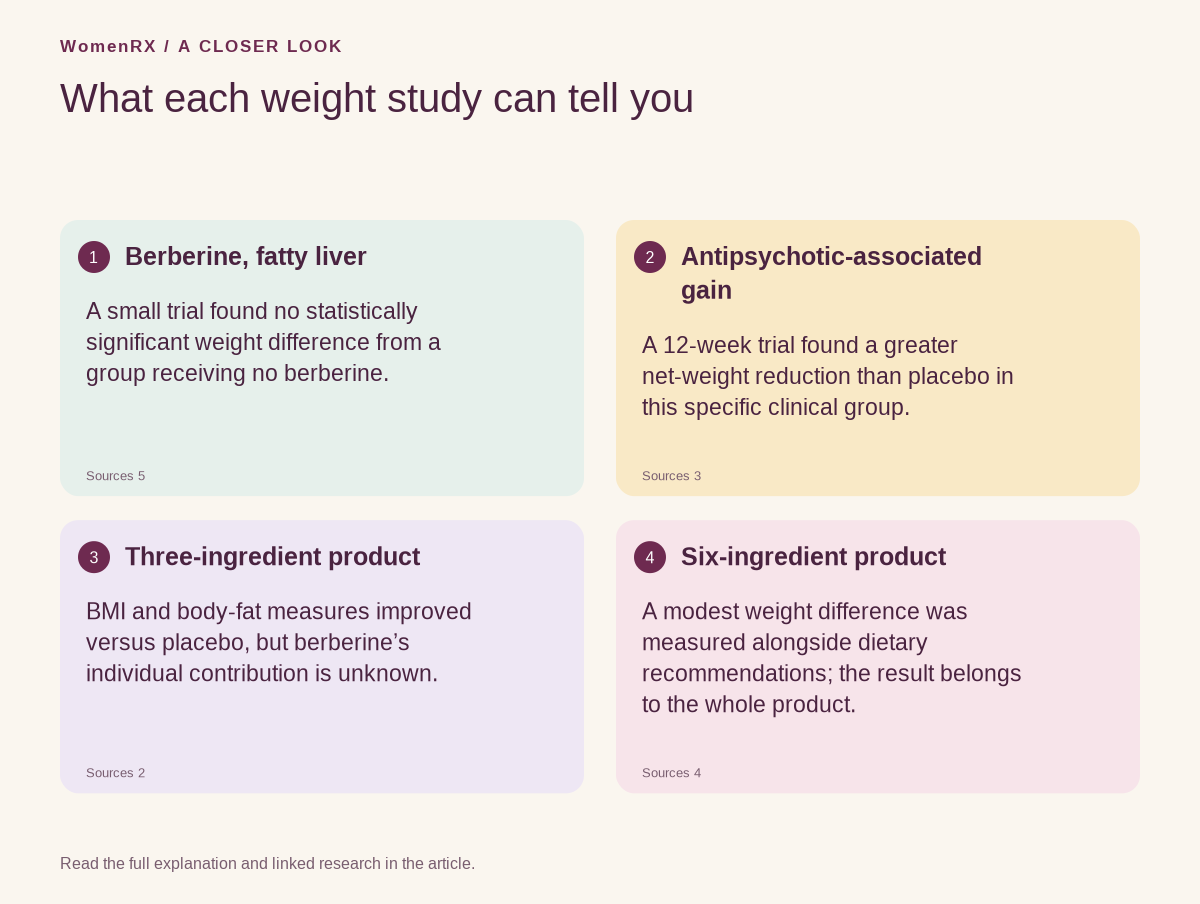
What each weight study can tell you
Berberine, fatty liver: A small trial found no statistically significant weight difference from a group receiving no berberine.5
Antipsychotic-associated gain: A 12-week trial found a greater net-weight reduction than placebo in this specific clinical group.3
Three-ingredient product: BMI and body-fat measures improved versus placebo, but berberine’s individual contribution is unknown.2
Six-ingredient product: A modest weight difference was measured alongside dietary recommendations; the result belongs to the whole product.4
Read the figure as text
The product and the reason participants were studied change how useful each result is for a general weight-loss claim.- Berberine, fatty liver: A small trial found no statistically significant weight difference from a group receiving no berberine.5
- Antipsychotic-associated gain: A 12-week trial found a greater net-weight reduction than placebo in this specific clinical group.3
- Three-ingredient product: BMI and body-fat measures improved versus placebo, but berberine’s individual contribution is unknown.2
- Six-ingredient product: A modest weight difference was measured alongside dietary recommendations; the result belongs to the whole product.4
More questions, answered
Do improvements in blood sugar or cholesterol mean berberine causes weight loss?
No. They’re different outcomes. For example, the berberine-and-mulberry combination trial primarily studied insulin sensitivity and also measured BMI and body composition; it cannot isolate a weight effect from berberine alone. 2
Sources you can check
- Body Weight: MedlinePlusAccessed 2026-09-25Return to first citation
- Effects of Berberine, White Mulberry Leaf Extract and Chromium Picolinate on Body Composition and Insulin Resistance in Adults with Obesity: A Randomized Controlled Trial.Xenos K, Chalkias K, Chryssou G, Alexandrou E, Vassilopoulou E. · Nutrients · 2026Return to first citation
- Adjunctive berberine reduces antipsychotic-associated weight gain and metabolic syndrome in patients with schizophrenia: a randomized controlled trial.Chan M, Qin Z, Man SC, Lam M, Lai WH, Ng RMK, Lee CK, Wong TL, Lee EHM, Wong HK, Feng Y, Liu L, Han F, Chen EYH, Zhang ZJ. · Psychiatry and clinical neurosciences · 2022Return to first citation
- Effects of poly-bioactive compounds on lipid profile and body weight in a moderately hypercholesterolemic population with low cardiovascular disease risk: a multicenter randomized trial.Solà R, Valls RM, Puzo J, Calabuig JR, Brea A, Pedret A, Moriña D, Villar J, Millán J, Anguera A. · PloS one · 2014Return to first citation
- The Effect of Berberine on Lipid Profile, Liver Enzymes, and Fasting Blood Glucose in Patients with Non-alcoholic Fatty Liver Disease (NAFLD): A Randomized Controlled Trial.Nejati L, Movahedi A, Salari G, Moeineddin R, Nejati P. · Medical journal of the Islamic Republic of Iran · 2022Return to first citation