What Human Studies Say About NAC and Weight
One small trial measured weight, but it tested NAC as part of a multi-ingredient supplement alongside a weight-loss diet.
The trial described here doesn’t show that NAC by itself causes weight loss or gain. In a small study of people with metabolic syndrome, both groups lost weight while following a weight-reduction diet; one group also took a four-ingredient supplement that included NAC. Weight-loss amounts and a between-group weight comparison weren’t reported, so NAC’s contribution can’t be determined. 2
What the weight study actually tested
A 2023 randomized trial enrolled 15 people with metabolic syndrome who were at risk of metabolic dysfunction-associated fatty liver disease and had an indication for weight reduction. One group followed a semipersonalized Mediterranean diet; the other followed the same diet and took MetioNac, a supplement containing S-adenosyl-L-methionine, NAC, thioctic acid, and vitamin B6. The researchers measured body weight as well as blood markers. 2
Both groups lost weight during the three-month study. But the reported results don’t say how much weight either group lost or give a clear comparison of weight change between the groups. That leaves the central question unanswered: did adding the supplement change weight beyond what happened with the diet alone? And even if there had been a difference between groups, the combination product wouldn’t show whether NAC or one of its other ingredients was responsible. 2
So this is a direct measurement of weight, but not a clean test of NAC’s effect on weight. The study was small, everyone was following a weight-reduction diet, and NAC wasn’t given on its own. Its result shouldn’t be read as proof that NAC causes weight loss, prevents weight gain, or has no effect at all. 2
Lab changes aren’t weight changes
The supplement group had reported improvements in several blood measures compared with the diet-only group, including triglycerides, cholesterol measures, and glucose. Those findings concern metabolic markers; they don’t establish that the supplement produced extra weight loss. Because MetioNac contained four ingredients, those reported marker changes can’t be attributed to NAC alone either. 2
That distinction matters when a study discusses “metabolic” outcomes alongside weight. A change in a blood test is not itself a change on the scale, and neither result automatically explains the other. For this trial, the weight finding was simply that loss occurred in both groups; the reported results don’t establish whether one group lost more. 2
What this means for your situation
This finding comes from a very specific group: people with metabolic syndrome who were at risk for fatty liver disease and following a weight-reduction diet. It doesn’t tell us whether NAC changes weight in people without that diagnosis, in women with other conditions, or when NAC is taken by itself. No separate weight result for women was reported, so the study can’t answer whether the result differs by sex. 2
If you’re trying to make sense of a change on the scale while taking NAC, this trial can’t tell you whether NAC is the reason. Body weight includes muscle, bone, fat, and water, so the number alone doesn’t show which part changed. 1 In practical terms, a study that could answer the NAC question more clearly would need to compare NAC alone with a control and report the amount of weight change in each group, along with the difference between them. A women-specific result would also be needed to draw conclusions about women separately.
For now, the useful takeaway is narrow: one small trial measured weight while testing a multi-ingredient supplement alongside a diet, and its reported results don’t isolate NAC’s effect. It offers no reliable basis for expecting NAC to make you lose or gain weight. 2
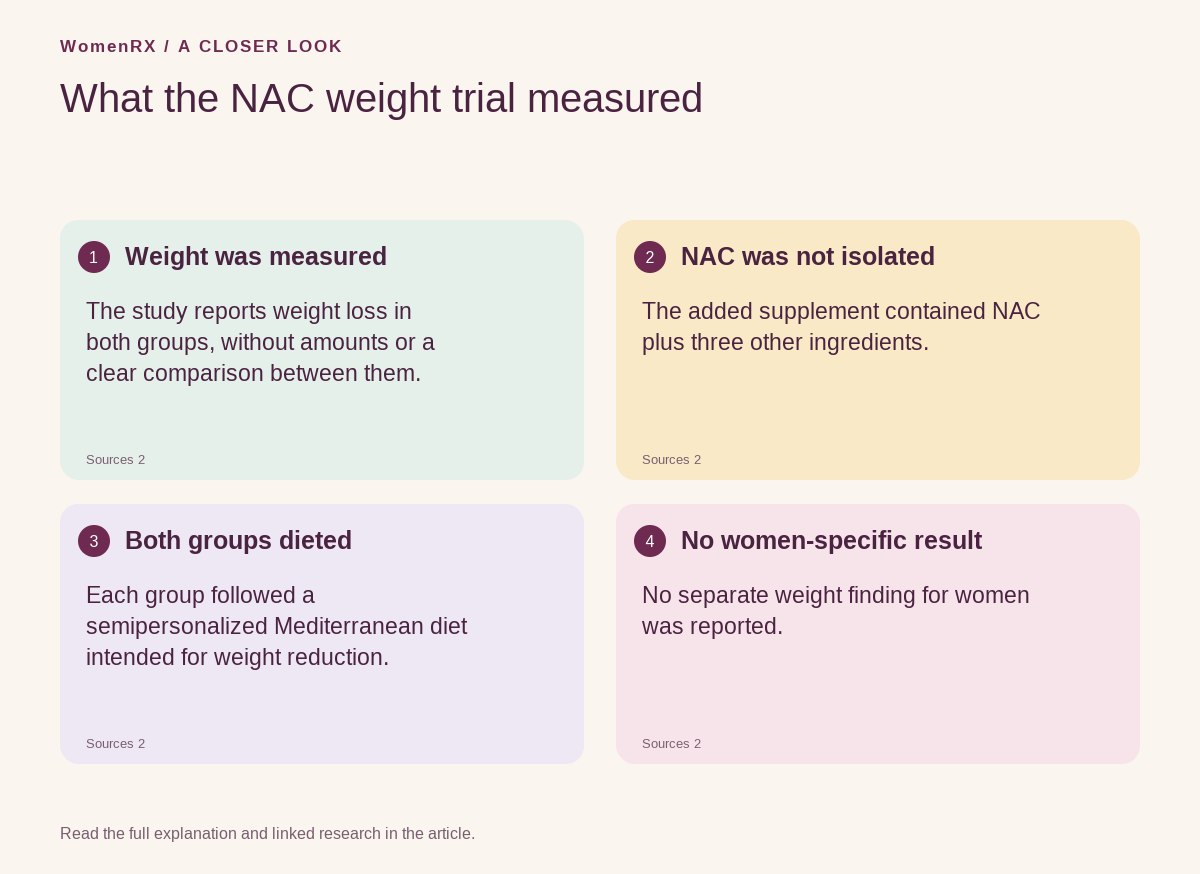
What the NAC weight trial measured
Weight was measured: The study reports weight loss in both groups, without amounts or a clear comparison between them.2
NAC was not isolated: The added supplement contained NAC plus three other ingredients.2
Both groups dieted: Each group followed a semipersonalized Mediterranean diet intended for weight reduction.2
No women-specific result: No separate weight finding for women was reported.2
Read the figure as text
The small trial measured body weight, but its design leaves NAC’s independent contribution unclear.- Weight was measured: The study reports weight loss in both groups, without amounts or a clear comparison between them.2
- NAC was not isolated: The added supplement contained NAC plus three other ingredients.2
- Both groups dieted: Each group followed a semipersonalized Mediterranean diet intended for weight reduction.2
- No women-specific result: No separate weight finding for women was reported.2
Sources you can check
- Body Weight: MedlinePlusAccessed 2026-09-25Return to first citation
- Effect of MetioNac® in patients with metabolic syndrome who are at risk of metabolic dysfunction associated fatty liver disease: a randomized controlled trial.Garicano Vilar E, Sanz Rojo S, López Oliva S, Martínez S, Terrén Lora A, San Mauro Martin I. · Nutricion hospitalaria · 2023Return to first citation