NAC Supplements: What the Human Evidence Shows
NAC has a well-established medical role in acetaminophen poisoning, while fertility findings in PCOS apply to specific treatment plans, not to NAC as a proven stand-alone fertility supplement.
N-acetylcysteine (NAC) is used as a medical antidote for acetaminophen poisoning, a very different situation from taking an over-the-counter supplement. In women with PCOS, several trials suggest NAC may help as an add-on to supervised ovulation treatment, but the results are mixed and don’t establish that a supplement alone improves fertility, PCOS symptoms, or general antioxidant health. 3 5 6 7
The same ingredient can mean different things
N-acetylcysteine, often shortened to NAC or called acetylcysteine, is not one interchangeable treatment. In hospitals, clinicians use acetylcysteine as an antidote for acetaminophen poisoning. It is most commonly given intravenously in the United States, with treatment selected and monitored for the poisoning situation. That evidence supports a specific medical use, not a general “detox” benefit from taking a supplement. 3 4
An over-the-counter NAC product is a different decision. Evidence for a medicine given in a poisoning emergency cannot be transferred automatically to a supplement taken for fertility, PCOS, or antioxidant support. The formulation, setting, purpose, and evidence all matter.
What PCOS fertility studies actually tested
There is some human evidence for NAC as an add-on during ovulation induction for women with PCOS. Two placebo-controlled trials studied NAC alongside fertility medicines: one paired it with clomiphene in 180 women, and another paired it with letrozole in 130 women. Both reported better ovulation and pregnancy outcomes in the NAC groups. These were specific, medically supervised treatment plans, not trials of NAC on its own. 6 7
A newer randomized comparison included 230 women with PCOS undergoing ovulation induction using letrozole followed by follicle-stimulating hormone. The study reported higher clinical pregnancy rates with NAC, as well as lower average follicle-stimulating hormone dose and treatment duration. The reported results don’t establish that the same benefit would occur with a store-bought product used without ovulation treatment. 5
The findings aren’t fully consistent. The newer trial’s review of previous research describes one earlier trial with improved ovulation and pregnancy outcomes, and another that did not find improved clinical pregnancy rates with a different induction protocol. Differences in the fertility medicines and study design make it hard to turn these results into a broad claim that NAC “boosts fertility.” 5
The practical takeaway: if you have PCOS and are discussing ovulation treatment, NAC is a question for the clinician managing that treatment. The studies tested it as an add-on to specific protocols. They don’t show that NAC treats all PCOS features, improves fertility for everyone with PCOS, or increases the chance of a live birth. 5 6 7
What these studies don’t establish
A proposed antioxidant or insulin-related mechanism isn’t the same as proof of a meaningful benefit for you. The PCOS research here focuses mainly on NAC alongside ovulation induction. It doesn’t establish a general antioxidant benefit for healthy people, or a reliable improvement in PCOS symptoms or metabolic health from taking NAC as a supplement. 5 6 7
The trial findings also shouldn’t be treated as a dose guide. The studies used specific amounts and schedules as part of monitored fertility protocols. That doesn’t tell you which consumer product, formulation, or schedule to choose, or whether using one without the rest of the treatment plan is beneficial.
Pregnancy, breastfeeding, and treatment discussions
If you’re trying to conceive, planning fertility treatment, pregnant, or breastfeeding, bring NAC up before starting it. Pregnancy medicine guidance includes supplements in the conversation about potential risks and benefits, and MedlinePlus advises checking medicines and supplements during pregnancy. MedlinePlus also recommends checking about medicines that could pass into breast milk. Those general recommendations don’t establish NAC-specific safety during pregnancy or breastfeeding. 1 2
For a specific advertised purpose, ask what evidence supports that use, whether it comes from a supplement or a supervised medical treatment, and whether the study population and treatment match your situation. For a PCOS fertility claim, the key distinction is whether NAC was studied alone or as an add-on to ovulation induction. In the trials described here, it was the add-on.
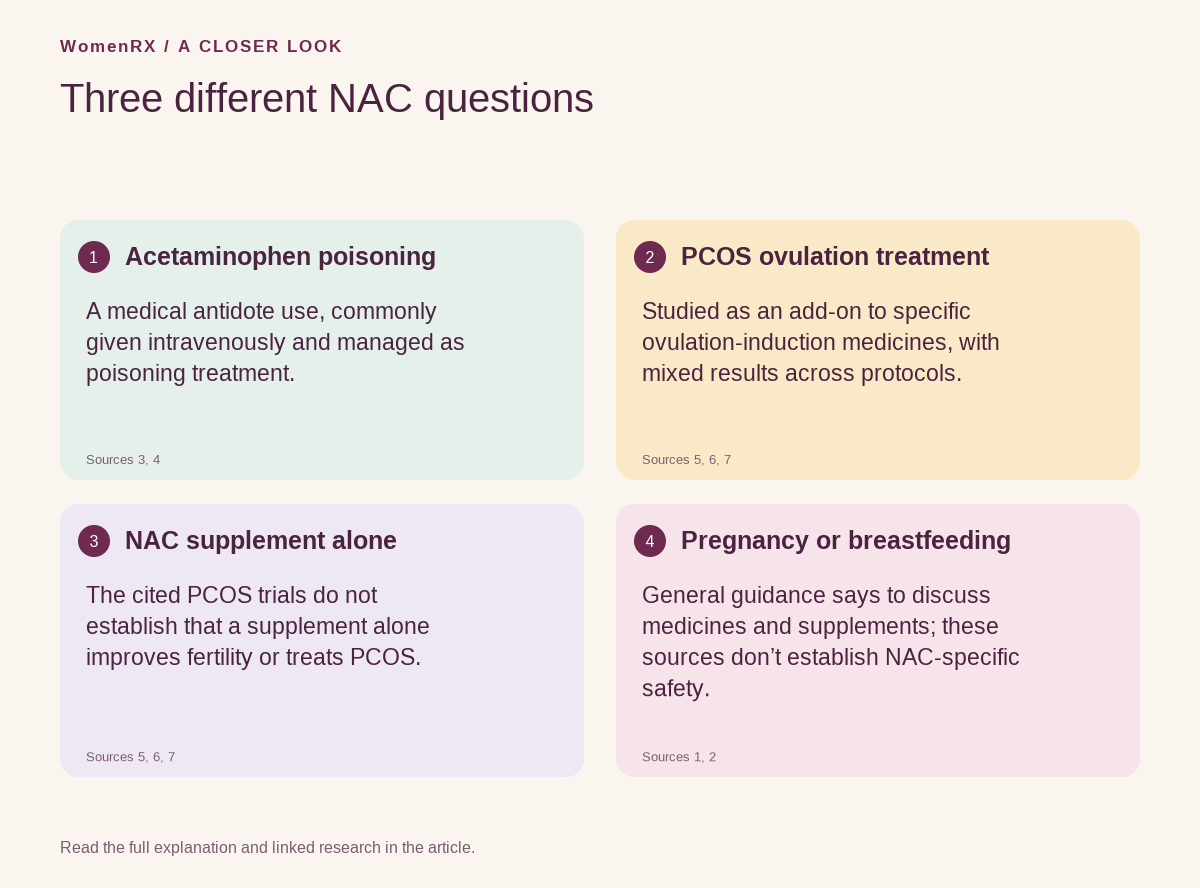
Three different NAC questions
Acetaminophen poisoning: A medical antidote use, commonly given intravenously and managed as poisoning treatment.34
PCOS ovulation treatment: Studied as an add-on to specific ovulation-induction medicines, with mixed results across protocols.567
NAC supplement alone: The cited PCOS trials do not establish that a supplement alone improves fertility or treats PCOS.567
Pregnancy or breastfeeding: General guidance says to discuss medicines and supplements; these sources don’t establish NAC-specific safety.12
Read the figure as text
The ingredient name alone doesn’t tell you whether evidence for one use applies to another. Compare the purpose, setting, and what the research actually tested.- Acetaminophen poisoning: A medical antidote use, commonly given intravenously and managed as poisoning treatment.34
- PCOS ovulation treatment: Studied as an add-on to specific ovulation-induction medicines, with mixed results across protocols.567
- NAC supplement alone: The cited PCOS trials do not establish that a supplement alone improves fertility or treats PCOS.567
- Pregnancy or breastfeeding: General guidance says to discuss medicines and supplements; these sources don’t establish NAC-specific safety.12
More questions, answered
Does NAC alone improve fertility in women with PCOS?
The trials described here studied NAC alongside ovulation-induction medicines, not as a stand-alone fertility treatment. They don’t establish that taking NAC alone improves fertility. 5 6 7
Is NAC used for acetaminophen poisoning the same as a supplement?
They contain the same named ingredient, but the medical use is a supervised antidote treatment for poisoning. Evidence for that use doesn’t establish a benefit from taking an over-the-counter NAC supplement for detox or another advertised purpose. 3 4
Sources you can check
- Breastfeeding | Benefits of Breastfeeding | MedlinePlusAccessed 2026-09-25Return to first citation
- Pregnancy and Medicines | MedlinePlusAccessed 2026-09-25Return to first citation
- Is Two Better Than Three? A Systematic Review of Two-bag Intravenous N-acetylcysteine Regimens for Acetaminophen Poisoning.Cole JB, Oakland CL, Lee SC, Considine KA, Rudis MI, Swanson AL, Olives TD. · The western journal of emergency medicine · 2023Return to first citation
- Metabolic and mitochondrial treatments for severe paracetamol poisoning: a systematic review.Mullins ME, Yeager LH, Freeman WE. · Clinical toxicology (Philadelphia, Pa.) · 2020Return to first citation
- N-acetylcysteine supplementation improves endocrine-metabolism profiles and ovulation induction efficacy in polycystic ovary syndrome.Fang YQ, Ding H, Li T, Zhao XJ, Luo D, Liu Y, Li Y. · Journal of ovarian research · 2024Return to first citation
- N-Acetylcysteine as an adjuvant to clomiphene citrate for successful induction of ovulation in infertile patients with polycystic ovary syndrome.Salehpour S, Sene AA, Saharkhiz N, Sohrabi MR, Moghimian F. · The journal of obstetrics and gynaecology research · 2012Return to first citation
- N-Acetylcysteine as an Adjuvant to Letrozole for Induction of Ovulation in Infertile Patients with Polycystic Ovary Syndrome.Mostajeran F, Tehrani HG, Rahbary B. · Advanced biomedical research · 2018Return to first citation