NAC Supplements: Does Timing Matter for Your Goal?
NAC timing depends on the medical use or treatment plan, and PCOS studies don’t establish a best time of day to take it.
These studies don’t identify a best time of day to take NAC or show that taking it with food changes results. In two PCOS fertility trials, NAC was given for five days starting on cycle day 3 alongside ovulation-induction medicine. Neither trial compared timing schedules, so that protocol isn’t general supplement advice. 4 5
NAC has different roles, not one universal purpose
N-acetylcysteine (NAC) has specific medical uses, including as an antidote for acetaminophen overdose and as a mucus-thinning treatment for certain respiratory conditions. Those uses involve particular medical settings and routes of administration. They don’t establish that an oral supplement works as a general “detox” or antioxidant treatment. 1
For supplement claims, the useful question is what specific outcome is being studied. Evidence from one condition or treatment setting doesn’t automatically apply to another.
What PCOS fertility studies actually tested
Some clinical trials have studied NAC as an add-on during ovulation induction for women with polycystic ovary syndrome (PCOS). In a randomized trial of 180 women, NAC was added to clomiphene and compared with clomiphene plus placebo. The study reported higher ovulation and pregnancy rates in the NAC group. A separate randomized trial of 130 women tested NAC with letrozole and also reported higher ovulation and pregnancy rates in the NAC group. These results concern NAC used alongside fertility medicines, not NAC taken by itself as a general PCOS treatment. 4 5
Both of those trials gave NAC for five days, starting on cycle day 3, as part of their ovulation-induction protocols. That describes when NAC was used in those particular studies. Neither trial compared different cycle schedules, morning with evening, or taking NAC with food, so it doesn’t show that those choices affect results. 4 5
A 2024 randomized study included 230 women with PCOS undergoing ovulation induction with sequential letrozole and urinary follicle-stimulating hormone. The NAC group had higher clinical pregnancy rates per treatment cycle and higher cumulative clinical pregnancy rates per patient than the control group. This finding is specific to that treatment setting; it doesn’t establish a benefit for every person with PCOS or every fertility approach. 3
A much smaller study of 20 women with PCOS undergoing assisted reproduction measured gene expression in cells surrounding the oocytes. A change in those cell measurements is not the same as evidence of improved pregnancy or live-birth outcomes. 2
The practical distinction is between a cycle-day schedule used as part of fertility treatment and a general tip about when to take a supplement. The studies above tested the first, not the second. If NAC is being considered as part of a fertility plan, the study schedule alone doesn’t show that it should be used outside that plan.
Medicine interactions and pregnancy are separate questions
A review of NAC’s clinical pharmacology describes systematic information on drug interactions and dose-ranging as limited. It doesn’t provide a complete, dependable interaction list for over-the-counter supplement use. That means there isn’t a simple timing rule here that can tell you whether NAC is a good fit with a particular medicine; the specific combination matters. 1
The PCOS fertility findings also don’t answer whether NAC should be continued during pregnancy or breastfeeding. The 2024 ovulation-induction study excluded participants who were already pregnant and evaluated treatment outcomes, not NAC use during pregnancy. Its results therefore don’t establish safety or benefit after conception, and the cited studies don’t address breastfeeding. 3
Match the claim to the reason for taking NAC
Before following a timing tip, identify whether the claim is about a specific medical use, an add-on in a PCOS fertility-treatment protocol, or general wellness. The evidence for one doesn’t automatically support the others. In particular, a cycle-day schedule in an ovulation-induction trial isn’t proof of an ideal time of day or a useful routine for other goals. 1 3 4 5
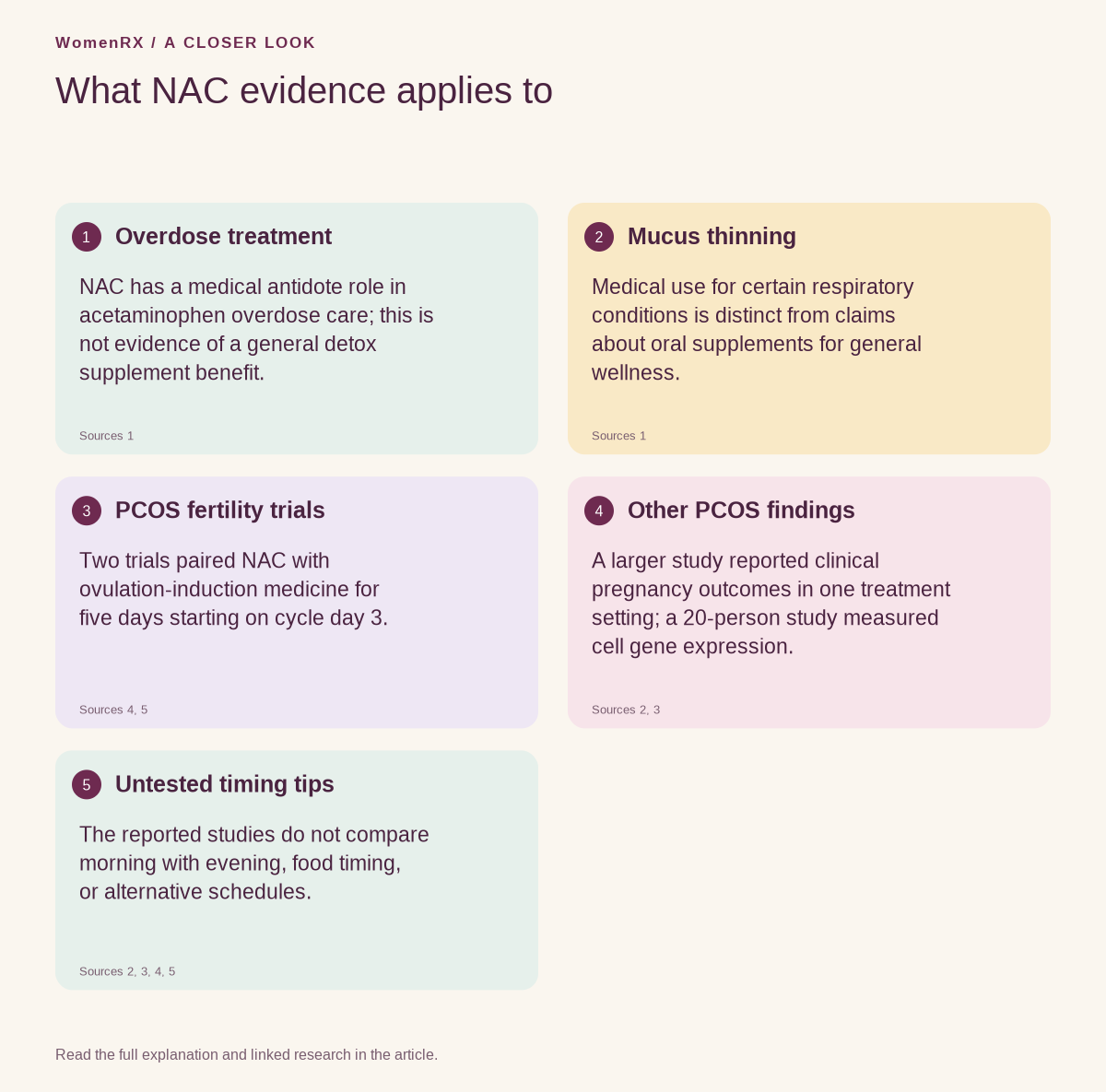
What NAC evidence applies to
Overdose treatment: NAC has a medical antidote role in acetaminophen overdose care; this is not evidence of a general detox supplement benefit.1
Mucus thinning: Medical use for certain respiratory conditions is distinct from claims about oral supplements for general wellness.1
PCOS fertility trials: Two trials paired NAC with ovulation-induction medicine for five days starting on cycle day 3.45
Other PCOS findings: A larger study reported clinical pregnancy outcomes in one treatment setting; a 20-person study measured cell gene expression.23
Untested timing tips: The reported studies do not compare morning with evening, food timing, or alternative schedules.2345
Read the figure as text
Compare NAC’s specific medical roles, PCOS fertility-treatment findings, and timing questions the studies did not test.- Overdose treatment: NAC has a medical antidote role in acetaminophen overdose care; this is not evidence of a general detox supplement benefit.1
- Mucus thinning: Medical use for certain respiratory conditions is distinct from claims about oral supplements for general wellness.1
- PCOS fertility trials: Two trials paired NAC with ovulation-induction medicine for five days starting on cycle day 3.45
- Other PCOS findings: A larger study reported clinical pregnancy outcomes in one treatment setting; a 20-person study measured cell gene expression.23
- Untested timing tips: The reported studies do not compare morning with evening, food timing, or alternative schedules.2345
More questions, answered
Does NAC need to be taken at a certain point in your menstrual cycle?
Two PCOS ovulation-induction trials used NAC for five days starting on cycle day 3, alongside clomiphene or letrozole. They didn’t compare cycle schedules, so they don’t show that cycle timing itself improves results or that the schedule applies outside those fertility-treatment protocols. 4 5
Do PCOS fertility studies show NAC is safe during pregnancy?
No. The 2024 ovulation-induction study excluded participants who were already pregnant and did not evaluate NAC use during pregnancy. The cited studies also don’t answer whether NAC is appropriate while breastfeeding. 3
Sources you can check
- N-acetylcysteine Pharmacology and Applications in Rare Diseases-Repurposing an Old Antioxidant.Sahasrabudhe SA, Terluk MR, Kartha RV. · Antioxidants (Basel, Switzerland) · 2023Return to first citation
- The Effect of Letrozole and N-Acetylcysteine on the Expression Levels of Genes Involved in Glucose Metabolism in Patients with Polycystic Ovary Syndrome: A Clinical Trial Study.Jafarzadeh E, Pashaei-Asl R, Hakimi P, Pashaiasl M. · Journal of reproduction & infertility · 2025Return to first citation
- N-acetylcysteine supplementation improves endocrine-metabolism profiles and ovulation induction efficacy in polycystic ovary syndrome.Fang YQ, Ding H, Li T, Zhao XJ, Luo D, Liu Y, Li Y. · Journal of ovarian research · 2024Return to first citation
- N-Acetylcysteine as an adjuvant to clomiphene citrate for successful induction of ovulation in infertile patients with polycystic ovary syndrome.Salehpour S, Sene AA, Saharkhiz N, Sohrabi MR, Moghimian F. · The journal of obstetrics and gynaecology research · 2012Return to first citation
- N-Acetylcysteine as an Adjuvant to Letrozole for Induction of Ovulation in Infertile Patients with Polycystic Ovary Syndrome.Mostajeran F, Tehrani HG, Rahbary B. · Advanced biomedical research · 2018Return to first citation