NAC Supplements: How to Assess Dose and Safety
NAC has been studied at different amounts for specific PCOS fertility treatments, not as a one-size-fits-all daily wellness supplement.
There isn’t one daily NAC amount established for general wellness in these clinical trials. PCOS fertility trials tested NAC alongside particular ovulation treatments, with differing amounts and schedules. 2 3 4 If you’re considering it, check the reason, the exact product and dose, and whether your fertility team or prescriber should coordinate its use with medicines, treatment, or pregnancy plans.
N-acetylcysteine, usually called NAC, has been studied for women with polycystic ovary syndrome (PCOS) in specific fertility-treatment settings. Those studies don’t establish a general daily dose for wellness, nor do they show that a dose used in one treatment plan is right for another purpose.
The useful first question isn’t simply “How much NAC should I take?” It’s “What am I taking it for, and does the evidence match my situation?”
What PCOS fertility studies actually tested
Some clinical trials tested NAC as an add-on to medicines used to induce ovulation. In one randomized trial of 180 women with PCOS, NAC was given with clomiphene for five days early in the menstrual cycle. The trial reported higher ovulation and pregnancy rates in the NAC group than in the placebo group. 3
A separate randomized trial enrolled 130 women with PCOS and tested NAC alongside letrozole, also for five days early in the cycle. It reported differences in follicle size, ovulation, and pregnancy outcomes between groups. These results apply to that study’s participants and treatment plan, not to NAC taken on its own or for general health. 4
A larger pragmatic trial assigned 230 women with PCOS to NAC or control while they underwent ovulation induction using letrozole followed by urinary FSH. The NAC group had higher clinical pregnancy outcomes in that treatment setting. The study was not a test of NAC as a stand-alone fertility treatment or a daily wellness supplement. 2
Amounts and schedules differed across these trials. For example, the studies tested 1.2 grams per day with clomiphene or letrozole for five days, and 1.8 grams per day alongside a particular ovulation-induction protocol. These are descriptions of research protocols, not dosing recommendations. 2 3 4
A much smaller study of 20 women with PCOS undergoing assisted reproductive treatment examined gene expression in cells surrounding eggs. It reported changes in the expression of glucose-metabolism genes in cumulus cells. These laboratory findings alone don’t establish an improvement in a fertility outcome. 1
A practical check before choosing a dose
Before buying NAC or adding it to your routine, work through these questions:
- What is the intended use? The clinical evidence described here concerns PCOS and specific fertility-treatment protocols. It doesn’t establish a general daily amount for other wellness goals.
- Does your situation match the study? PCOS, ovulation induction, and assisted reproductive treatment are not interchangeable settings. The participants and co-treatments matter.
- What does the product label say? Note the amount of NAC per serving, the form, and how often the label says to take it. Compare that with the treatment plan you’re considering, rather than assuming that a research dose transfers directly.
- Who needs to coordinate it? The trials tested NAC alongside specified treatments; they weren’t designed to establish a complete list of medicine interactions. 2 3 4 If you take prescription medicines or are receiving fertility care, show your prescriber or fertility team the actual product and label.
That last point matters especially if you’re planning ovulation induction or assisted reproductive treatment. Some studies administered NAC as part of a coordinated treatment protocol, but their results don’t establish the right dose or timing for your clinic’s plan. 1 2 3 4 Ask the team managing that treatment before adding it or changing how you take it.
What safety findings can and can’t tell you
Two of the smaller ovulation-induction trials reported no adverse side effects in their NAC groups; one also reported no cases of ovarian hyperstimulation syndrome in that group. Those findings describe what happened in those particular trials. They don’t establish that NAC is risk-free for everyone, or answer every question about long-term use, other medicines, or different health conditions. 3 4
These trials also don’t establish how to use NAC during pregnancy or breastfeeding. 2 3 4 If you’re trying to conceive, tell your fertility team before starting it. If you’re pregnant or breastfeeding, don’t assume that results from a PCOS ovulation-treatment study settle whether it’s appropriate for you; ask the clinician coordinating your care.
the dose is only meaningful in relation to its purpose and treatment setting. A PCOS fertility-trial schedule is not a general-purpose daily recommendation, and the studies don’t replace a review of your own medicines and reproductive plans.
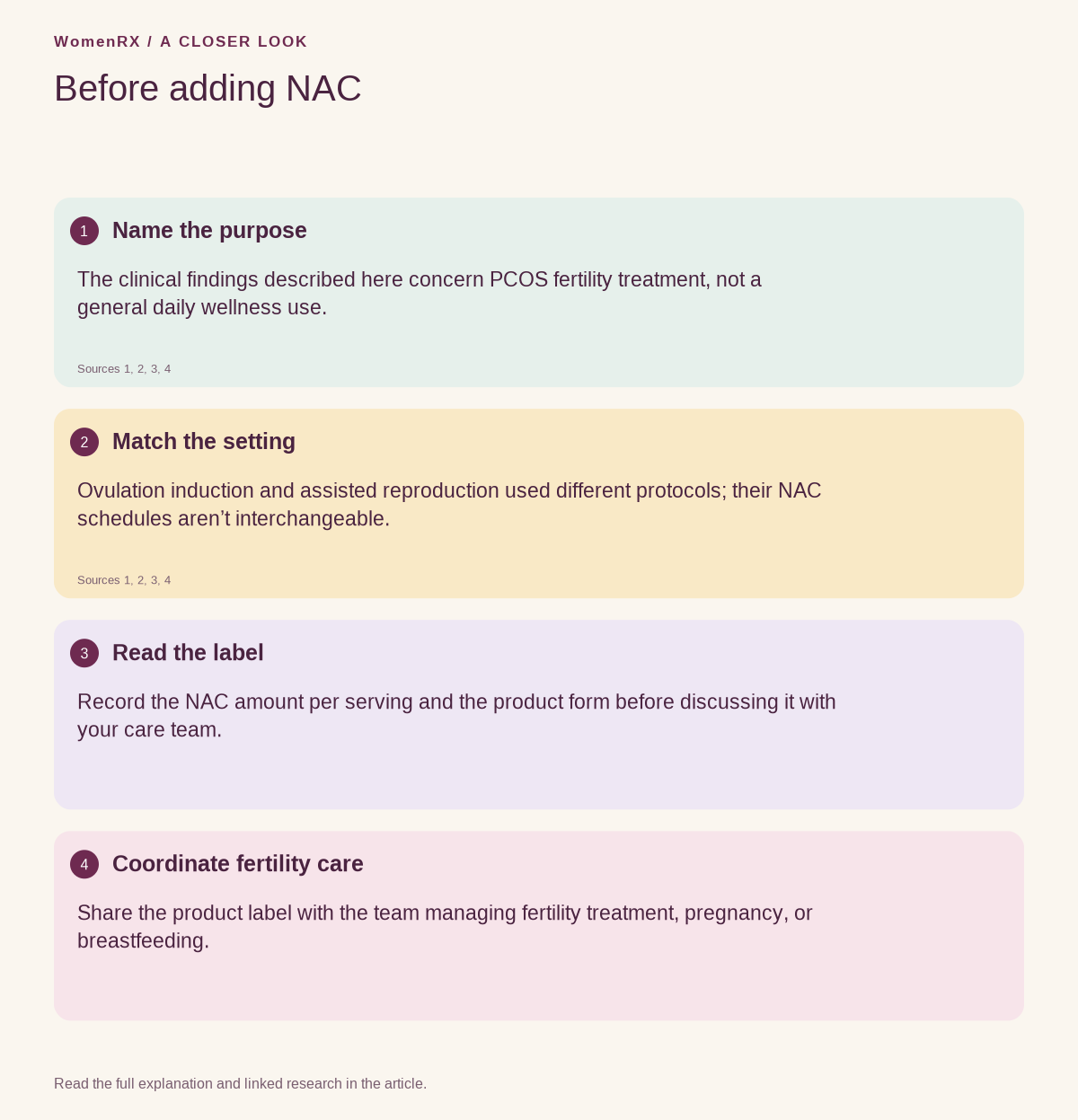
Before adding NAC
Name the purpose: The clinical findings described here concern PCOS fertility treatment, not a general daily wellness use.1234
Match the setting: Ovulation induction and assisted reproduction used different protocols; their NAC schedules aren’t interchangeable.1234
Read the label: Record the NAC amount per serving and the product form before discussing it with your care team.
Coordinate fertility care: Share the product label with the team managing fertility treatment, pregnancy, or breastfeeding.
Read the figure as text
Use these checks to connect the reason for taking NAC with the research setting, product label, and care plan.- Name the purpose: The clinical findings described here concern PCOS fertility treatment, not a general daily wellness use.1234
- Match the setting: Ovulation induction and assisted reproduction used different protocols; their NAC schedules aren’t interchangeable.1234
- Read the label: Record the NAC amount per serving and the product form before discussing it with your care team.
- Coordinate fertility care: Share the product label with the team managing fertility treatment, pregnancy, or breastfeeding.
More questions, answered
Do NAC studies in PCOS show that it improves fertility for everyone?
No. The studies tested NAC as an add-on to particular ovulation-induction or assisted-reproduction protocols in women with PCOS. Their results don’t establish an effect for people without PCOS, for NAC taken alone, or for every fertility-treatment plan. 1 2 3 4
Do these studies give a complete list of NAC medicine interactions?
No. They assessed NAC in specific treatment settings, not interactions across a person’s full medication list. 1 2 3 4 Show the product label to the clinician or pharmacist reviewing your medicines and fertility care.
Sources you can check
- The Effect of Letrozole and N-Acetylcysteine on the Expression Levels of Genes Involved in Glucose Metabolism in Patients with Polycystic Ovary Syndrome: A Clinical Trial Study.Jafarzadeh E, Pashaei-Asl R, Hakimi P, Pashaiasl M. · Journal of reproduction & infertility · 2025Return to first citation
- N-acetylcysteine supplementation improves endocrine-metabolism profiles and ovulation induction efficacy in polycystic ovary syndrome.Fang YQ, Ding H, Li T, Zhao XJ, Luo D, Liu Y, Li Y. · Journal of ovarian research · 2024Return to first citation
- N-Acetylcysteine as an adjuvant to clomiphene citrate for successful induction of ovulation in infertile patients with polycystic ovary syndrome.Salehpour S, Sene AA, Saharkhiz N, Sohrabi MR, Moghimian F. · The journal of obstetrics and gynaecology research · 2012Return to first citation
- N-Acetylcysteine as an Adjuvant to Letrozole for Induction of Ovulation in Infertile Patients with Polycystic Ovary Syndrome.Mostajeran F, Tehrani HG, Rahbary B. · Advanced biomedical research · 2018Return to first citation