What NAC Research in Women Actually Shows
NAC has been studied for specific conditions, but results in fertility care, pregnancy, and hair loss don’t add up to a general benefit for women.
N-acetylcysteine (NAC) has been tested in women with PCOS, infertility or endometriosis, lichen planopilaris, and certain pregnancy complications. Some small trials report promising findings, but results vary by condition and outcome: improved lab markers or embryo measures don’t necessarily mean better chances of pregnancy, and pregnancy studies have examined specific high-risk situations. None establishes a general benefit for women.
NAC research in women isn’t one story. It’s a set of small and condition-specific studies, from ovulation treatment to inflammatory hair loss and preterm birth. The useful question is not simply whether NAC “works,” but what outcome was measured, in whom, and alongside what other treatment.
That distinction matters because a change in a lab marker, an embryo measure, or a newborn outcome is not automatically evidence that NAC improves a woman’s overall health or fertility.
PCOS: studied as an add-on to ovulation treatment
One randomized clinical study included 230 women with polycystic ovary syndrome (PCOS). Both groups received ovulation induction using letrozole followed by injectable follicle-stimulating hormone; one group also received NAC. The study reported higher clinical pregnancy rates per ovulation-induction cycle and cumulative clinical pregnancy rates per patient in the NAC group, along with lower average injectable hormone dose and treatment duration. The abstract reports statistical significance but not the size of the pregnancy-rate differences, making it hard to judge how large or meaningful the benefit was. And because NAC was added to a specific fertility-treatment protocol, the results don’t show that NAC on its own improves fertility or applies to people with PCOS who aren’t having ovulation induction. 6
Endometriosis and IVF: promising signals, different endpoints
A small randomized trial in 25 infertile women with endometriosis reported changes in antioxidant measures and in the expression of genes in ovarian granulosa cells. Those are biological findings, not proof of improved pregnancy or live-birth outcomes; the reported abstract doesn’t establish those benefits. 5
A separate prospective randomized study followed 200 women of advanced reproductive age undergoing IVF/ICSI. The NAC group had more high-quality blastocysts on average, but clinical pregnancy rates did not differ significantly between groups. The study also reported a difference in follicular-fluid glutathione, a laboratory measure, but not in granulosa-cell mitochondrial DNA copy number. Taken together, these results suggest some measures may change during IVF, while a difference in clinical pregnancy was not demonstrated in this study. 7
The distinction is practical: embryo quality and lab markers may be of interest, but they are not substitutes for outcomes such as pregnancy or live birth. These studies also don’t establish a benefit for women trying to conceive without fertility treatment.
Pregnancy: specific high-risk situations, not routine use
Two randomized trials looked at NAC in pregnancies at risk of preterm birth. In a single-center trial, 67 pregnant women with confirmed intra-amniotic infection or inflammation and impending preterm birth were randomized to intravenous NAC or placebo. Among their newborns, two or more severe prematurity-related morbidities occurred in 21% of the NAC group and 47% of the placebo group. This is a promising result for a narrowly defined, high-risk situation, but the trial was small and does not establish a role for NAC in routine pregnancy care. 2
A later pilot trial randomized 39 pregnant women at risk of impending preterm birth to NAC or placebo. NAC did not significantly change the primary measure, newborn glutathione levels. The study reported encouraging secondary findings, including longer pregnancy duration and more infants without neonatal complications, but its authors said those findings need confirmation in larger trials. 3
These trials studied medical treatment in specific pregnancy circumstances, including intravenous treatment in one study. They are not evidence that taking an over-the-counter NAC supplement during pregnancy has the same effects. A study protocol proposing a trial for early-onset preeclampsia is not a result: it describes a planned study, so it cannot show that NAC slows the condition. 4
Lichen planopilaris: a small add-on study
Lichen planopilaris is an inflammatory hair-loss condition. In a randomized trial of 30 people, nearly all of whom were women, researchers compared topical clobetasol alone with clobetasol combined with either NAC or pentoxifylline. Symptoms improved in all three groups over four months; the NAC combination group had a greater decline in disease activity than the clobetasol-only group. Because the study was small and tested NAC as an add-on to a prescribed treatment, it doesn’t show that NAC alone treats hair loss or that the result applies to other types of hair loss. 1
How to weigh a claim about NAC
When you see a claim that NAC benefits women, check three things: the condition studied, the outcome measured, and whether NAC was used alone or alongside treatment. A trial of an add-on during ovulation induction, for example, answers a different question from a trial of NAC for a pregnancy complication or an inflammatory scalp condition.
These findings offer some reasons for further research, especially in reproductive care. They don’t support treating NAC as a general-purpose women’s health supplement or assuming that a promising lab finding means a meaningful personal benefit. For a specific health question, the most relevant evidence is the study that matches that condition and outcome, not a benefits list that combines unrelated results.
Where NAC has been studied in women
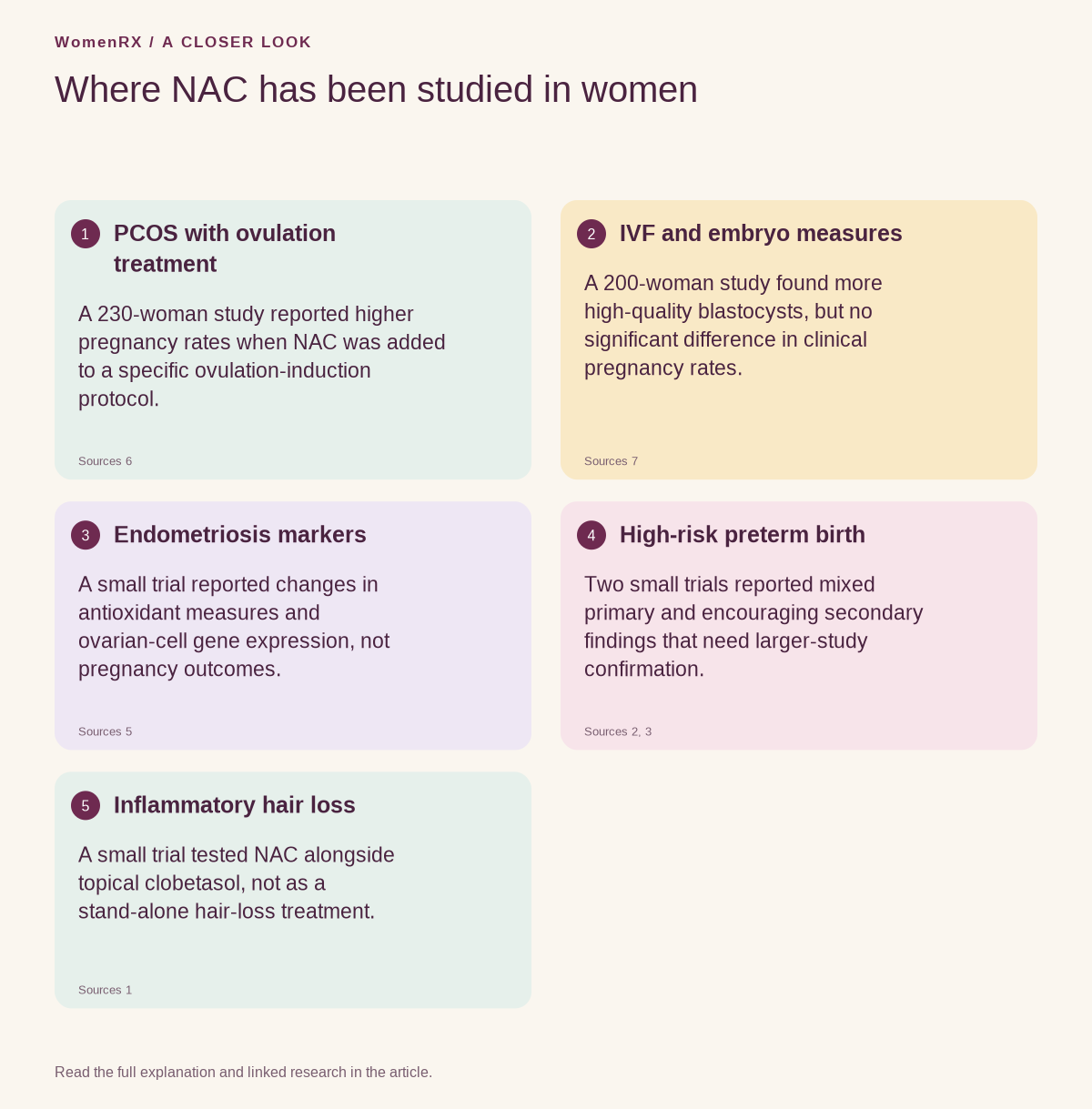
PCOS with ovulation treatment: A 230-woman study reported higher pregnancy rates when NAC was added to a specific ovulation-induction protocol.6
IVF and embryo measures: A 200-woman study found more high-quality blastocysts, but no significant difference in clinical pregnancy rates.7
Endometriosis markers: A small trial reported changes in antioxidant measures and ovarian-cell gene expression, not pregnancy outcomes.5
High-risk preterm birth: Two small trials reported mixed primary and encouraging secondary findings that need larger-study confirmation.23
Inflammatory hair loss: A small trial tested NAC alongside topical clobetasol, not as a stand-alone hair-loss treatment.1
Read the figure as text
These studies concern different conditions and outcomes. A promising result in one setting does not establish a general benefit.- PCOS with ovulation treatment: A 230-woman study reported higher pregnancy rates when NAC was added to a specific ovulation-induction protocol.6
- IVF and embryo measures: A 200-woman study found more high-quality blastocysts, but no significant difference in clinical pregnancy rates.7
- Endometriosis markers: A small trial reported changes in antioxidant measures and ovarian-cell gene expression, not pregnancy outcomes.5
- High-risk preterm birth: Two small trials reported mixed primary and encouraging secondary findings that need larger-study confirmation.23
- Inflammatory hair loss: A small trial tested NAC alongside topical clobetasol, not as a stand-alone hair-loss treatment.1
More questions, answered
Does the PCOS study show NAC improves fertility on its own?
No. The study tested NAC as an addition to a specific ovulation-induction treatment. It doesn’t show whether NAC alone improves fertility or whether the result applies outside that treatment setting. 6
Do the pregnancy trials support taking NAC during pregnancy?
They studied NAC in particular high-risk situations, including impending preterm birth, and used specific medical protocols. They don’t establish that an over-the-counter supplement is appropriate or has the same effects in pregnancy. 2 3
Sources you can check
- Efficacy, safety, tolerability, and satisfaction of N-acetylcysteine and pentoxifylline in lichen planopilaris patients under treatment with topical clobetasol: A triple arm blinded randomized controlled trial.Ahmadi Kahjoogh H, Yazdanian N, Behrangi E, Roohaninasab M, Hejazi P, Goodarzi A. · Dermatologic therapy · 2022Return to first citation
- Antenatal N-acetylcysteine to improve outcomes of premature infants with intra-amniotic infection and inflammation (Triple I): randomized clinical trial.Buhimschi CS, Bahtiyar MO, Zhao G, Abdelghany O, Schneider L, Razeq SA, Dulay AT, Lipkind HS, Mieth S, Rogers L, Bhandari V, Buhimschi IA. · Pediatric research · 2021Return to first citation
- Antenatal N-acetylcysteine supplementation in pregnant women with impending preterm birth: a prospective randomized placebo-controlled trial.Küster A, Legrand A, Vibet MA, Nguyen PC, Winer N, Barribaud M, Gourdel M, Boivin M, Vincke M, Flet L, Darmaun D, Alexandre-Gouabau MC. · Pediatric research · 2026Return to first citation
- A randomized controlled trial of N-acetylcysteine in the treatment of early-onset preeclampsia: Study Protocol.Okunade KS, Adejimi AA, Adenekan MA, Ademuyiwa IY, Adelabu H, Habeebu-Adeyemi FM, Soibi-Harry AP, Onasanya O, Fayinto AI, Adekanye TV, Adeboje-Jimoh F, Oghide O, Davies NO, Akhenam... · PloS one · 2026Return to first citation
- Administration of N-acetylcysteine influence the expression of apoptotic genes in the granulosa cells of infertile women diagnosed with endometriosis.Heshmati ZS, Amiri-Yekta A, Khosravifar M, Akbarian F, Moini A, Eftekhari-Yazdi P, Hafezi M, Afsharian P. · Scientific reports · 2026Return to first citation
- N-acetylcysteine supplementation improves endocrine-metabolism profiles and ovulation induction efficacy in polycystic ovary syndrome.Fang YQ, Ding H, Li T, Zhao XJ, Luo D, Liu Y, Li Y. · Journal of ovarian research · 2024Return to first citation
- Role of N-acetylcysteine treatment in women with advanced age undergoing IVF/ICSI cycles: A prospective study.Li X, Wang Z, Wang H, Xu H, Sheng Y, Lian F. · Frontiers in medicine · 2022Return to first citation