NAC in Midlife: Match It to a Specific Goal
NAC has been studied for some reproductive and exercise-related questions, but those findings don’t establish it as a treatment for menopause symptoms or a routine need after 40.
N-acetylcysteine (NAC) isn’t an established treatment for perimenopause or menopause symptoms, and age over 40 alone isn’t a reason to take it. The human studies discussed here focus on specific situations, including fertility treatment, endometriosis after surgery, and exercise. Results from those settings can’t show that NAC helps hot flashes, sleep changes, or general midlife health. 1 2 3 4
Start with the health goal, not your age
NAC has been studied in several specific clinical settings, but that doesn’t make it a general-purpose midlife supplement. The studies described below don’t establish that it treats hot flashes, night sweats, mood changes, or other perimenopause and menopause symptoms. They also don’t show that women need NAC simply because they’re over 40.
A useful first question is: what outcome are you hoping to change? Evidence about fertility treatment, endometriosis, or exercise doesn’t automatically apply to menopause symptoms or “anti-aging.”
What the studies actually tested
Fertility treatment in women described as advanced age: A prospective randomized study included 200 women undergoing IVF/ICSI. The NAC group had a higher average number of high-quality blastocysts than the control group, 1.82 versus 1.43. But clinical pregnancy rates did not differ significantly. The study measured fertility-treatment outcomes, not menopause symptoms or broader health, and it doesn’t establish that NAC improves the chance of pregnancy. 4
Ovulation induction for PCOS: A randomized study included 230 women with PCOS undergoing ovulation induction with letrozole and urinary follicle-stimulating hormone. The researchers reported higher clinical pregnancy rates per treatment cycle and cumulative clinical pregnancy rates per patient in the NAC group than in the control group. This is evidence about an add-on in a specific fertility-treatment protocol, not a menopause intervention; the study description doesn’t establish that its results apply specifically to midlife women. 2
Endometrioma after surgery: In a randomized trial of 100 women who had surgery for ovarian endometrioma, adding NAC to a low-dose contraceptive did not reduce recurrence or pelvic pain more than the contraceptive alone at the reported follow-ups. This doesn’t support taking NAC for pelvic pain generally or for menopause symptoms. 1
Exercise: In a small crossover study of 20 recreationally trained women, a single NAC intervention changed some blood markers during cycling, but it didn’t improve 1-kilometer cycling time-trial performance. The study compared naturally cycling women and women using oral contraceptives; it wasn’t a study of midlife or menopausal women. 3
A decision aid for your own question
- If your goal is relief from menopause symptoms: These studies don’t show that NAC works for that purpose. They aren’t a reason to replace or delay care directed at the symptom you want to address.
- If your goal is fertility treatment: Some research has tested NAC as an add-on for particular protocols or patient groups. The results aren’t interchangeable across protocols, and a change in a lab or embryo outcome isn’t the same as a proven improvement in pregnancy outcomes. 2 4
- If your goal is endometriosis-related pain or recurrence: The cited postoperative trial found no added benefit over the contraceptive alone. 1
- If your goal is general energy, exercise performance, or healthy aging: The small exercise study didn’t find better time-trial performance, and it doesn’t answer broader midlife-health questions. 3
For any proposed use, check whether the study population, treatment setting, and outcome match your actual goal. “Women” in a study doesn’t necessarily mean women in perimenopause or menopause. Here, the advanced-age IVF study is the closest match to a midlife question, but it concerns fertility treatment and doesn’t establish a menopause benefit. 4
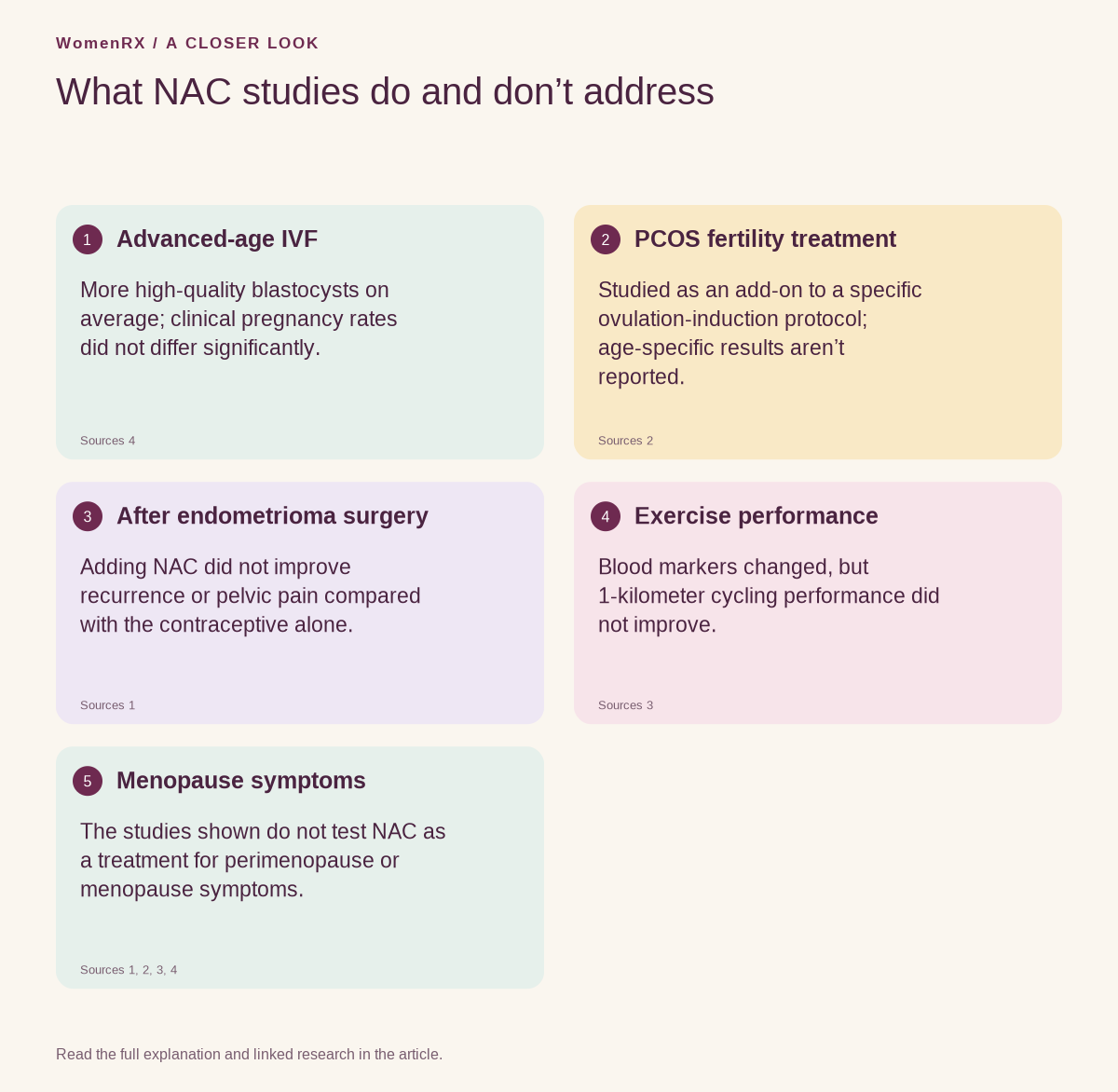
What NAC studies do and don’t address
Advanced-age IVF: More high-quality blastocysts on average; clinical pregnancy rates did not differ significantly.4
PCOS fertility treatment: Studied as an add-on to a specific ovulation-induction protocol; age-specific results aren’t reported.2
After endometrioma surgery: Adding NAC did not improve recurrence or pelvic pain compared with the contraceptive alone.1
Exercise performance: Blood markers changed, but 1-kilometer cycling performance did not improve.3
Menopause symptoms: The studies shown do not test NAC as a treatment for perimenopause or menopause symptoms.1234
Read the figure as text
The research questions differ by population and goal. A finding in one setting should not be read as evidence for menopause symptoms or general midlife health.- Advanced-age IVF: More high-quality blastocysts on average; clinical pregnancy rates did not differ significantly.4
- PCOS fertility treatment: Studied as an add-on to a specific ovulation-induction protocol; age-specific results aren’t reported.2
- After endometrioma surgery: Adding NAC did not improve recurrence or pelvic pain compared with the contraceptive alone.1
- Exercise performance: Blood markers changed, but 1-kilometer cycling performance did not improve.3
- Menopause symptoms: The studies shown do not test NAC as a treatment for perimenopause or menopause symptoms.1234
More questions, answered
Does being over 40 mean I need NAC?
No age-based need is established by these studies. The research concerns particular fertility, endometriosis, and exercise settings, not routine use for women over 40. 1 2 3 4
Sources you can check
- Comparing the effect of adjunctive N-acetylcysteine plus low dose contraceptive with low dose contraceptive alone on recurrence of ovarian endometrioma and chronic pelvic pain after conservative laparoscopic surgery: a randomised clinical trial study.Asgari Z, Moini A, Montazeri A, Tavoli Z, Hosseini L, Hosseini R, Tehranian A, Karimi R. · Journal of obstetrics and gynaecology : the journal of the Institute of Obstetrics and Gynaecology · 2022Return to first citation
- N-acetylcysteine supplementation improves endocrine-metabolism profiles and ovulation induction efficacy in polycystic ovary syndrome.Fang YQ, Ding H, Li T, Zhao XJ, Luo D, Liu Y, Li Y. · Journal of ovarian research · 2024Return to first citation
- Blood oxidative stress biomarkers in women: influence of oral contraception, exercise, and N-acetylcysteine.Quinn KM, Roberts L, Cox AJ, Borg DN, Pennell EN, McKeating DR, Fisher JJ, Perkins AV, Minahan C. · European journal of applied physiology · 2022Return to first citation
- Role of N-acetylcysteine treatment in women with advanced age undergoing IVF/ICSI cycles: A prospective study.Li X, Wang Z, Wang H, Xu H, Sheng Y, Lian F. · Frontiers in medicine · 2022Return to first citation