What Is NAC, and What Is It Studied For?
NAC has established medical uses, but research on supplements for reproductive health and other conditions is much less settled.
N-acetylcysteine (NAC) is a cysteine derivative that can supply cysteine for the body’s production of glutathione. Clinicians use acetylcysteine as a medicine, including for acetaminophen poisoning and to help loosen mucus. Research on NAC for conditions such as endometriosis, PCOS, and compulsive skin picking is separate: results vary by diagnosis, treatment setting, and outcome, and don’t establish a general benefit for women. 12346
NAC is a cysteine derivative and a precursor the body can use to make glutathione, a compound involved in cellular antioxidant defenses. That biological role is one reason NAC has been studied in many settings. It doesn’t, by itself, show that taking NAC as a supplement improves health or treats a particular condition. 13
The clearest distinction is between acetylcysteine used as a medicine in a specific clinical setting and studies testing NAC for other purposes. Those uses involve different conditions, routes of administration, and evidence. A result in one setting can’t be carried over automatically to another.
Established medical uses are different from supplement research
Acetylcysteine is used clinically as an antidote for acetaminophen toxicity and as a mucolytic, which means it helps loosen airway mucus. These are medical uses, not proof that a supplement provides the same benefit for an unrelated concern. 13
For example, a randomized trial in adults receiving invasive ventilation compared giving nebulized acetylcysteine with salbutamol routinely with giving acetylcysteine or salbutamol only when clinically indicated. The on-demand approach was not inferior for ventilator-free days, and adverse events were more frequent with routine treatment. This was a hospital-based treatment strategy, not a trial of oral NAC supplements or a general test of NAC’s benefits. 5
What reproductive-health studies actually show
Endometrioma after surgery: In a randomized trial, 100 women who had surgery for ovarian endometrioma received a low-dose contraceptive alone or with NAC. At follow-up 3 and 6 months after surgery, the groups had similar results for recurrence and pelvic pain. This study does not show an added benefit from NAC in that particular treatment context. 2
Pregnancy and preterm birth: A small, single-center randomized trial studied intravenous NAC in pregnant women with confirmed intra-amniotic infection or inflammation and impending preterm birth. The researchers reported fewer newborns with two or more severe prematurity-related complications in the NAC group than in the placebo group: 21% (7 of 33) versus 47% (16 of 34). The trial stopped before reaching its planned enrollment, so the result is promising but needs confirmation in larger studies. It concerns clinician-directed treatment during a specific pregnancy complication, not taking NAC supplements during pregnancy. 3
PCOS and fertility treatment: A clinical study assigned 20 women with PCOS undergoing assisted reproduction to four small groups, including NAC and NAC with letrozole. It measured gene expression in cells surrounding the eggs, not pregnancy or live-birth outcomes. Changes in those laboratory measures can prompt further research, but they don’t establish that NAC improves fertility or treatment success. 6
Together, these studies show why “studied for women’s health” isn’t the same as “shown to help women.” Diagnosis, timing, accompanying treatment, and the outcome measured all matter.
Research beyond reproductive health
A randomized trial of NAC for excoriation, or skin-picking, disorder included 66 adults, 59 of them women. After 12 weeks, symptom scores improved more in the NAC group than in the placebo group; among participants who completed the study, 15 of 32 in the NAC group and 4 of 21 in the placebo group were rated much or very much improved. This is a result in adults with a specific disorder, not evidence of a general skin, mood, or antioxidant benefit, and the study did not report a separate effect for women. 4
How to judge a claim about NAC
When you see NAC promoted for a particular reason, check what was actually studied. Was it a supplement or a medical treatment? Did the study include people with your diagnosis? Did it measure an outcome that matters to you, such as pain, pregnancy, or symptom improvement, or only a biological marker? Was there a comparison group, and did NAC add a benefit to the usual treatment?
Those questions help separate a plausible mechanism or early research signal from a demonstrated treatment effect. This evidence does not support treating NAC as a general-purpose antioxidant remedy or assuming it has a benefit simply because a study involved women.
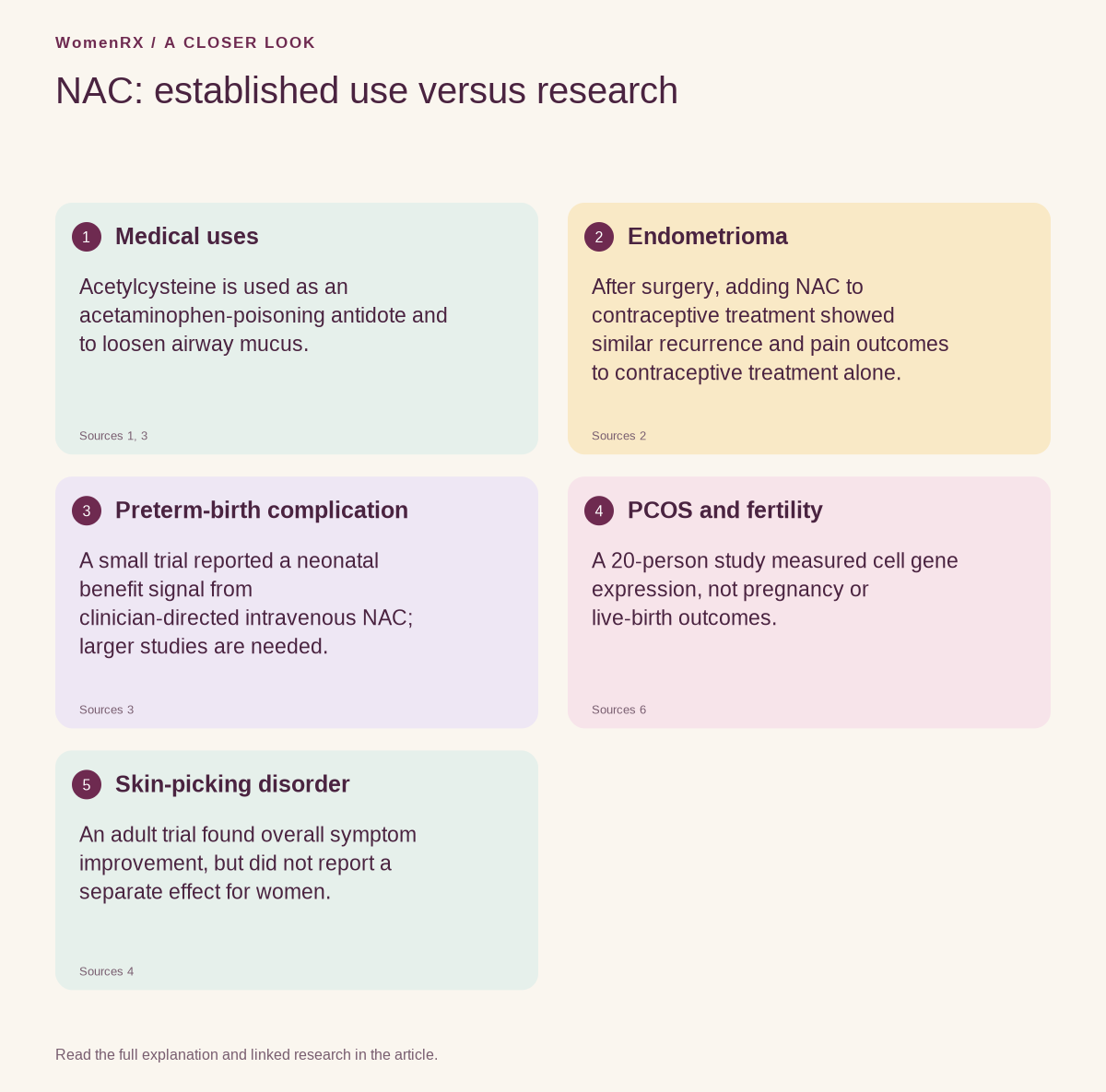
NAC: established use versus research
Medical uses: Acetylcysteine is used as an acetaminophen-poisoning antidote and to loosen airway mucus.13
Endometrioma: After surgery, adding NAC to contraceptive treatment showed similar recurrence and pain outcomes to contraceptive treatment alone.2
Preterm-birth complication: A small trial reported a neonatal benefit signal from clinician-directed intravenous NAC; larger studies are needed.3
PCOS and fertility: A 20-person study measured cell gene expression, not pregnancy or live-birth outcomes.6
Skin-picking disorder: An adult trial found overall symptom improvement, but did not report a separate effect for women.4
Read the figure as text
These examples show how NAC evidence changes with the condition, treatment setting, and outcome measured.- Medical uses: Acetylcysteine is used as an acetaminophen-poisoning antidote and to loosen airway mucus.13
- Endometrioma: After surgery, adding NAC to contraceptive treatment showed similar recurrence and pain outcomes to contraceptive treatment alone.2
- Preterm-birth complication: A small trial reported a neonatal benefit signal from clinician-directed intravenous NAC; larger studies are needed.3
- PCOS and fertility: A 20-person study measured cell gene expression, not pregnancy or live-birth outcomes.6
- Skin-picking disorder: An adult trial found overall symptom improvement, but did not report a separate effect for women.4
More questions, answered
Does NAC have a proven benefit for women in general?
These studies examine specific conditions and settings, not women as a general group. Some show no added benefit for the outcome tested, while others offer early or condition-specific findings. They don’t establish a broad benefit for women. 236
Does the skin-picking study show a women-specific effect?
No. Women made up 59 of the 66 participants, but the study summary reports results for the overall group, not a separate treatment effect for women. 4
Sources you can check
- Therapeutic Potential of Cysteine and Its Derivatives in Dermatology.Choi JY, Lee WJ, Boo YC. · Molecules (Basel, Switzerland) · 2026Return to first citation
- Comparing the effect of adjunctive N-acetylcysteine plus low dose contraceptive with low dose contraceptive alone on recurrence of ovarian endometrioma and chronic pelvic pain after conservative laparoscopic surgery: a randomised clinical trial study.Asgari Z, Moini A, Montazeri A, Tavoli Z, Hosseini L, Hosseini R, Tehranian A, Karimi R. · Journal of obstetrics and gynaecology : the journal of the Institute of Obstetrics and Gynaecology · 2022Return to first citation
- Antenatal N-acetylcysteine to improve outcomes of premature infants with intra-amniotic infection and inflammation (Triple I): randomized clinical trial.Buhimschi CS, Bahtiyar MO, Zhao G, Abdelghany O, Schneider L, Razeq SA, Dulay AT, Lipkind HS, Mieth S, Rogers L, Bhandari V, Buhimschi IA. · Pediatric research · 2021Return to first citation
- N-Acetylcysteine in the Treatment of Excoriation Disorder: A Randomized Clinical Trial.Grant JE, Chamberlain SR, Redden SA, Leppink EW, Odlaug BL, Kim SW. · JAMA psychiatry · 2016Return to first citation
- Effect of On-Demand vs Routine Nebulization of Acetylcysteine With Salbutamol on Ventilator-Free Days in Intensive Care Unit Patients Receiving Invasive Ventilation: A Randomized Clinical Trial.van Meenen DMP, van der Hoeven SM, Binnekade JM, de Borgie CAJM, Merkus MP, Bosch FH, Endeman H, Haringman JJ, van der Meer NJM, Moeniralam HS, Slabbekoorn M, Muller MCA, Stilma W,... · JAMA · 2018Return to first citation
- The Effect of Letrozole and N-Acetylcysteine on the Expression Levels of Genes Involved in Glucose Metabolism in Patients with Polycystic Ovary Syndrome: A Clinical Trial Study.Jafarzadeh E, Pashaei-Asl R, Hakimi P, Pashaiasl M. · Journal of reproduction & infertility · 2025Return to first citation