What to Review Before Taking NAC Long Term
NAC may be reasonably well tolerated in studied settings, but the reason you take it matters more than its reputation as an antioxidant.
Start with what you expect NAC to do. Its established medical uses don’t prove that ongoing use helps with another goal. Reviews describe mostly gastrointestinal side effects, while long-term benefit remains uncertain across many conditions. Compare your goal, amount, and duration with the research that actually fits your situation; a medicine-interaction check needs your exact product and medication list. 3 4
N-acetylcysteine, usually called NAC, has established medical uses, including treating acetaminophen poisoning and helping clear mucus. Those uses involve particular conditions and treatment plans. They aren’t a reason, on their own, to keep taking NAC for a different goal. 3
First, match the evidence to your reason
Ask a more useful question than “Is NAC good for me?”: What benefit am I taking it for, and has that benefit been studied in a similar situation? NAC helps the body make glutathione, but a plausible antioxidant mechanism doesn’t establish that taking it improves every condition linked to oxidative stress. A review spanning multiple organ systems describes promising findings alongside inconsistent clinical results and uncertainty about long-term usefulness. 3
For example, a randomized trial in 50 adolescents with primary menstrual pain found lower average pain scores with oral NAC than with placebo. Participants took it for five days beginning with their periods, across three cycles. That finding is relevant to that specific question; it doesn’t test continuous use in adults or establish benefit for a different goal. 2
For endometriosis, a review describes early clinical findings for NAC as promising, while calling for randomized trials and long-term safety and fertility assessment. If that’s why you started taking it, the honest takeaway is neither “proven treatment” nor “no evidence.” It’s that the findings are preliminary and don’t yet settle whether ongoing use will help you. 5
Dose and duration only make sense beside the goal
There isn’t one research-backed NAC amount or stopping date that applies to every reason for taking it. Studies differ in who receives NAC, how much they receive, and how long treatment lasts. A dose studied for menstrual pain over three cycles, for instance, cannot establish what happens with daily use over years. 2 3
Look at the amount on your product label and how often you actually take it. Then separate two questions: Is there evidence for my goal at all? And does that evidence resemble my pattern of use? If the answer to the second question is no, a reassuring result from a shorter or different study cannot fill that gap. Nor does taking more make a benefit more likely on the strength of these findings. 2 3
What tolerability findings can, and can’t, tell you
Across the settings covered by reviews, NAC’s reported side effects are commonly mild and gastrointestinal, such as nausea, bloating, or diarrhea. That’s worth considering if a stomach symptom began after you started it. But “generally well tolerated” describes what was observed in studied groups; it doesn’t promise that any amount, product, or duration will suit you. A review of glutathione-related approaches in people with HIV or HIV-tuberculosis also notes that short studies and limited long-term outcome data constrain conclusions about chronic use. 3 4
There’s a practical tradeoff here. If you can identify a meaningful benefit that matches a studied goal, you have something concrete to weigh against side effects and uncertainty. If you can’t tell whether NAC is helping, continuing it indefinitely asks you to accept those uncertainties without a clear benefit in return.
Medicines need an individual interaction check
The broad reviews cited here don’t establish a dependable list of specific medicine interactions for ongoing NAC use. That is not a finding that NAC has no interactions. It means a general statement about tolerability cannot clear your particular combination of prescription medicines, over-the-counter medicines, and supplements. The exact NAC product, its other ingredients, and what else you take are the details a pharmacist or prescribing clinician needs to check. 3 4
This distinction matters especially if NAC was recommended as part of care for a medical condition: don’t treat research on NAC alone as evidence about how it fits with the rest of that treatment.
Pregnancy and breastfeeding are separate questions
A systematic review examined NAC given during pregnancies complicated by chorioamnionitis or related inflammation. Human evidence was limited, protocols varied, and some studies found no benefit or negative effects. That research does not establish a benefit or safety profile for taking NAC for a general wellness or reproductive-health goal during pregnancy. It also doesn’t answer whether ongoing use while breastfeeding is appropriate. 1
If pregnancy, trying to conceive, or breastfeeding is relevant to you, assess the specific reason and formulation rather than borrowing reassurance from a different medical use. The same principle applies to the rest of the decision: keep taking NAC because the likely benefit fits your situation, not simply because NAC has been used safely somewhere else.
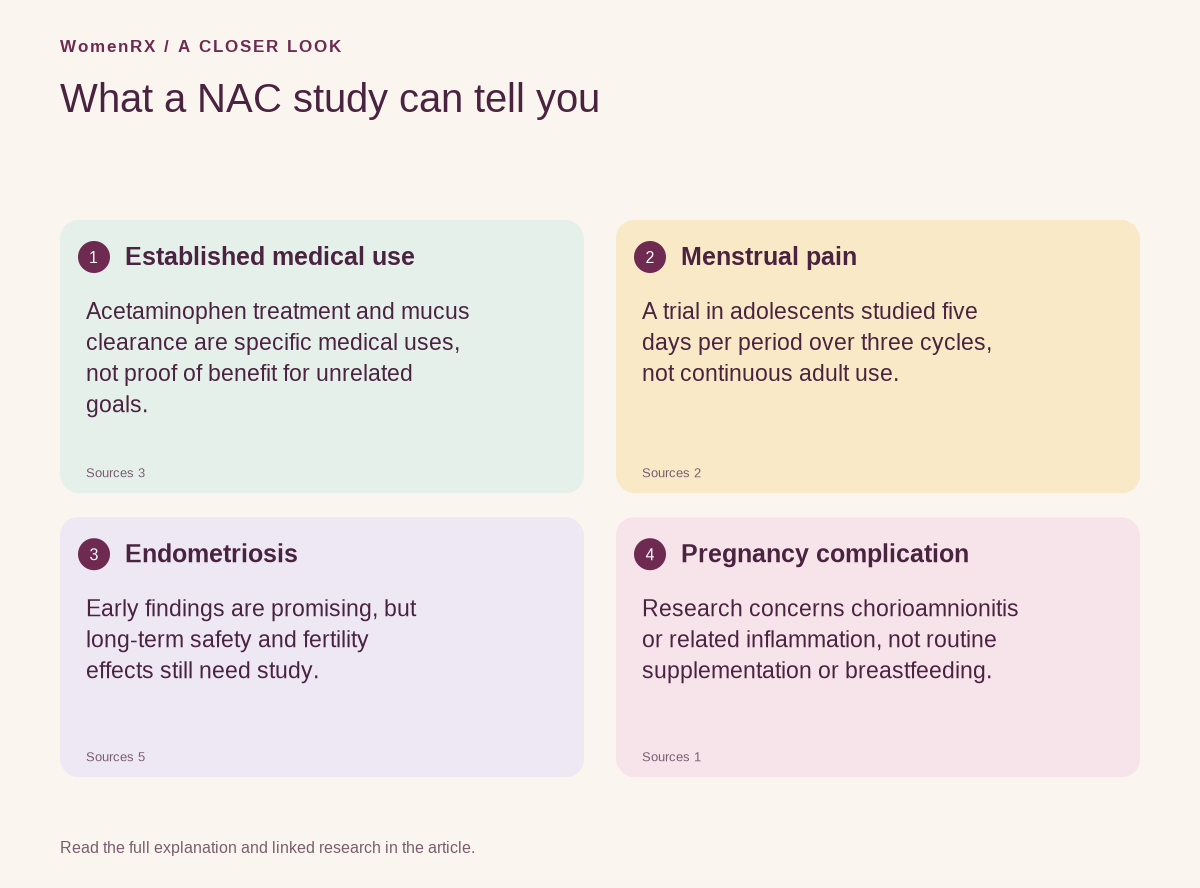
What a NAC study can tell you
Established medical use: Acetaminophen treatment and mucus clearance are specific medical uses, not proof of benefit for unrelated goals.3
Menstrual pain: A trial in adolescents studied five days per period over three cycles, not continuous adult use.2
Endometriosis: Early findings are promising, but long-term safety and fertility effects still need study.5
Pregnancy complication: Research concerns chorioamnionitis or related inflammation, not routine supplementation or breastfeeding.1
Read the figure as text
Match the reason and pattern of use before applying a finding to your own decision.- Established medical use: Acetaminophen treatment and mucus clearance are specific medical uses, not proof of benefit for unrelated goals.3
- Menstrual pain: A trial in adolescents studied five days per period over three cycles, not continuous adult use.2
- Endometriosis: Early findings are promising, but long-term safety and fertility effects still need study.5
- Pregnancy complication: Research concerns chorioamnionitis or related inflammation, not routine supplementation or breastfeeding.1
More questions, answered
If NAC hasn’t caused side effects, does that support taking it indefinitely?
Tolerating it so far is useful information about your experience, but it doesn’t show that it’s helping or establish long-term safety for your particular goal. The reviews distinguish generally favorable tolerability in studied settings from the still-uncertain long-term clinical value of NAC across conditions. 3 4
Sources you can check
- Fetal and neonatal effects of N-acetylcysteine for maternal chorioamnionitis: a systematic review.Elgharbawy FM, Bayoumi MAA, Ajele KW, Lwaleed BA. · Frontiers in pediatrics · 2026Return to first citation
- ORAL N-ACETYLCYSTEINE FOR MENSTRUAL PAIN IN ADOLESCENTS: A RANDOMIZED CONTROLLED STUDY OF OXIDATIVE STRESS REDUCTION WITHOUT HORMONAL MODULATION.Al Khafaji W, Eswad M, Jabber A. · Georgian medical news · 2026Return to first citation
- The therapeutic potential of N-acetylcysteine across multiple organ systems: a narrative review.Joy T, Bhargavi C, Kadur K, Mehta P, Rao YL, Millis RM, Nahata S. · La Clinica terapeutica · 2026Return to first citation
- Efficacy and Safety of Glutathione Supplementation in Patients with HIV Infection and HIV-Tuberculosis Co-Infection.Dawi J, Affa S, Au S, Misakyan Y, Gonzalez E, Chorbajian A, Hammi M, Dave P, Qumsieh K, Venketaraman V. · Nutrients · 2026Return to first citation
- Targeting inflammation in endometriosis: emerging therapeutic options.Perrone U, Barra F, Anatrà M, Paudice M, Vellone VG, Gullo G, Ferrero S. · Expert opinion on investigational drugs · 2025Return to first citation