Vitamin B6: Food, Benefits, and Supplement Safety
B6 is found in everyday foods, but supplements can add up across a multivitamin and other products.
Vitamin B6 helps enzymes do their work and is found in foods such as fish, poultry, potatoes, fortified cereals, and some fruit. A supplement may be useful for a specific reason, but more is not automatically better. Before adding one, total the B6 listed on your multivitamin and other products; long-term excess can harm nerves. 1
What B6 does, and where to get it
Vitamin B6 is a family of related compounds. Its active forms help enzymes carry out reactions in the body. You can get it from a varied diet: fish, beef and other organ meats, potatoes and other starchy vegetables, poultry, fortified cereals, and some noncitrus fruit are among the sources. In the US, fortified cereals, beef, poultry, starchy vegetables, and some noncitrus fruits contribute much of people’s dietary B6. 1
That makes B6 different from a nutrient you can only get through a supplement. A supplement also isn’t automatically needed just because B6 supports normal body functions. In a nationally representative analysis of pregnant US women’s reported food and supplement intake from 2001 to 2014, 11.5% had usual total B6 intake below the Estimated Average Requirement. That’s a population estimate of intake, not a diagnosis of deficiency in any individual woman. 2
Check the whole supplement stack
If you’re considering a B6 product, first check the Supplement Facts panels on everything you take. Look for “vitamin B6” and note the amount per serving, including on a multivitamin, prenatal, and any single-nutrient or combination supplement. Add the amounts for the servings you actually use. This gives you a practical view of supplemental B6, though it does not calculate your full food intake.
B6 may appear under names such as pyridoxine or pyridoxal 5'-phosphate (PLP), an active form. Don’t assume that a different form means there is no B6 to count: supplements’ forms do not differ substantially in absorption, according to the NIH Office of Dietary Supplements. 1
US guidance sets an adult tolerable upper intake level (UL) of 100 mg per day from food and supplements combined. A UL is a limit intended to reduce the risk of harm, not a target or a recommended supplement dose. Safety assessments aren’t identical everywhere: the European Food Safety Authority set a lower adult UL of 12 mg per day, including for pregnant and breastfeeding women. These different limits reflect different assessments of the evidence; neither is a reason to seek out a higher intake. 1
For everyday use, the practical point is to avoid stacking products without checking their amounts. If a clinician has recommended B6 for a particular reason, show them the full list of products rather than assessing one bottle in isolation.
Why excess B6 deserves attention
The best-established concern from excessive supplemental B6 is peripheral neuropathy, which affects nerves and can cause sensory problems; severe cases can also affect coordination. NIH describes severe, progressive sensory neuropathy after chronic very high pyridoxine intake, and notes that reports have also described neuropathy at lower doses. The evidence does not establish a single dose or duration at which every person will develop symptoms, so don’t treat the US UL as a guarantee that an individual product stack is risk-free. 1
If you take B6 and develop new numbness, tingling, or trouble coordinating movement, check every product label and seek timely medical advice. Don’t add another B6-containing product while you’re sorting out the total. High B6 from food has not been reported to cause adverse effects; the concern is especially relevant to sustained supplemental exposure. 1
Pregnancy: nausea is a separate question from PMS
B6 has been studied for nausea and vomiting in pregnancy. A systematic review and network meta-analysis of 24 randomized trials involving 3,017 participants found possible benefit among several interventions, including vitamin B6, but rated comparative conclusions as uncertain because studies varied and safety reporting was limited. 4
A small randomized trial in Iran assigned 120 pregnant women to vitamin B6, ginger, or placebo; 97 completed the study. It found no significant difference between ginger and B6 for reducing nausea and vomiting, but its short follow-up and setting limit what it can tell us about broader use or safety. These studies concern pregnancy-related nausea, not a general reason to add B6 to a prenatal or take extra B6 during pregnancy. 5
Premenstrual symptoms are a separate evidence question. Findings about pregnancy nausea do not establish that B6 relieves PMS, so don’t treat the pregnancy research as proof of a PMS benefit. If you’re pregnant and considering an additional supplement, check the prenatal label and review the whole combination with your pregnancy-care team, especially if another product already contains B6. Prenatal supplement formulations vary, making a full-label review more useful than judging a product by its name. 3
A quick label review
Before buying or adding a product, write down each supplement’s B6 amount per serving and how many servings you use. Include combination products, not just bottles labeled “B6.” Keep food sources in mind too, but don’t mistake a food-based diet for a reason to take extra B6. The goal is to understand what you already use and why another product would be worth adding.
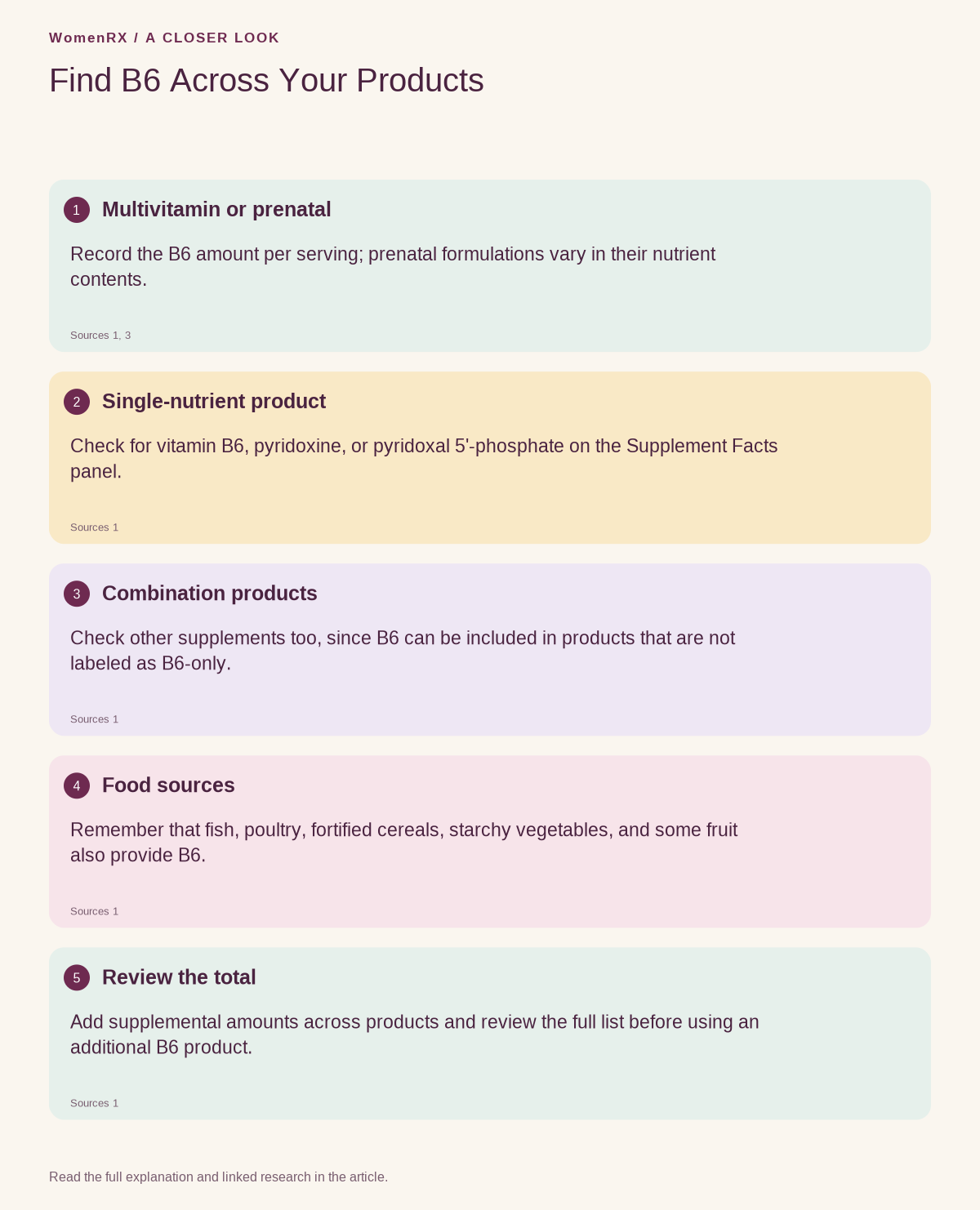
Find B6 Across Your Products
Multivitamin or prenatal: Record the B6 amount per serving; prenatal formulations vary in their nutrient contents.13
Single-nutrient product: Check for vitamin B6, pyridoxine, or pyridoxal 5'-phosphate on the Supplement Facts panel.1
Combination products: Check other supplements too, since B6 can be included in products that are not labeled as B6-only.1
Food sources: Remember that fish, poultry, fortified cereals, starchy vegetables, and some fruit also provide B6.1
Review the total: Add supplemental amounts across products and review the full list before using an additional B6 product.1
Read the figure as text
Use this label check to see where supplemental B6 is coming from before adding another product.- Multivitamin or prenatal: Record the B6 amount per serving; prenatal formulations vary in their nutrient contents.13
- Single-nutrient product: Check for vitamin B6, pyridoxine, or pyridoxal 5'-phosphate on the Supplement Facts panel.1
- Combination products: Check other supplements too, since B6 can be included in products that are not labeled as B6-only.1
- Food sources: Remember that fish, poultry, fortified cereals, starchy vegetables, and some fruit also provide B6.1
- Review the total: Add supplemental amounts across products and review the full list before using an additional B6 product.1
Sources you can check
- Vitamin B6 - Health Professional Fact SheetAccessed 2026-09-25Return to first citation
- Estimation of Total Usual Dietary Intakes of Pregnant Women in the United States.Bailey RL, Pac SG, Fulgoni VL, Reidy KC, Catalano PM. · JAMA network open · 2019Return to first citation
- Micronutrient Gaps and Supplement Use in a Diverse Cohort of Pregnant Women.Crawford SA, Brown AR, Teruel Camargo J, Kerling EH, Carlson SE, Gajewski BJ, Sullivan DK, Valentine CJ. · Nutrients · 2023Return to first citation
- Comparative Effectiveness of Pharmacological and Non-Pharmacological Interventions for Nausea and Vomiting in Pregnancy: A Systematic Review and Network Meta-Analysis.Frivaldszky L, Obeidat M, Hegyi P, Kárpáti C, Kobza Z, Ács N, Bánhidy F, Agócs G, Szentes BL, Keszthelyi M. · Nutrients · 2026Return to first citation
- Comparison of ginger with vitamin B6 in relieving nausea and vomiting during pregnancy.Firouzbakht M, Nikpour M, Jamali B, Omidvar S. · Ayu · 2014Return to first citation