How to Check a Vitamin B6 Supplement Label
The number that matters most may be the B6 you already get from a multivitamin or another supplement.
Start by adding up vitamin B6 from every supplement you take, not just the bottle you’re considering. For each product, multiply its B6 amount per serving by the number of servings you take, then add those results. Check the form, other ingredients, and any testing claim separately. More B6 isn’t automatically better, and excessive intake can harm nerves. 12
Make one total from all your supplements
Vitamin B6 can appear in a multivitamin, B-complex, or stand-alone supplement. 1 If you already take one of those, the amount on a new bottle is only part of the picture.
Put your products side by side, including a prenatal if you take one. For each, write down the B6 amount listed for one serving and how many servings you actually take in a day. Multiply those two figures for each product, then add the results. If you take two servings of a product, count its B6 twice. That gives you a daily supplement subtotal, not a complete count of B6 from food.
B6 also occurs naturally in food and is added to some foods. In the U.S., food labels don’t have to list B6 unless it has been added, so a supplement-label calculation won’t capture your entire diet. 1
The amount, the form, and the Daily Value do different jobs
The label may name pyridoxine hydrochloride, the most common B6 form in supplements, or pyridoxal 5′-phosphate, often shortened to PLP. PLP is an active coenzyme form of B6. That description alone doesn’t establish that a PLP product will work better for the reason you’re considering it. 1
You may also see a percentage of Daily Value. The U.S. Daily Value for B6 is 1.7 mg for adults and children age 4 and older. It helps you compare nutrient amounts; it is not a safety ceiling or a sign that a higher-percentage product is better for you. 1
Next, scan the rest of the ingredient list. A product marketed for a particular symptom may contain more than B6, while another product you already take may contain B6 even if its name doesn’t mention it. Check the listed ingredients rather than relying on the front of the bottle. If a brand advertises testing, look for who performed it and what was tested. An unclear claim is a reason to ask for specifics, not a reason to assume the product has been independently checked.
Why the combined amount deserves attention
Excessive B6 intake can cause peripheral neuropathy, a type of nerve injury. In a 2023 assessment, the European Food Safety Authority set a tolerable upper intake level of 12 mg per day for adults, including pregnant and lactating women. That level concerns total intake, not just your supplement subtotal. The panel also identified uncertainty in the human evidence about the dose at which nerve problems begin. This is European guidance, not a U.S. label target or a personal dosing instruction. 2
A practical next move is to compare your supplement subtotal with current safety guidance for your situation before adding another B6 product. If you’re unsure what counts toward your total, take photos of the labels to a pharmacist or your care team. The point is to spot overlap, especially when a multivitamin or prenatal is already in the mix.
Match the reason for taking it to the evidence
If you’re considering B6 for premenstrual syndrome (PMS), there’s some evidence of symptom benefit, but many studies have been small or methodologically weak. A randomized trial in 78 women with PMS compared B6 with a broad-spectrum micronutrient formula over three treatment cycles. Both groups improved, but there was no placebo group, so that trial can’t tell you how much improvement B6 provides compared with no treatment. It also doesn’t make a high-dose product the right choice for you. 14
Pregnancy-related nausea is a different question. Trials and reviews have found possible benefit from B6, while conclusions about its effect on its own and how treatments compare remain uncertain. A 2026 review of randomized trials found that differences among treatments and limited reporting of adverse effects made firm comparisons difficult. If nausea is why you’re considering B6, count what’s already in your prenatal and discuss the specific product with your pregnancy-care team rather than treating a general supplement label as a nausea-treatment plan. 13
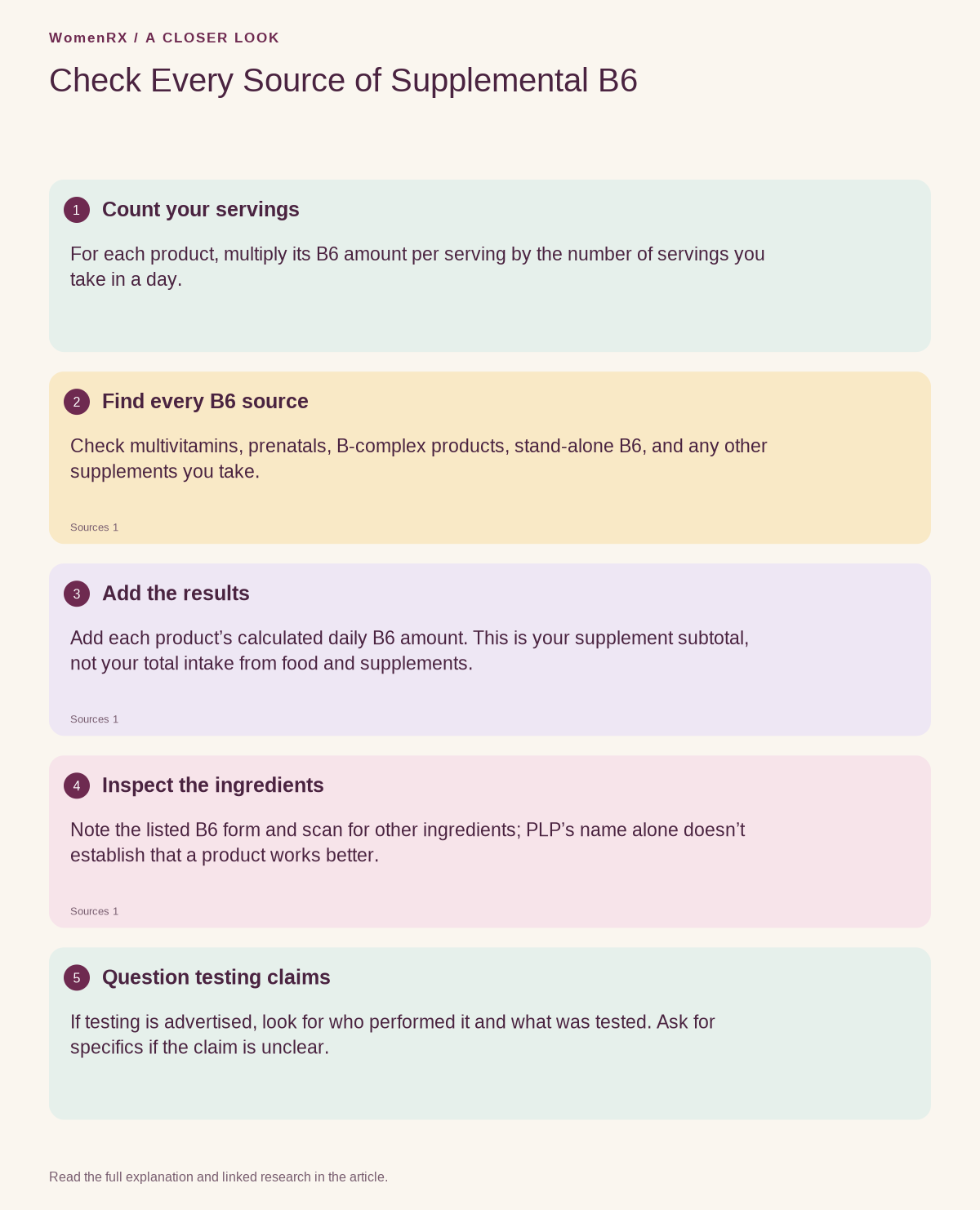
Check Every Source of Supplemental B6
Count your servings: For each product, multiply its B6 amount per serving by the number of servings you take in a day.
Find every B6 source: Check multivitamins, prenatals, B-complex products, stand-alone B6, and any other supplements you take.1
Add the results: Add each product’s calculated daily B6 amount. This is your supplement subtotal, not your total intake from food and supplements.1
Inspect the ingredients: Note the listed B6 form and scan for other ingredients; PLP’s name alone doesn’t establish that a product works better.1
Question testing claims: If testing is advertised, look for who performed it and what was tested. Ask for specifics if the claim is unclear.
Read the figure as text
Use this checklist to calculate your daily supplement subtotal, then inspect what else a product offers or claims.- Count your servings: For each product, multiply its B6 amount per serving by the number of servings you take in a day.
- Find every B6 source: Check multivitamins, prenatals, B-complex products, stand-alone B6, and any other supplements you take.1
- Add the results: Add each product’s calculated daily B6 amount. This is your supplement subtotal, not your total intake from food and supplements.1
- Inspect the ingredients: Note the listed B6 form and scan for other ingredients; PLP’s name alone doesn’t establish that a product works better.1
- Question testing claims: If testing is advertised, look for who performed it and what was tested. Ask for specifics if the claim is unclear.
More questions, answered
Does PLP on the label mean the product is better?
Not necessarily. PLP is an active coenzyme form of B6, while pyridoxine hydrochloride is common in supplements. The form’s name alone doesn’t show that the product will work better for PMS or pregnancy-related nausea. 1
Sources you can check
- Vitamin B6 - Health Professional Fact SheetAccessed 2026-09-25Return to first citation
- Scientific opinion on the tolerable upper intake level for vitamin B6.EFSA Panel on Nutrition, Novel Foods and Food Allergens (NDA), Turck D, Bohn T, Castenmiller J, de Henauw S, Hirsch-Ernst KI, Knutsen HK, Maciuk A, Mangelsdorf I, McArdle HJ, Pelae... · EFSA journal. European Food Safety Authority · 2023Return to first citation
- Comparative Effectiveness of Pharmacological and Non-Pharmacological Interventions for Nausea and Vomiting in Pregnancy: A Systematic Review and Network Meta-Analysis.Frivaldszky L, Obeidat M, Hegyi P, Kárpáti C, Kobza Z, Ács N, Bánhidy F, Agócs G, Szentes BL, Keszthelyi M. · Nutrients · 2026Return to first citation
- A Pilot Randomized Treatment-Controlled Trial Comparing Vitamin B6 with Broad-Spectrum Micronutrients for Premenstrual Syndrome.Retallick-Brown H, Blampied N, Rucklidge JJ. · Journal of alternative and complementary medicine (New York, N.Y.) · 2020Return to first citation