Vitamin B6 Supplements: Add Up Every Product
Check the label on each product, including any prenatal, before adding another source of vitamin B6.
Check the Supplement Facts panel on every multivitamin, prenatal, B-complex, and standalone product you use, then add the listed vitamin B6 amounts for your daily servings. B6 may appear as pyridoxine or pyridoxal 5′-phosphate (PLP). In US guidance, the adult upper limit is 100 mg a day from food and supplements, but it is not a target or a guarantee that lower amounts cannot cause problems. 1
Vitamin B6 is available in multivitamins, B-complex supplements, and standalone products. If you use several products, check the labels together rather than judging each one on its own. Include any prenatal or pregnancy-related supplement in that check rather than assuming what it contains.
Add the amounts on your labels
Look in each product’s Supplement Facts panel for “Vitamin B6.” The ingredient may be listed as pyridoxine or pyridoxal 5′-phosphate, also called PLP. The NIH Office of Dietary Supplements identifies pyridoxine as a common supplement form and notes that some products contain PLP. 1
Write down the amount per serving and how many servings you take in a day. Multiply where needed, then add the amounts from all products. This gives you a practical total from supplements. The US Food and Nutrition Board’s upper limit includes B6 from food as well as supplements, so a label-only sum isn’t your full daily intake. Still, it can make overlapping products easier to spot. 1
For context, the recommended amount is not the same as the upper limit. For women ages 19-50, the recommended dietary allowance is 1.3 mg daily; it is 1.9 mg during pregnancy and 2.0 mg while breastfeeding. For women 51 and older, it is 1.5 mg. These are recommended amounts for meeting needs, not goals for supplement stacking. 1
An upper limit is not a personal safety guarantee
For adults 19 and older, including pregnant and breastfeeding adults, the US Food and Nutrition Board’s upper limit is 100 mg per day from all sources. It is a limit set as the highest daily intake unlikely to cause adverse effects, not a dose to aim for and not a line that proves a lower amount is safe for every person. The NIH fact sheet also describes uncertainty in the evidence used to set that limit. 1
Authorities have reached different limits using different assessments. In 2023, the European Food Safety Authority set an adult upper limit of 12 mg daily, including during pregnancy and lactation. That is not the US limit, but the difference is a reason not to treat any single number as a personalized guarantee. 1 3
High, prolonged pyridoxine intake can cause sensory neuropathy. In severe cases, toxicity can affect coordination. Human evidence supports a link between excessive B6 intake and neuropathy, but a symptom by itself can’t establish that B6 is the cause. Neuropathy has many possible causes, and the exact intake level and time to symptoms are not reliably defined for every person. 1 2 3
If you’re pregnant or taking B6 for nausea
If you’re considering a separate B6 product for pregnancy-related nausea, check the prenatal or other pregnancy-related supplement’s actual label and include its listed B6 amount in your total. Discuss the products and amounts with your pregnancy-care clinician before adding more. NIH’s summary of pregnancy guidance specifically cautions that treatment doses can approach the upper limit. 1
Don’t stop a prenatal or a treatment recommended for you based only on a label comparison. Instead, show the labels to your clinician or pharmacist so they can review the combined amount and why you’re taking each product.
If you notice sensory changes
If you notice new or persistent sensory changes while taking B6-containing products, show a clinician or pharmacist the labels and explain how much you take and when you started. Mention every product, not just the one labeled “B6.” This can help review your exposure, but it can’t diagnose the cause of the symptoms. 1 2
Avoid adding another B6-containing supplement while you’re sorting out your total. Ask whether any non-prescribed product should be paused or changed, especially if you’re pregnant or taking a prescribed treatment. NIH reports that symptoms from excessive pyridoxine intake often stop after the supplement is discontinued when neurologic symptoms first appear. 1
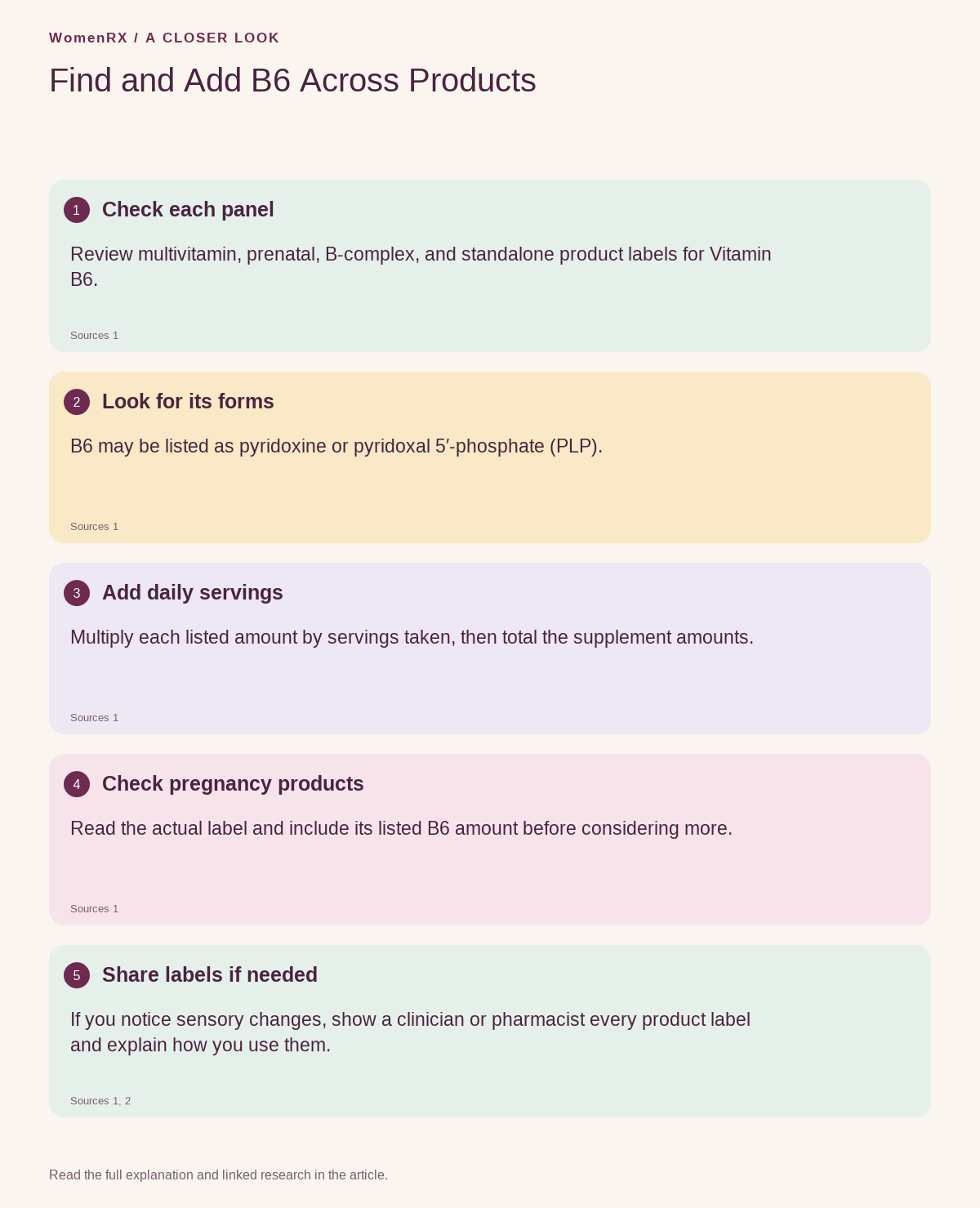
Find and Add B6 Across Products
Check each panel: Review multivitamin, prenatal, B-complex, and standalone product labels for Vitamin B6.1
Look for its forms: B6 may be listed as pyridoxine or pyridoxal 5′-phosphate (PLP).1
Add daily servings: Multiply each listed amount by servings taken, then total the supplement amounts.1
Check pregnancy products: Read the actual label and include its listed B6 amount before considering more.1
Share labels if needed: If you notice sensory changes, show a clinician or pharmacist every product label and explain how you use them.12
Read the figure as text
Use this label check to identify overlapping B6 amounts and gather useful information for a product review.- Check each panel: Review multivitamin, prenatal, B-complex, and standalone product labels for Vitamin B6.1
- Look for its forms: B6 may be listed as pyridoxine or pyridoxal 5′-phosphate (PLP).1
- Add daily servings: Multiply each listed amount by servings taken, then total the supplement amounts.1
- Check pregnancy products: Read the actual label and include its listed B6 amount before considering more.1
- Share labels if needed: If you notice sensory changes, show a clinician or pharmacist every product label and explain how you use them.12
More questions, answered
Should I count B6 from food when checking products?
The US adult upper limit applies to B6 from food and supplements. For a practical product check, first add the amounts listed on your supplement labels; remember that this is not your total intake from all sources. NIH reports no adverse effects from high B6 intake from food sources, unlike the recognized concern with excessive supplement intake. 1
Sources you can check
- Vitamin B6 - Health Professional Fact SheetAccessed 2026-09-25Return to first citation
- The Role of Vitamin B6 in Peripheral Neuropathy: A Systematic Review.Muhamad R, Akrivaki A, Papagiannopoulou G, Zavridis P, Zis P. · Nutrients · 2023Return to first citation
- Scientific opinion on the tolerable upper intake level for vitamin B6.EFSA Panel on Nutrition, Novel Foods and Food Allergens (NDA), Turck D, Bohn T, Castenmiller J, de Henauw S, Hirsch-Ernst KI, Knutsen HK, Maciuk A, Mangelsdorf I, McArdle HJ, Pelae... · EFSA journal. European Food Safety Authority · 2023Return to first citation