Vitamin B6: What Treatment Can Change, and the Risks
Treating a real B6 deficiency addresses low B6, while long-term excessive supplemental intake can harm nerves.
If you’re low in vitamin B6, replacing what’s missing addresses the deficiency, but whether a symptom improves depends on whether B6 was its cause. Nerve symptoms alone don’t tell you to take more: high supplemental B6 can itself harm sensory nerves. Check your daily B6 across products and how long you’ve taken them, especially if new symptoms appear. 1 2
First, is low B6 actually the problem?
Vitamin B6 deficiency can cause changes such as anemia, skin inflammation, cracked lips, a swollen tongue, confusion, and weakened immune function. But isolated deficiency is uncommon in the United States, and similar symptoms can have other causes. Risk is higher with some conditions, including kidney disease and problems absorbing nutrients, and with some medications. A symptom by itself can’t confirm that B6 is the cause. 1
That distinction matters especially if you’re considering B6 for nerve symptoms. A 2023 systematic review found that high B6 levels, usually associated with supplement use, can cause predominantly sensory nerve damage. But it found no firm evidence that low B6 directly causes peripheral neuropathy, and no evidence establishing B6 alone as a treatment for neuropathy. Some reports of improvement involved B6 combined with other vitamins, so they can’t show that B6 itself helped. 2
What changes after deficiency treatment?
Correcting a confirmed deficiency addresses an inadequate nutrient level. It doesn’t, by itself, tell you whether or when a particular symptom will improve: that depends on whether the symptom was related to B6 deficiency and what caused the low level. For example, low mood or tingling on its own isn’t a reason to assume B6 is the missing piece. 1 2
If a deficiency is suspected, the useful next step is to work out why. Poor absorption, kidney disease, and certain medicines can be relevant; treating the underlying issue may matter alongside replacing the vitamin. Don’t assume that a higher dose will work faster. The amount used for medical treatment may differ from routine nutrition needs, and ongoing medical treatment should be supervised. 1
When more B6 can become a nerve risk
Long-term excessive B6 from supplements can cause sensory neuropathy, a problem affecting the nerves that carry sensation. The NIH Office of Dietary Supplements describes severe, progressive neuropathy after chronic use of very high oral pyridoxine amounts; symptoms can include loss of coordination. The risk is a reason to take new numbness, painful sensations, or balance problems seriously when you’re using B6, rather than adding more for a suspected deficiency. 1
There isn’t a single intake threshold that guarantees safety for every person. The U.S. adult tolerable upper intake level is 100 mg per day from all sources, but that is a population-level upper limit, not a suggested target or proof that long-term intake below it cannot cause harm. In 2023, the European Food Safety Authority set a lower adult upper limit of 12 mg per day. The different limits reflect differing assessments of the evidence; neither is a reason to take B6 without a clear need. 1
Count B6 across the whole shelf
B6 may appear in a multivitamin, a B-complex product, and a standalone supplement. Check the Supplement Facts panel on each one and add the amounts listed for vitamin B6. It may be named pyridoxine hydrochloride or pyridoxal 5′-phosphate (PLP). The NIH fact sheet notes that pyridoxine is the most common form in supplements. Don’t treat a product’s “B-complex” or “nerve support” wording as a substitute for checking the amount. 1
The recommended amount changes with life stage, but that doesn’t mean everyone needs a separate high-dose supplement. For adults ages 19-50, the recommended dietary allowance is 1.3 mg daily; it is 1.5 mg for women 51 and older, 1.9 mg during pregnancy, and 2.0 mg while lactating. These are daily intake recommendations, not treatment doses. 1
Pregnancy-related use deserves its own distinction: the recommended intake is higher during pregnancy, but that alone doesn’t show that extra B6 treats a particular symptom. The NIH fact sheet describes an observational study of pregnant women taking a mean of about 132 mg daily for several weeks that found no association with birth defects. An observational finding at that intake doesn’t establish that high-dose use is effective or risk-free. Use pregnancy-specific supplements with a clear understanding of their B6 content rather than stacking products. 1
A practical check before taking it
Write down the B6 amount in each supplement you use, including a multivitamin, B-complex, and standalone product, and note how long you’ve used each one. If you’re considering B6 for symptoms, or you’ve developed new numbness, pain, or trouble with coordination while taking it, review the total and duration with a clinician or pharmacist. The key question isn’t simply whether B6 can help: it’s whether a deficiency is present and whether the amount and length of use make sense for you.
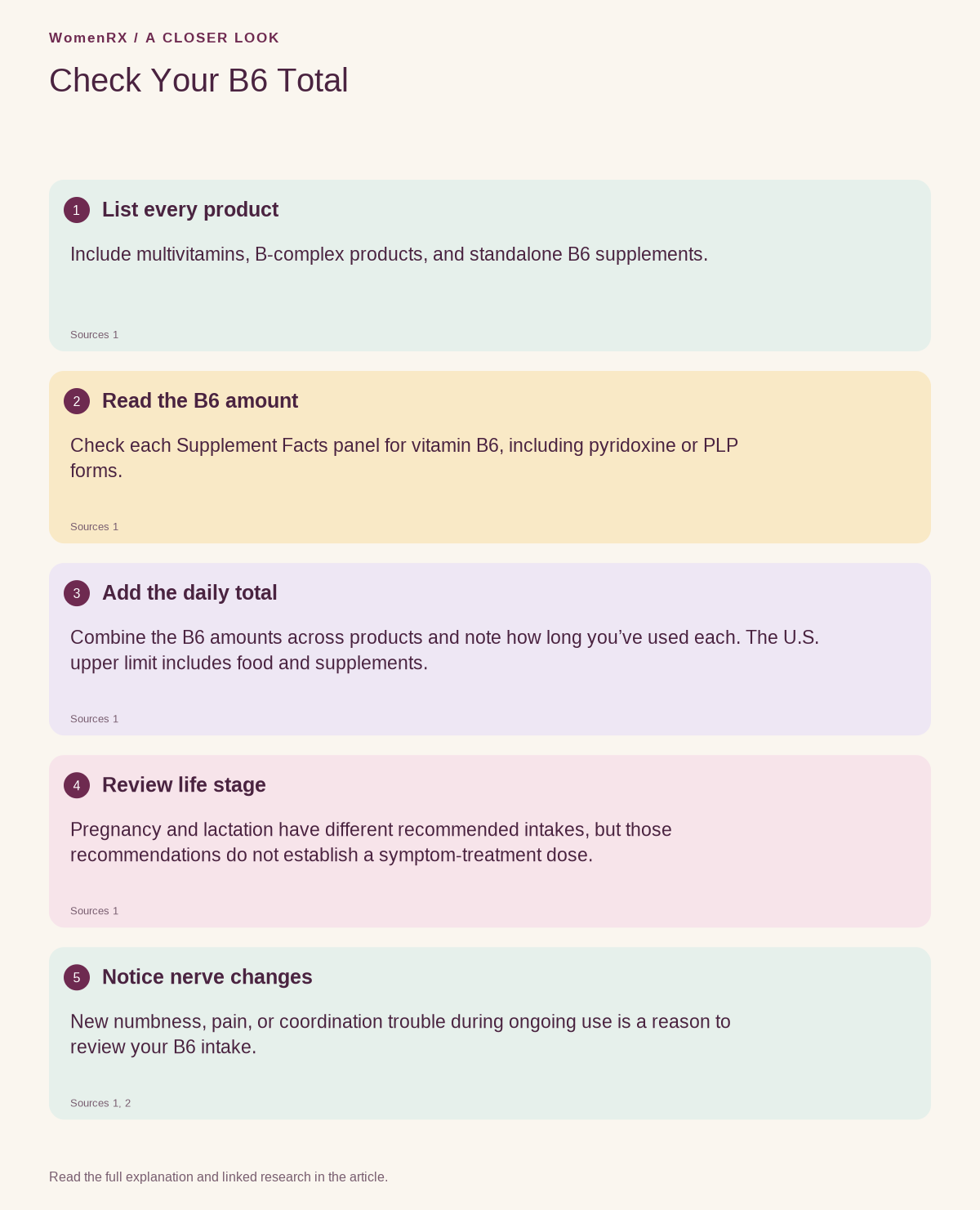
Check Your B6 Total
List every product: Include multivitamins, B-complex products, and standalone B6 supplements.1
Read the B6 amount: Check each Supplement Facts panel for vitamin B6, including pyridoxine or PLP forms.1
Add the daily total: Combine the B6 amounts across products and note how long you’ve used each. The U.S. upper limit includes food and supplements.1
Review life stage: Pregnancy and lactation have different recommended intakes, but those recommendations do not establish a symptom-treatment dose.1
Notice nerve changes: New numbness, pain, or coordination trouble during ongoing use is a reason to review your B6 intake.12
Read the figure as text
Use this label check to spot overlapping B6 products and know what to review if symptoms arise.- List every product: Include multivitamins, B-complex products, and standalone B6 supplements.1
- Read the B6 amount: Check each Supplement Facts panel for vitamin B6, including pyridoxine or PLP forms.1
- Add the daily total: Combine the B6 amounts across products and note how long you’ve used each. The U.S. upper limit includes food and supplements.1
- Review life stage: Pregnancy and lactation have different recommended intakes, but those recommendations do not establish a symptom-treatment dose.1
- Notice nerve changes: New numbness, pain, or coordination trouble during ongoing use is a reason to review your B6 intake.12
More questions, answered
Can B6 from food cause nerve damage?
The NIH fact sheet reports no adverse effects from high B6 intake from food. The neuropathy concern described there is associated with excessive supplemental intake. 1
Does a higher B6 level prove my nerve symptoms are from the supplement?
No. In a study of 261 people with chronic idiopathic neuropathy, moderately elevated plasma B6 levels were not associated with worse symptoms or examination findings. That study doesn’t rule out harm from higher or prolonged intake, and it cannot determine whether stopping a supplement improves symptoms. 3
Sources you can check
- Vitamin B6 - Health Professional Fact SheetAccessed 2026-09-25Return to first citation
- The Role of Vitamin B6 in Peripheral Neuropathy: A Systematic Review.Muhamad R, Akrivaki A, Papagiannopoulou G, Zavridis P, Zis P. · Nutrients · 2023Return to first citation
- Vitamin B6 levels do not correlate with severity of neuropathy in chronic idiopathic axonal polyneuropathy.Stewart SL, Thomas S, Höke E, Simpson D, Singleton JR, Höke A. · Journal of the peripheral nervous system : JPNS · 2022Return to first citation