Vitamin B6 Deficiency: Signs and Testing
B6 deficiency can affect the skin, mouth, blood and nervous system, but those clues overlap with other conditions and with harm from excess supplements.
Vitamin B6 deficiency is uncommon in the United States, and symptoms alone can’t confirm it. Possible signs include a scaly rash, cracked lips or mouth corners, a swollen tongue, anemia, confusion and sensory changes. A blood test can measure pyridoxal 5′-phosphate (PLP), but results need context: supplements can affect levels, and published cutoffs vary. Excess supplemental B6 can also cause nerve symptoms, so review all sources before adding more. 1 2 3
What deficiency can look like
B6 deficiency may cause several kinds of changes rather than one telltale symptom. Possible findings include microcytic anemia; dermatitis, sometimes with scaling on the lips and cracks at the mouth corners; a swollen tongue; depression or confusion; and weakened immune function. Sensory changes can occur too. Mild deficiency may cause no noticeable symptoms for months or years, and these findings can have other explanations. They’re clues to assess, not a way to diagnose yourself. 1 3
Frank deficiency is relatively rare in the United States. The chance of low B6 status may be more relevant with certain conditions, including kidney disease, malabsorption conditions such as celiac disease or Crohn’s disease, and alcohol dependence. Some medications, including certain antiseizure medicines, can also affect B6 status over time. That history helps make a symptom more or less meaningful; it doesn’t prove deficiency. 1
Why nerve symptoms need a two-sided review
Numbness or other sensory changes aren’t a simple signal to take B6. Deficiency can be associated with sensory abnormalities, while chronic excessive pyridoxine from supplements can cause sensory neuropathy, sometimes with ataxia, or difficulty coordinating movement. Excess intake has also been associated with skin lesions, sensitivity to light, nausea and heartburn. The nerve symptoms can overlap, so taking extra B6 as a test could add to the problem rather than clarify it. 1 3
When discussing symptoms, include supplements as well as food and prescribed medicines. Note any B6-containing product you take and the amount stated for it, including multivitamins, B-complex products and standalone B6 supplements. Pyridoxine is a common supplement form; some products contain PLP. 1
How a clinician may assess B6 status
A blood test can measure pyridoxal 5′-phosphate, or PLP, the main circulating active form of B6. The result is one part of the assessment, not a standalone explanation for symptoms. PLP levels can be influenced by B6 from food and supplements, and low levels may occur alongside other conditions. 1 2
There isn’t a single cutoff that settles every case. One discussion of B6 status describes thresholds around 20 or 30 nmol/L, reflecting differences in how low or borderline status has been defined. A clinician interprets a result alongside your symptoms, health conditions, medication history and supplement use rather than treating a number as a diagnosis by itself. 3
That context matters because kidney disease can cause symptoms similar to B6 deficiency, and low B6 status often occurs alongside low levels of other B vitamins. A low result may prompt a broader look at what could be affecting your status, not just a recommendation to add a supplement. 1
Pregnancy and B6 for nausea
B6 is used in the management of pregnancy-associated nausea and vomiting, but using it for nausea doesn’t mean you have a deficiency. If you’re pregnant and considering B6, or already taking it, include the product and its stated amount in a conversation about your overall intake. The recommended dietary allowance for adults ages 19-50 is 1.3 mg daily, and for pregnancy it is 1.9 mg; these reference amounts are not a diagnosis or a personal treatment plan. 1 4
The practical takeaway is to investigate both possibilities when nerve symptoms are part of the picture: too little B6 in the right context, or too much from supplements. A clinician can decide whether a PLP blood test is useful and interpret it with your full supplement and medication picture.
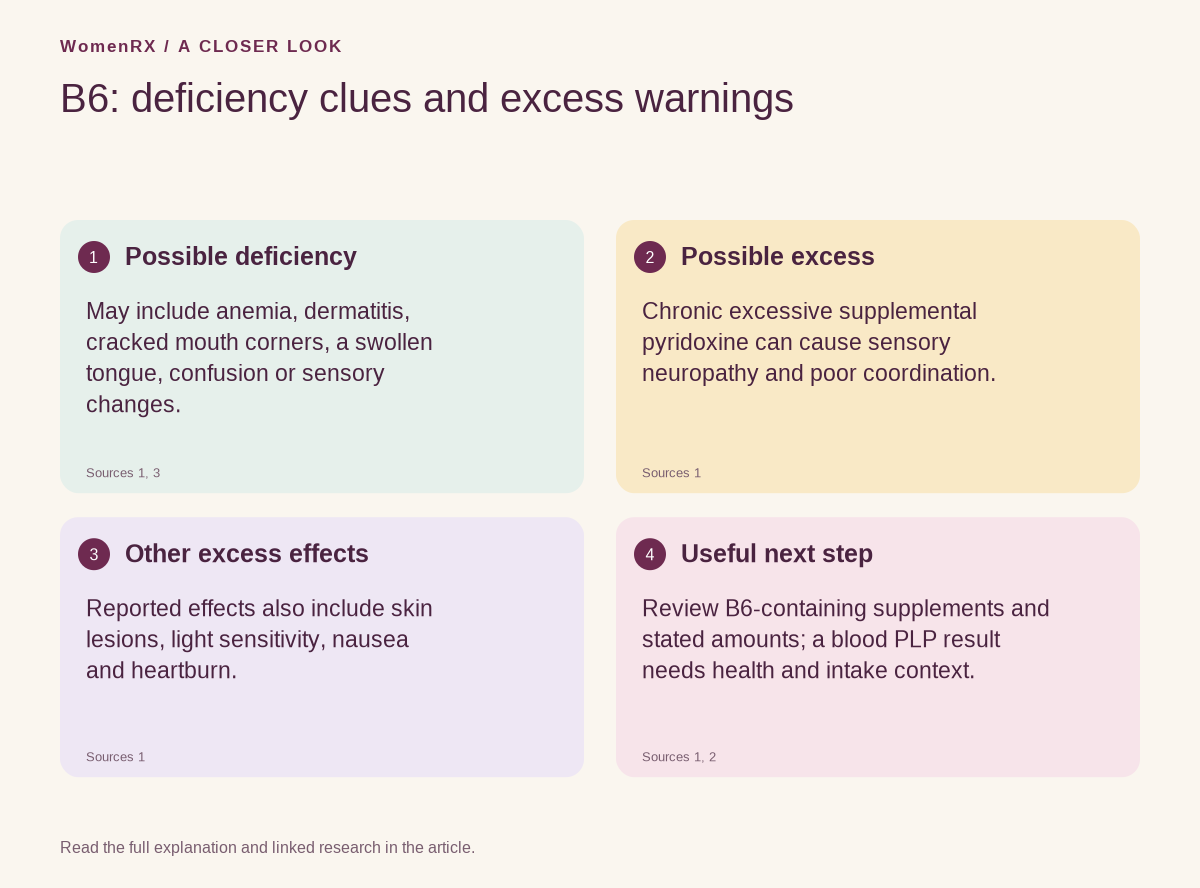
B6: deficiency clues and excess warnings
Possible deficiency: May include anemia, dermatitis, cracked mouth corners, a swollen tongue, confusion or sensory changes.13
Possible excess: Chronic excessive supplemental pyridoxine can cause sensory neuropathy and poor coordination.1
Other excess effects: Reported effects also include skin lesions, light sensitivity, nausea and heartburn.1
Useful next step: Review B6-containing supplements and stated amounts; a blood PLP result needs health and intake context.12
Read the figure as text
Some nerve symptoms can occur with either low status or excess supplemental B6. These patterns are clues for a full assessment, not a way to diagnose yourself.- Possible deficiency: May include anemia, dermatitis, cracked mouth corners, a swollen tongue, confusion or sensory changes.13
- Possible excess: Chronic excessive supplemental pyridoxine can cause sensory neuropathy and poor coordination.1
- Other excess effects: Reported effects also include skin lesions, light sensitivity, nausea and heartburn.1
- Useful next step: Review B6-containing supplements and stated amounts; a blood PLP result needs health and intake context.12
More questions, answered
Can a rash or cracked lips confirm B6 deficiency?
No. Dermatitis, cracks at the corners of the mouth and a swollen tongue are possible deficiency findings, but they aren’t specific enough to diagnose B6 deficiency on their own. 1
Should I take B6 to see if my symptoms improve?
No. Deficiency and excess supplemental B6 can both be associated with nerve symptoms. Review your current products and amounts before adding B6, and ask whether a PLP blood test makes sense. 1 3
Sources you can check
- Vitamin B6 - Health Professional Fact SheetAccessed 2026-09-25Return to first citation
- Vitamin B6 challenge as a tool for detecting ALPL mutations and diagnosing hypophosphatasia.Alvarez S, Ocampo A, Caso PC, Del Real A, Puente N, Vega AI, Riancho-Zarrabeitia L, García-Unzueta MT, Riancho JA. · Osteoporosis international : a journal established as result of cooperation between the European Foundation for Osteoporosis and the National Osteoporosis Foundation of the USA · 2025Return to first citation
- Association between serum pyridoxal 5'-phosphate levels and chronic obstructive pulmonary disease: findings based on NHANES 2005-2010.Liu Y, Yan J. · Frontiers in nutrition · 2024Return to first citation
- Vitamin B6 (Pyridoxine)Abosamak NR, Rout P. · 2026Return to first citation