Vitamin B6: How Much You Need, and When to Check
Your daily target depends on age and life stage, but adding up every supplement matters more than choosing the highest-dose bottle.
For most adult women ages 19-50, the recommended intake is 1.3 mg of vitamin B6 a day; it rises to 1.5 mg after 50, 1.9 mg during pregnancy, and 2.0 mg while breastfeeding. Check the B6 amount in each supplement and fortified product you use. The U.S. adult upper limit is 100 mg a day from all sources, but it is a ceiling, not a goal. 1 2
Start with your life-stage target
The recommended dietary allowance (RDA) is a daily planning target for healthy people, not a dose you need to take as a pill. For women ages 19-50, the RDA is 1.3 mg daily. It is 1.5 mg at age 51 and older. For teens ages 14-18, it is 1.2 mg. Pregnancy raises the RDA to 1.9 mg, and breastfeeding raises it to 2.0 mg. 1 2
Those pregnancy and breastfeeding values are higher than the RDA for most adult women. The reference values do not set a higher target just because you are cycling or in perimenopause, and the adult RDA is already higher after age 50. 1
Food can contribute without a supplement
B6 is found in many foods, including fish, poultry, potatoes, chickpeas, bananas, and fortified cereals. For example, a cup of chickpeas provides 1.1 mg; a medium banana provides 0.4 mg. These are examples, not required daily servings. U.S. adults get B6 from a mix of foods such as fortified cereals, meat, poultry, starchy vegetables, and some fruit. 1
The FDA Daily Value shown on many labels is 1.7 mg. That is a reference for comparing products, not the exact RDA for every woman: it is above the RDA for women ages 19-50 and below the pregnancy and breastfeeding RDAs. 1
Do a label audit before adding B6
B6 may appear in a multivitamin, prenatal vitamin, B-complex, or standalone product. The amount per serving can differ, so look for “Vitamin B6” in the Supplement Facts panel and note the milligrams (mg). It may be listed as pyridoxine or pyridoxal 5′-phosphate (PLP). Add the amounts from products you actually take, checking whether the label’s serving is one pill or more. B6 from fortified foods contributes too. 1
Example: If a multivitamin and a separate B-complex both list B6, count both amounts rather than judging either product on its own. Then consider food and fortified-food contributions when comparing your overall intake with the upper limit. You do not need to take a supplement just because a product’s amount is higher than your RDA; the goal is adequate intake, not the biggest number.
The upper limit is not a target
The U.S. tolerable upper intake level (UL) for B6 is 100 mg per day for adults, including women who are pregnant or breastfeeding. For ages 14-18, it is 80 mg per day. The U.S. UL applies to total intake from food and supplements. It means the highest daily intake unlikely to cause adverse effects for the general population; it does not mean that intake near the limit is useful or that everyone faces the same risk at every dose and duration. 1 2
There is a meaningful difference among authorities: the European Food Safety Authority set a much lower adult UL of 12 mg per day in 2023, including during pregnancy and lactation, based on its review of peripheral neuropathy evidence. The U.S. and European limits reflect different assessments of the evidence. Neither figure is a recommended supplement dose. 1
Why long-term excess deserves attention
Excess B6 from food has not been reported to cause adverse effects. Chronic, very high oral pyridoxine doses can cause sensory neuropathy and loss of coordination (ataxia). Reported severity appears related to dose, and symptoms usually stop if pyridoxine is discontinued when neurological symptoms appear. This does not mean the risk is identical at every dose or that a symptom automatically proves B6 toxicity. 1
If you’re taking B6 products, check their labels and count overlapping amounts. The U.S. UL is a useful point of comparison when you add up total intake. B6 used for medical treatment is a different situation: the UL does not apply to people receiving it for treatment, who should be under a physician’s care. Some rare conditions require specialist-supervised B6 treatment, which is not routine nutritional supplementation. 1 3 4
For most women, the practical move is simple: meet the life-stage target through food and appropriate supplements, count overlapping products, and do not treat the upper limit as a goal.
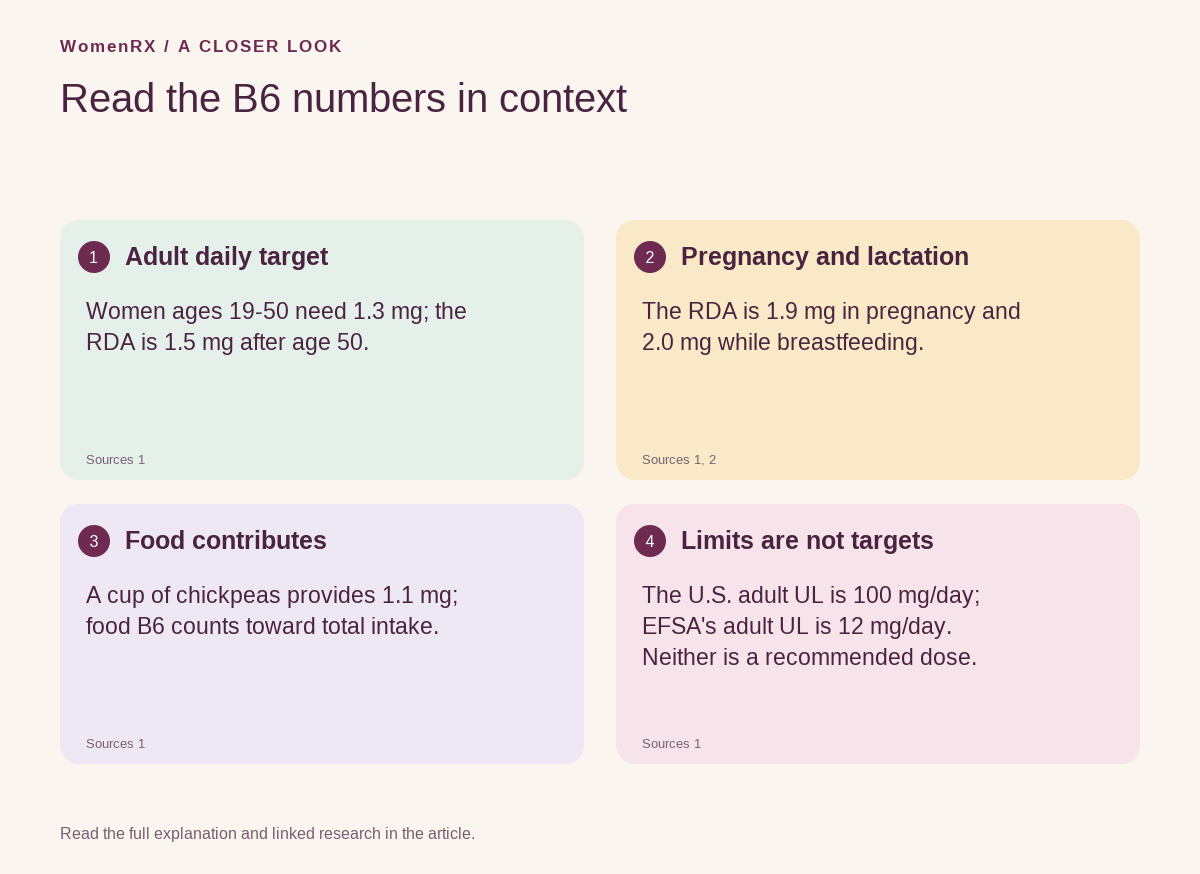
Read the B6 numbers in context
Adult daily target: Women ages 19-50 need 1.3 mg; the RDA is 1.5 mg after age 50.1
Pregnancy and lactation: The RDA is 1.9 mg in pregnancy and 2.0 mg while breastfeeding.12
Food contributes: A cup of chickpeas provides 1.1 mg; food B6 counts toward total intake.1
Limits are not targets: The U.S. adult UL is 100 mg/day; EFSA's adult UL is 12 mg/day. Neither is a recommended dose.1
Read the figure as text
Daily needs, food contributions, and safety limits answer different questions. Compare them before adding another supplement.- Adult daily target: Women ages 19-50 need 1.3 mg; the RDA is 1.5 mg after age 50.1
- Pregnancy and lactation: The RDA is 1.9 mg in pregnancy and 2.0 mg while breastfeeding.12
- Food contributes: A cup of chickpeas provides 1.1 mg; food B6 counts toward total intake.1
- Limits are not targets: The U.S. adult UL is 100 mg/day; EFSA's adult UL is 12 mg/day. Neither is a recommended dose.1
More questions, answered
Does a prenatal vitamin mean I should take extra B6?
Not automatically. Pregnancy raises the B6 RDA to 1.9 mg per day, but the amount in a prenatal product varies. Check its label and count any other B6-containing products before adding a separate supplement. 1 2
Is 100 mg a recommended amount to take?
No. It is the U.S. adult upper limit, the highest daily intake considered unlikely to cause adverse effects for the general population, not a recommended dose or a target. The EFSA limit is lower, but that difference between authorities does not make either limit a supplement goal. 1
Sources you can check
- Vitamin B6 - Health Professional Fact SheetAccessed 2026-09-25Return to first citation
- Dietary Supplements and Life Stages: Pregnancy - Health Professional Fact SheetAccessed 2026-09-25Return to first citation
- Pyridoxine-Dependent Epilepsy - ALDH7A1Gospe SM. · 1993Return to first citation
- PNPO DeficiencyPlecko B, Mills P. · 1993Return to first citation