Does Vitamin B6 Need Change After 40?
For women in the U.S., the recommended intake stays the same through age 50 and rises modestly at 51, but that doesn’t automatically mean you need a supplement.
Being 40 or entering perimenopause doesn’t, by itself, raise the U.S. recommended intake for vitamin B6. For women ages 19-50, the recommended daily amount is 1.3 mg from food and supplements combined; at 51, it rises to 1.5 mg. That’s a small age-based change in total intake, not a recommendation to start a B6 pill. 1
What changes at 51, and what doesn’t
In U.S. guidance, women ages 19-50 have a recommended dietary allowance (RDA) of 1.3 mg of vitamin B6 a day. For women 51 and older, it’s 1.5 mg. So turning 40 doesn’t change the target, and the later increase is modest. The RDA is an amount to get from your overall diet, including fortified foods and any supplements, not a supplement dose to add on top. 1
That distinction matters if a product is marketed as “B6 for women over 40.” A birthday alone doesn’t establish that you need extra B6. The European Food Safety Authority uses a different adult reference intake, which does not replace the age-specific U.S. RDA for women. 1 3
Start with what you already get
B6 is found in a range of everyday foods, including poultry, fish, potatoes, chickpeas, bananas, and some fortified cereals. A varied diet can contribute B6 from several places, so check the whole picture rather than assuming a single food or supplement determines your intake. 1
If you’re considering a supplement, read the Supplement Facts panel and check whether B6 is already in a multivitamin, B-complex product, or another product you take. Add up the amounts across products before deciding that you need another source. This is especially useful for long-term use because chronic excessive B6 intake can cause sensory neuropathy. 1 3
The U.S. adult upper limit is 100 mg per day from all sources, but it is a safety boundary, not a target or a suggested dose. The European authority set a lower adult upper limit of 12 mg per day after reviewing evidence about peripheral neuropathy. These limits come from different assessments; neither means that an amount below the limit is needed or will improve how you feel. 1 3
Perimenopause symptoms are a separate question
B6 has been studied for premenstrual syndrome, but the studies summarized by the NIH have limitations. PMS is not the same question as symptoms during perimenopause or menopause, and those PMS findings don’t establish that B6 treats hot flashes, sleep disruption, or mood changes at midlife. 1
B6 also has roles in normal metabolism, but that fact alone doesn’t show that taking extra will improve energy when your intake is adequate. If fatigue or mood changes are what’s prompting you to consider a supplement, the symptom itself doesn’t tell you that B6 is the cause. 1 2
Check your age-based needs and every B6 label
Use age as one small part of the decision: the U.S. RDA changes at 51, not 40. Then look at your usual food sources and the B6 listed on every supplement label. If you have a health condition, take medicines, or are considering sustained supplement use, ask a clinician or pharmacist to review your specific situation and products.
In short, you don’t need a B6 supplement simply because you’re over 40 or in menopause. The useful question is whether your overall intake meets the age-appropriate recommendation, and whether a supplement’s amount and duration make sense for you.
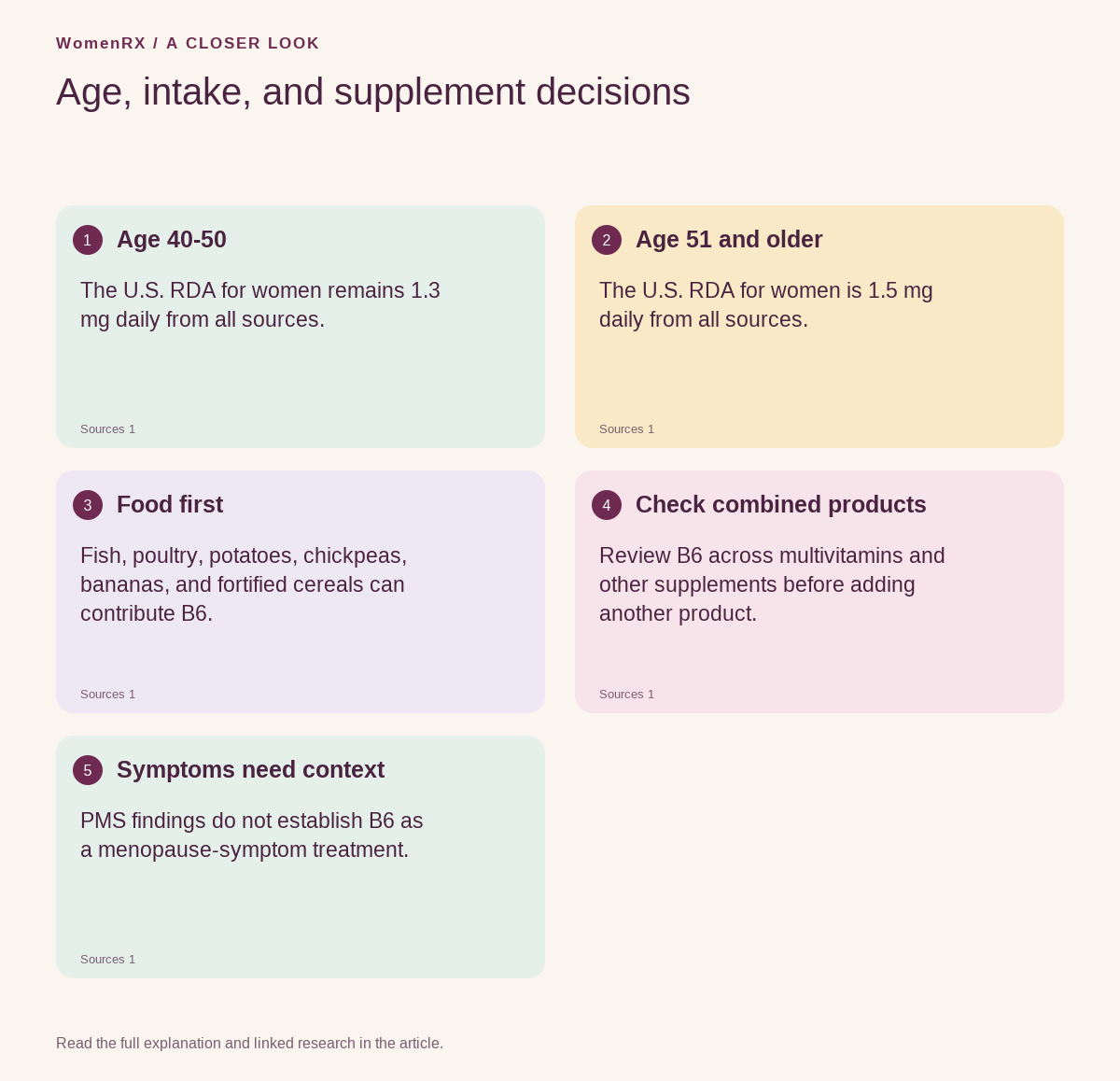
Age, intake, and supplement decisions
Age 40-50: The U.S. RDA for women remains 1.3 mg daily from all sources.1
Age 51 and older: The U.S. RDA for women is 1.5 mg daily from all sources.1
Food first: Fish, poultry, potatoes, chickpeas, bananas, and fortified cereals can contribute B6.1
Check combined products: Review B6 across multivitamins and other supplements before adding another product.1
Symptoms need context: PMS findings do not establish B6 as a menopause-symptom treatment.1
Read the figure as text
Separate the age-specific U.S. intake target from the individual reasons someone might consider a supplement.- Age 40-50: The U.S. RDA for women remains 1.3 mg daily from all sources.1
- Age 51 and older: The U.S. RDA for women is 1.5 mg daily from all sources.1
- Food first: Fish, poultry, potatoes, chickpeas, bananas, and fortified cereals can contribute B6.1
- Check combined products: Review B6 across multivitamins and other supplements before adding another product.1
- Symptoms need context: PMS findings do not establish B6 as a menopause-symptom treatment.1
More questions, answered
Does the B6 RDA mean I should take that amount as a supplement?
No. The RDA is a daily intake target from your diet and supplements combined. It isn’t a recommended pill dose. 1
Does evidence about B6 and PMS apply to menopause symptoms?
Not by itself. PMS research addresses a different life-stage question, and the evidence summarized by the NIH does not establish B6 as a treatment for perimenopause or menopause symptoms. 1
Sources you can check
- Vitamin B6 - Health Professional Fact SheetAccessed 2026-09-25Return to first citation
- Vitamin B6 DeficiencyBrown MJ, Daley SF, Beier K. · 2023Return to first citation
- Scientific opinion on the tolerable upper intake level for vitamin B6.EFSA Panel on Nutrition, Novel Foods and Food Allergens (NDA), Turck D, Bohn T, Castenmiller J, de Henauw S, Hirsch-Ernst KI, Knutsen HK, Maciuk A, Mangelsdorf I, McArdle HJ, Pelae... · EFSA journal. European Food Safety Authority · 2023Return to first citation