Can Food Supply Enough Vitamin B6?
Fish, poultry, potatoes, fruit, and fortified cereal can all contribute vitamin B6, while supplements can add more than you realize.
Yes, food can supply enough vitamin B6, and a supplement isn’t automatically necessary. B6 is found in many familiar foods, including fish, poultry, potatoes, and some noncitrus fruits. Whether your usual intake meets your needs depends on your eating pattern and life stage. If you already take supplements, check their labels before adding B6 separately. 1
Build from foods you already eat
Vitamin B6 shows up in more places than a supplement aisle. Fish, beef liver and other organ meats, potatoes and other starchy vegetables, and noncitrus fruit are among its richer sources. In U.S. diets, fortified cereals, beef, poultry, starchy vegetables, and some noncitrus fruits provide much of adults’ dietary B6. 1
That gives you options rather than a required menu. For example, a day with fortified cereal at breakfast, poultry or fish at another meal, and a potato or other starchy vegetable draws on several B6 sources. No single example can tell you whether you’ve met your needs; the useful question is what your usual meals add up to.
If you eat mostly plant foods, you don’t need to assume your B6 intake is low. Potatoes, other starchy vegetables, fruit, and fortified cereal can contribute B6. A review also found similar average blood levels of B6 across meat-eaters, vegetarians, and vegans in the studies it examined, although the usability of B6 varies among foods. 12
Use labels for what they can tell you
On U.S. food and supplement labels, the Daily Value for B6 is 1.7 mg for adults and children age 4 and older. Percent Daily Value helps you compare labeled products; it isn’t a personalized intake recommendation. B6 needs vary with age and sex, so the number on a package alone can’t settle whether your diet meets your needs. 1
A fortified cereal label can show you how much B6 that cereal contributes. An unlabeled amount doesn’t mean a food has none: U.S. food labels generally don’t have to list B6 unless it was added. If you want a closer look at foods you regularly eat, USDA FoodData Central lists B6 content for many foods. Consider your usual portions and meals, rather than judging your diet by one package or one day. 1
Pregnancy changes the question, not the food list
Pregnancy and breastfeeding are reasons to consider your needs in their own context, not reasons to assume you need a separate B6 pill. In a U.S. cohort of pregnant women, dietary B6 intake fell below the pregnancy intake benchmark for non-Hispanic/Latina participants; that finding wasn’t reported as applying to every participant. A study of 133 pregnant women in Spain characterized average dietary B6 intake as close to adequacy against the recommendations it assessed. Neither result tells you what your own meals supply. 34
If you take a prenatal while pregnant or breastfeeding, include it when you review your B6 intake. Prenatal products vary in nutrient content, and B6 may also appear in a multivitamin or B-complex product. Checking what you already take is more useful than adding a standalone product by default. 14
The supplement check is different from the food check
B6 supplements are sold on their own and in multivitamins and B-complex products. Pyridoxine is a common supplemental form, so look for both vitamin B6 and pyridoxine when reading labels. Compare the amount of B6 in each product you use and notice where products overlap. 1
High B6 intake from food hasn’t been reported to cause adverse effects. Prolonged high-dose pyridoxine supplementation, by contrast, can cause sensory nerve problems, including loss of control of bodily movements. The point isn’t to avoid B6-containing foods. It’s to know what’s already in your supplement routine before adding more. 1
A practical next move is to look at your usual meals alongside every supplement label. If your food choices are very limited, or you’re pregnant or breastfeeding and unsure how your diet and prenatal fit together, those specifics can guide a more useful nutrition conversation than a blanket recommendation to take B6.
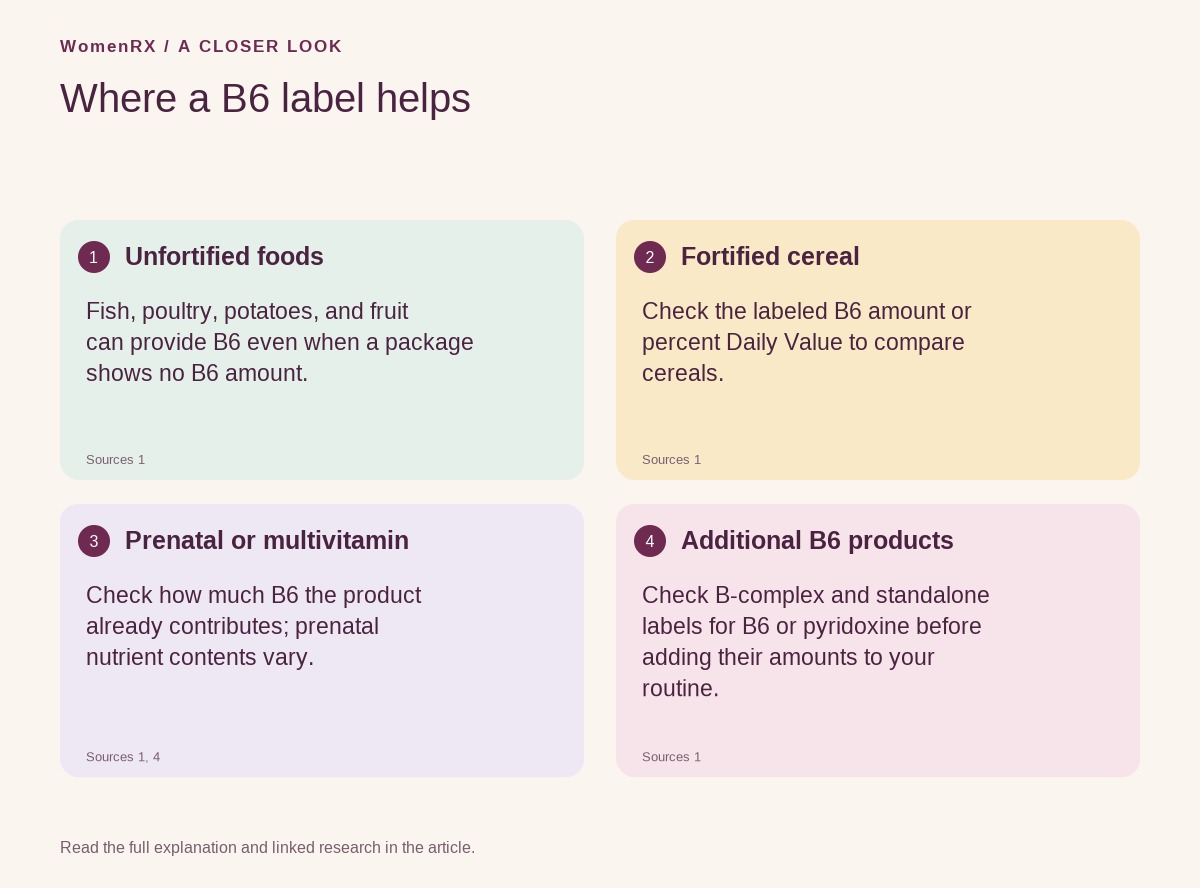
Where a B6 label helps
Unfortified foods: Fish, poultry, potatoes, and fruit can provide B6 even when a package shows no B6 amount.1
Fortified cereal: Check the labeled B6 amount or percent Daily Value to compare cereals.1
Prenatal or multivitamin: Check how much B6 the product already contributes; prenatal nutrient contents vary.14
Additional B6 products: Check B-complex and standalone labels for B6 or pyridoxine before adding their amounts to your routine.1
Read the figure as text
Food and supplement labels answer different parts of the intake question.- Unfortified foods: Fish, poultry, potatoes, and fruit can provide B6 even when a package shows no B6 amount.1
- Fortified cereal: Check the labeled B6 amount or percent Daily Value to compare cereals.1
- Prenatal or multivitamin: Check how much B6 the product already contributes; prenatal nutrient contents vary.14
- Additional B6 products: Check B-complex and standalone labels for B6 or pyridoxine before adding their amounts to your routine.1
More questions, answered
Does a blank vitamin B6 line on a food label mean the food has none?
No. U.S. labels generally aren’t required to list vitamin B6 unless it has been added. USDA FoodData Central can help you look up B6 in foods whose labels don’t show it. 1
Sources you can check
- Vitamin B6 - Health Professional Fact SheetAccessed 2026-09-25Return to first citation
- Vitamin B6: a scoping review for Nordic Nutrition Recommendations 2023.Bjørke-Monsen AL, Ueland PM. · Food & nutrition research · 2023Return to first citation
- [Quantification, dietary intake adequacy, and food sources of nutrients involved in the methionine-methylation cycle (choline, betaine, folate, vitamin B6 and vitamin B12) in pregnant women in Spain].Redruello Requejo M, Carretero Krug A, Samaniego Vaesken ML, Partearroyo Cediel T, Varela Moreiras G. · Nutricion hospitalaria · 2021Return to first citation
- Micronutrient Gaps and Supplement Use in a Diverse Cohort of Pregnant Women.Crawford SA, Brown AR, Teruel Camargo J, Kerling EH, Carlson SE, Gajewski BJ, Sullivan DK, Valentine CJ. · Nutrients · 2023Return to first citation