Resveratrol and Weight: What Human Trials Show
A few trials report small weight changes, but the results don’t show that resveratrol reliably produces lasting fat loss.
Human trials haven’t established resveratrol as a reliable way to lose weight. One 12-week trial in people with fatty liver found a small average reduction compared with placebo, while a six-month trial found no significant benefit from resveratrol alone. A trial in women with PCOS found no weight change versus placebo, and no menopause-specific effect is established. 1 4 5
The short version: a possible small effect, not a dependable result
Resveratrol has been tested in people, but the findings are mixed. Some trials report lower weight; others don’t show a clear difference from placebo. Even a statistically significant change in a small, short study doesn’t tell you whether the effect is large enough to matter to you, whether it lasts, or whether the weight lost was body fat.
For example, in a 12-week randomized trial of 90 people with nonalcoholic fatty liver disease, participants receiving resveratrol lost 1.1% of their body weight, a statistically significant reduction compared with placebo. A separate group assigned a calorie-restricted diet lost 4.5%, significantly more than either the resveratrol or placebo group. The study included women and men, but its abstract doesn’t report whether the weight result differed by sex. 1
That is a signal worth distinguishing from a proven weight-loss treatment. It doesn’t establish that the result will be sustained or apply to people without fatty liver disease.
Why the trial results don’t line up neatly
The studies enrolled different groups and measured different things. A small trial in 24 people with metabolic syndrome reported reductions in weight, waist size, and fat mass after resveratrol, but the study is too small to establish a dependable effect for a wider population. 7
In another 12-week trial of 50 people with fatty liver disease, the resveratrol group’s average weight fell from 88.75 to 87.54 kg. The researchers reported a significant reduction compared with placebo, but the abstract doesn’t provide the placebo group’s weight change, making the size of the between-group difference difficult to assess from the reported results. 6
Other findings are less encouraging. In a four-week study of 19 men with schizophrenia, resveratrol didn’t significantly change body weight or waist circumference compared with placebo. 2
A four-week COPD trial found a small decrease in body weight with resveratrol compared with placebo, but the decrease was accompanied by a reduction in lean mass. That result is a reminder that a lower scale number doesn’t necessarily mean a loss of body fat or an improvement in body composition. 3
Different study lengths, health conditions, and outcomes make these results hard to combine into one clear estimate. Most of the trials described here were small and lasted weeks or a few months. A six-month trial tested resveratrol alone as well as with orlistat: resveratrol alone did not significantly outperform placebo, while the combination did. 4
The combination study isn’t proof that resveratrol works alone
In a six-month trial, people with obesity received an energy-reduced diet alongside placebo, resveratrol, orlistat, or both resveratrol and orlistat. The resveratrol-only group lost an average of 4.68 kg and the placebo group 3.50 kg, but the difference wasn’t statistically significant. The combination group lost more than the placebo group, while orlistat alone also produced a larger, though not statistically significant, loss than placebo. Because the combination includes orlistat, its result can’t be credited to resveratrol alone. Only 84 of the 161 selected participants completed the study. 4
What the evidence says for women
One randomized trial focused specifically on 78 women with PCOS. After three months, resveratrol didn’t produce a significant weight change compared with placebo. That study is directly relevant to women with PCOS, but it doesn’t tell us whether results differ by menstrual stage or apply to women without PCOS. 5
The fatty-liver trial that reported a 1.1% reduction included women and men, but didn’t provide a sex-specific weight result. These findings therefore don’t establish a special effect for women, or for perimenopause or menopause. 1
How to use these findings for a personal goal
If your goal is weight loss, treat resveratrol as an unproven option rather than something to count on. The human evidence includes some small positive results, but it doesn’t show a consistent, durable effect, and one trial raises a separate question about loss of lean mass. The most useful comparison is not just whether a study’s scale number changed, but whether resveratrol clearly outperformed placebo, what else participants were doing, and what kind of weight changed.
The current studies don’t answer those questions well enough to make resveratrol a reliable weight-loss strategy. They also don’t establish a different weight effect for women based on menopause or other life stage.
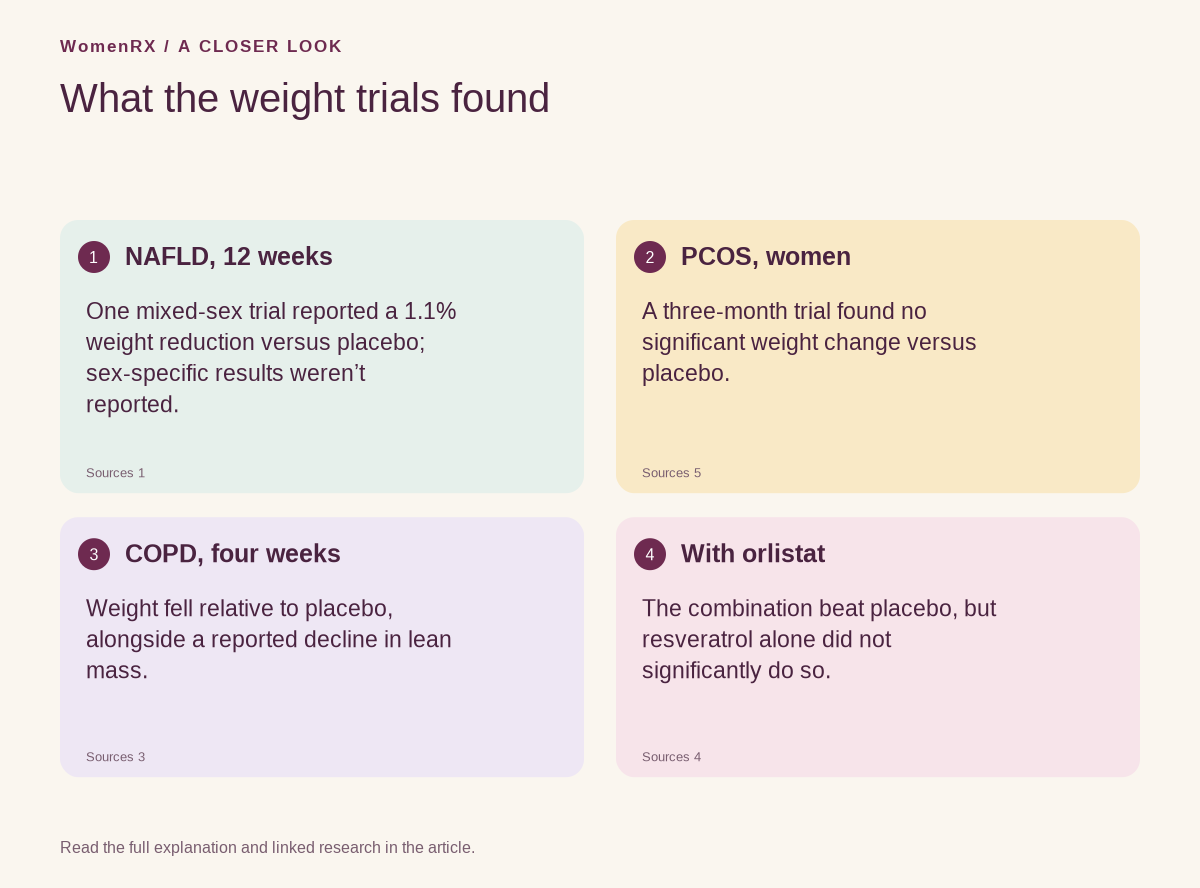
What the weight trials found
NAFLD, 12 weeks: One mixed-sex trial reported a 1.1% weight reduction versus placebo; sex-specific results weren’t reported.1
PCOS, women: A three-month trial found no significant weight change versus placebo.5
COPD, four weeks: Weight fell relative to placebo, alongside a reported decline in lean mass.3
With orlistat: The combination beat placebo, but resveratrol alone did not significantly do so.4
Read the figure as text
Human results vary by group and study design. This comparison separates resveratrol alone from combination treatment and highlights when a lower scale reading may not mean fat loss.- NAFLD, 12 weeks: One mixed-sex trial reported a 1.1% weight reduction versus placebo; sex-specific results weren’t reported.1
- PCOS, women: A three-month trial found no significant weight change versus placebo.5
- COPD, four weeks: Weight fell relative to placebo, alongside a reported decline in lean mass.3
- With orlistat: The combination beat placebo, but resveratrol alone did not significantly do so.4
More questions, answered
Did resveratrol cause weight loss when combined with orlistat?
The combination group lost more weight than the placebo group in one six-month trial, but resveratrol alone did not significantly outperform placebo. The combination result can’t show that resveratrol itself caused the additional loss. 4
Does the evidence show a weight-loss benefit for women with PCOS?
Not in the trial described here: among 78 women with PCOS, resveratrol did not significantly change weight compared with placebo over three months. That finding doesn’t settle effects in other groups of women. 5
Sources you can check
- Comparison of Calorie-Restricted Diet and Resveratrol Supplementation on Anthropometric Indices, Metabolic Parameters, and Serum Sirtuin-1 Levels in Patients With Nonalcoholic Fatty Liver Disease: A Randomized Controlled Clinical Trial.Asghari S, Asghari-Jafarabadi M, Somi MH, Ghavami SM, Rafraf M. · Journal of the American College of Nutrition · 2018Return to first citation
- Resveratrol Supplementation in Schizophrenia Patients: A Randomized Clinical Trial Evaluating Serum Glucose and Cardiovascular Risk Factors.Zortea K, Franco VC, Francesconi LP, Cereser KM, Lobato MI, Belmonte-de-Abreu PS. · Nutrients · 2016Return to first citation
- Resveratrol and metabolic health in COPD: A proof-of-concept randomized controlled trial.Beijers RJ, Gosker HR, Sanders KJ, de Theije C, Kelders M, Clarke G, Cryan JF, van den Borst B, Schols AM. · Clinical nutrition (Edinburgh, Scotland) · 2020Return to first citation
- Efficacy of an orlistat-resveratrol combination for weight loss in subjects with obesity: A randomized controlled trial.Arzola-Paniagua MA, García-Salgado López ER, Calvo-Vargas CG, Guevara-Cruz M. · Obesity (Silver Spring, Md.) · 2016Return to first citation
- Effect of resveratrol on menstrual cyclicity, hyperandrogenism and metabolic profile in women with PCOS.Mansour A, Samadi M, Sanginabadi M, Gerami H, Karimi S, Hosseini S, Shirzad N, Hekmatdoost A, Mahdavi-Gorabi A, Mohajeri-Tehrani MR, Qorbani M. · Clinical nutrition (Edinburgh, Scotland) · 2021Return to first citation
- No beneficial effects of resveratrol supplementation on atherogenic risk factors in patients with nonalcoholic fatty liver disease.Farzin L, Asghari S, Rafraf M, Asghari-Jafarabadi M, Shirmohammadi M. · International journal for vitamin and nutrition research. Internationale Zeitschrift fur Vitamin- und Ernahrungsforschung. Journal international de vitaminologie et de nutrition · 2020Return to first citation
- Effect of resveratrol administration on metabolic syndrome, insulin sensitivity, and insulin secretion.Méndez-del Villar M, González-Ortiz M, Martínez-Abundis E, Pérez-Rubio KG, Lizárraga-Valdez R. · Metabolic syndrome and related disorders · 2014Return to first citation