What Resveratrol Supplements Can, and Can’t, Show
Human studies have tested resveratrol’s effects on some metabolic markers and heart measurements, but those changes aren’t proof that it prevents heart disease or slows aging.
Resveratrol supplements have shown mixed results on metabolic measures, mostly in people with type 2 diabetes, and one small hypertension trial found changes in some heart measurements without a difference in left ventricular structure. These studies don’t establish that resveratrol prevents heart attacks, extends life, or helps after menopause. Results from supplements also can’t be assumed to apply to resveratrol in foods. 124
What the human studies have actually measured
Resveratrol is a plant compound found in foods including grapes and peanuts. But finding it in a food doesn’t show that eating that food, or taking a concentrated supplement, produces a particular health benefit. The clinical findings discussed here come from supplement studies; they don’t compare supplements with resveratrol-rich foods. 2345
For heart health, one randomized trial studied 80 people with hypertension. Participants received conventional therapy alone or conventional therapy plus resveratrol for six months. Some measures of heart function and remodeling differed between the groups, but left ventricular structure did not. The study measured heart-related markers and imaging measures, not whether people had fewer heart attacks or lived longer. 4
A separate short trial involved people with stable angina and tested resveratrol, calcium fructoborate, or their combination. It reported a reduction in NT-proBNP in the resveratrol-only group as well as in the calcium fructoborate and combination groups; the largest reported reduction was in the combination group. High-sensitivity C-reactive protein decreased in all groups at the 30-day and 60-day visits; the decreases were greater in the calcium fructoborate group and the combination group. The trial reported 87 people completing the 60-day test-treatment period, while 29 followed their usual care in parallel. These short-term findings don’t establish long-term heart protection. 5
Metabolic results are mixed, and apply to a specific group
The metabolic evidence is mainly from studies of people with type 2 diabetes, not from trials showing that resveratrol prevents diabetes in people who don’t have it. A 2026 systematic review described resveratrol’s clinical effects as mixed and inconsistent. 1
A separate review summarized randomized trials in type 2 diabetes. One analysis of 11 trials with 388 participants reported average improvements in fasting glucose, HbA1c, and insulin-resistance measures. But the same review described a Cochrane analysis of nine trials with 362 participants as finding low-certainty evidence for a small HbA1c reduction, with inconsistent results for fasting glucose and insulin. Those differences are a reason not to treat a promising average result as a reliable benefit for every person. 2
Studies of blood markers such as inflammation or oxidative stress answer a narrower question than whether a supplement prevents complications or improves how someone feels. For example, a meta-analysis of six randomized trials in people with type 2 diabetes found changes in some inflammation and oxidative-stress markers, but rated the evidence low or very low for the reported outcomes. Those markers aren’t the same as evidence of fewer cardiovascular events. 3
Healthy aging and women’s results
These studies don’t establish that resveratrol slows aging, extends life, or preserves independence. Changes in blood tests or heart measurements can be scientifically interesting, but they don’t by themselves demonstrate those broader outcomes.
The results described here don’t show whether resveratrol’s effects differ by sex or after menopause. That means they can’t establish whether it works differently for women, or whether it offers a menopause-related benefit. Don’t assume a general study result applies specifically to you on that basis.
What to weigh before spending money
The trial formulations and populations aren’t interchangeable: studies included people with type 2 diabetes or hypertension, and one angina study combined resveratrol with another supplement. One hypertension trial tested 400 mg daily for six months, but that’s a study detail, not a recommended dose. A review of trials in type 2 diabetes reported larger metabolic effects in subgroup analyses using more than 500 mg daily and lasting more than three months. Those subgroup findings don’t identify a dose for you, and they answer a different question from the six-month hypertension trial’s heart measurements. These studies don’t establish an effective dose for disease prevention or healthy aging. 245
A practical way to assess a claim is to ask what outcome a study measured. A change in a biomarker, a heart scan measurement, fewer heart attacks, and living longer are different kinds of evidence. For resveratrol, the clinical findings discussed here are mostly in the first two categories. They don’t yet support buying a supplement on the promise of preventing cardiovascular disease or slowing aging.
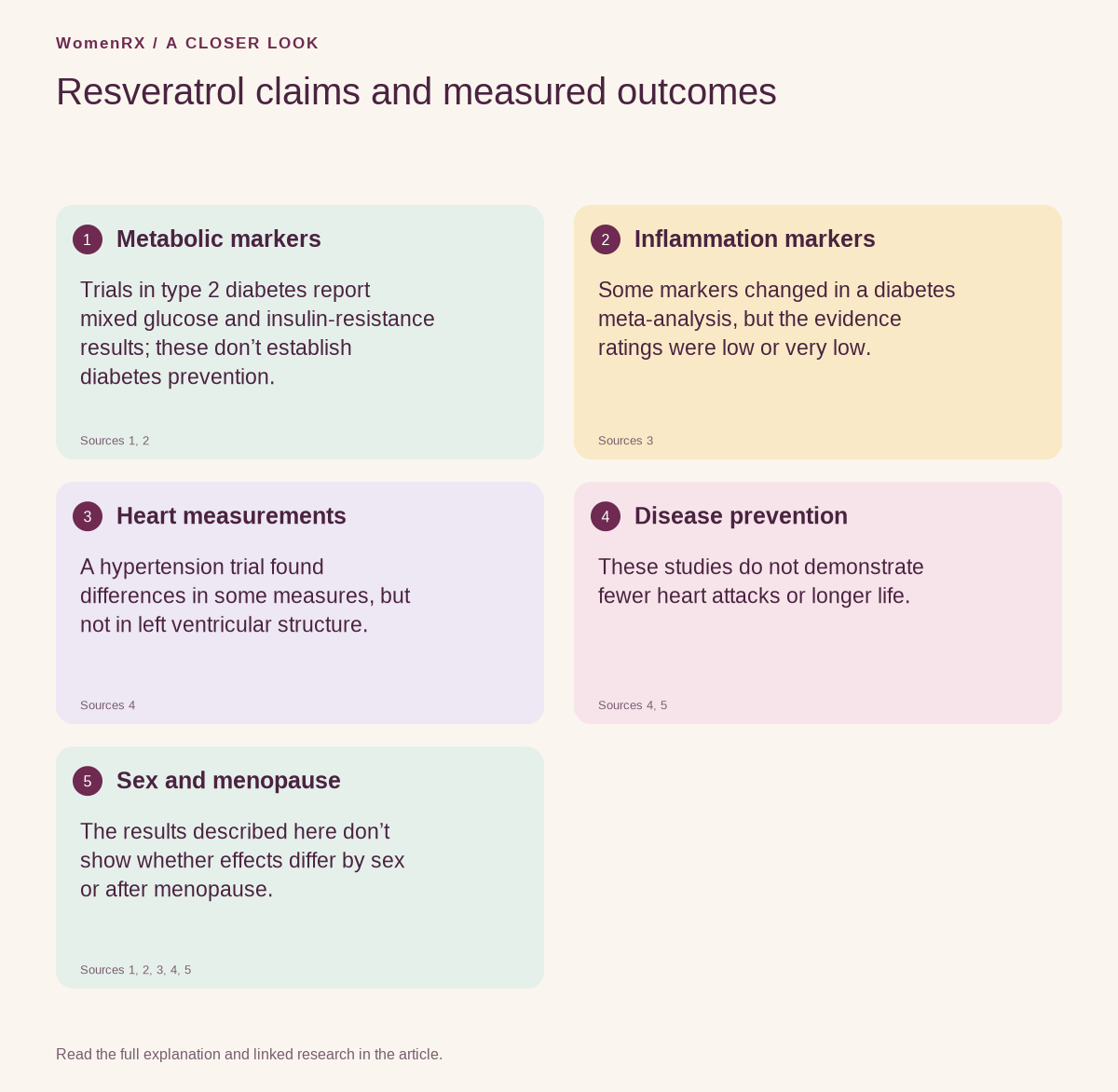
Resveratrol claims and measured outcomes
Metabolic markers: Trials in type 2 diabetes report mixed glucose and insulin-resistance results; these don’t establish diabetes prevention.12
Inflammation markers: Some markers changed in a diabetes meta-analysis, but the evidence ratings were low or very low.3
Heart measurements: A hypertension trial found differences in some measures, but not in left ventricular structure.4
Disease prevention: These studies do not demonstrate fewer heart attacks or longer life.45
Sex and menopause: The results described here don’t show whether effects differ by sex or after menopause.12345
Read the figure as text
Separate what human trials measured from the larger benefits people may hope a supplement will deliver.- Metabolic markers: Trials in type 2 diabetes report mixed glucose and insulin-resistance results; these don’t establish diabetes prevention.12
- Inflammation markers: Some markers changed in a diabetes meta-analysis, but the evidence ratings were low or very low.3
- Heart measurements: A hypertension trial found differences in some measures, but not in left ventricular structure.4
- Disease prevention: These studies do not demonstrate fewer heart attacks or longer life.45
- Sex and menopause: The results described here don’t show whether effects differ by sex or after menopause.12345
More questions, answered
Is resveratrol from food equivalent to a supplement?
These studies test supplements, not whether foods containing resveratrol produce the same effects. A result from a supplement trial can’t establish a benefit from eating a particular food, or the reverse. 2345
Is there a proven resveratrol dose for healthy aging?
This evidence doesn’t establish a dose for healthy aging or disease prevention. The 400 mg daily amount was used in one six-month hypertension trial; it shouldn’t be read as a general recommendation. 4
Sources you can check
- The Role of Anthocyanins, Curcumin, and Resveratrol in the Prevention and Management of Metabolic Disorders: A Systematic Review.Gazda P, Glibowski P. · Molecules (Basel, Switzerland) · 2026Return to first citation
- Resveratrol in diabetes and pancreatic function: implications for the exocrine-endocrine pancreatic axis-a systematic review.Meden A, Mičetić-Turk D. · Frontiers in nutrition · 2026Return to first citation
- The efficacy of resveratrol supplementation on inflammation and oxidative stress in type-2 diabetes mellitus patients: randomized double-blind placebo meta-analysis.Zhu P, Jin Y, Sun J, Zhou X. · Frontiers in endocrinology · 2024Return to first citation
- Effects of resveratrol supplementation on cardiac remodeling in hypertensive patients: a randomized controlled clinical trial.Zheng X, Hai J, Yang Y, Zhang C, Ma X, Kong B, Zhao Y, Hu Y, Bu P, Ti Y. · Hypertension research : official journal of the Japanese Society of Hypertension · 2023Return to first citation
- Oral resveratrol and calcium fructoborate supplementation in subjects with stable angina pectoris: effects on lipid profiles, inflammation markers, and quality of life.Militaru C, Donoiu I, Craciun A, Scorei ID, Bulearca AM, Scorei RI. · Nutrition (Burbank, Los Angeles County, Calif.) · 2013Return to first citation