Resveratrol Supplements: Is There a Reliable Time to Notice an Effect?
Human trials have measured different outcomes over weeks or months, but they don’t establish a general timeline for feeling a benefit.
There’s no reliable, general time when resveratrol is shown to “start working.” In human trials, researchers tested specific outcomes at set follow-ups: some found no difference from placebo after four weeks or six months, and a six-month memory trial also found no significant improvement. One metabolic marker differed after six months, but that doesn’t establish when a meaningful health benefit begins. 1 2 3
The clock depends on what you’re measuring
“Taking effect” can mean a change in a blood test, a difference on a memory test, or an improvement you can feel in daily life. Those aren’t interchangeable. A supplement might be studied for one outcome without showing another, and a measurement that differs at the end of a trial doesn’t tell you when the difference first appeared.
That distinction matters with resveratrol. The human trials here tested particular groups, formulations and outcomes over periods ranging from weeks to a year. They don’t point to one waiting period that applies to everyone or every goal. 1 2 3 6
What trials found at their follow-ups
For metabolic markers, a randomized trial in 45 overweight or slightly obese men and women found no differences between resveratrol and placebo in the measured metabolic risk markers after four weeks. A separate four-week trial in 24 men with obesity also found no detectable changes in its primary insulin-sensitivity outcome or several other metabolic measures. These results don’t prove that no effect could ever occur; they show that those trials did not detect the tested changes at that follow-up. 3 4
A larger time window didn’t establish a general metabolic benefit either. In a six-month trial of 41 overweight men and women, insulin sensitivity was not different between the resveratrol and placebo groups at the end. HbA1c, a blood measure related to average blood sugar, was lower in the resveratrol group at that final assessment. Because this was one result among several measured outcomes, it doesn’t show when the difference arose or whether it translates into a noticeable health benefit. 1
For memory, a randomized trial in 60 older adults assessed participants after 26 weeks. It did not find a significant improvement in its main verbal-memory outcome. A possible difference in another memory task was not statistically significant, so it is not evidence of a demonstrated benefit or a reliable onset time. 2
A small pilot study in people with mild to moderate Alzheimer’s disease followed participants for a year using a preparation that combined resveratrol with glucose and malate. At 12 months, none of the reported cognitive or daily-function outcome differences between groups was statistically significant. This study therefore doesn’t establish a clinical timeline for resveratrol alone. 6
Why a mechanism or biomarker isn’t the same as a benefit
Resveratrol has been studied for biological mechanisms and changes in measurements such as blood markers. But a proposed mechanism, or a change in a measurement, isn’t by itself proof that someone will feel better or have a better health outcome. The results above show why it helps to ask what a trial actually measured, in whom, and compared with what.
Even trials that study a similar goal can differ in participants, product, dose, duration and outcome. A review of registered resveratrol trials for weight loss found that designs varied in these ways; weight loss was the primary outcome in only three of the seven trials it assessed. So a duration used in one study isn’t a validated personal trial period for another goal or product. 5
What this means if you’re taking it
Choose the outcome before choosing a timeline. If your goal is a particular lab result, ask whether human trials of a similar population measured that result and whether they found a difference from placebo. If your goal is something you can feel, look for a patient-relevant outcome, not just a proposed mechanism or laboratory marker. The trials above don’t support a general rule such as “you’ll notice it after a few weeks” or “give it six months.”
Women were included in some metabolic trials, but the reported results don’t establish whether effects differ by sex. One six-month study enrolled women aged 50 to 70 as well as men; another enrolled 20 women and 25 men. The cited results don’t provide a separate effect estimate for women in either trial. The cited results from a separate memory trial in older adults also don’t provide a women-specific effect estimate. 1 2 3
These outcome trials also don’t answer separate safety questions about resveratrol during pregnancy or breastfeeding, or for people with hormone-sensitive conditions. A study’s duration or inclusion of some women shouldn’t be treated as evidence for those situations.
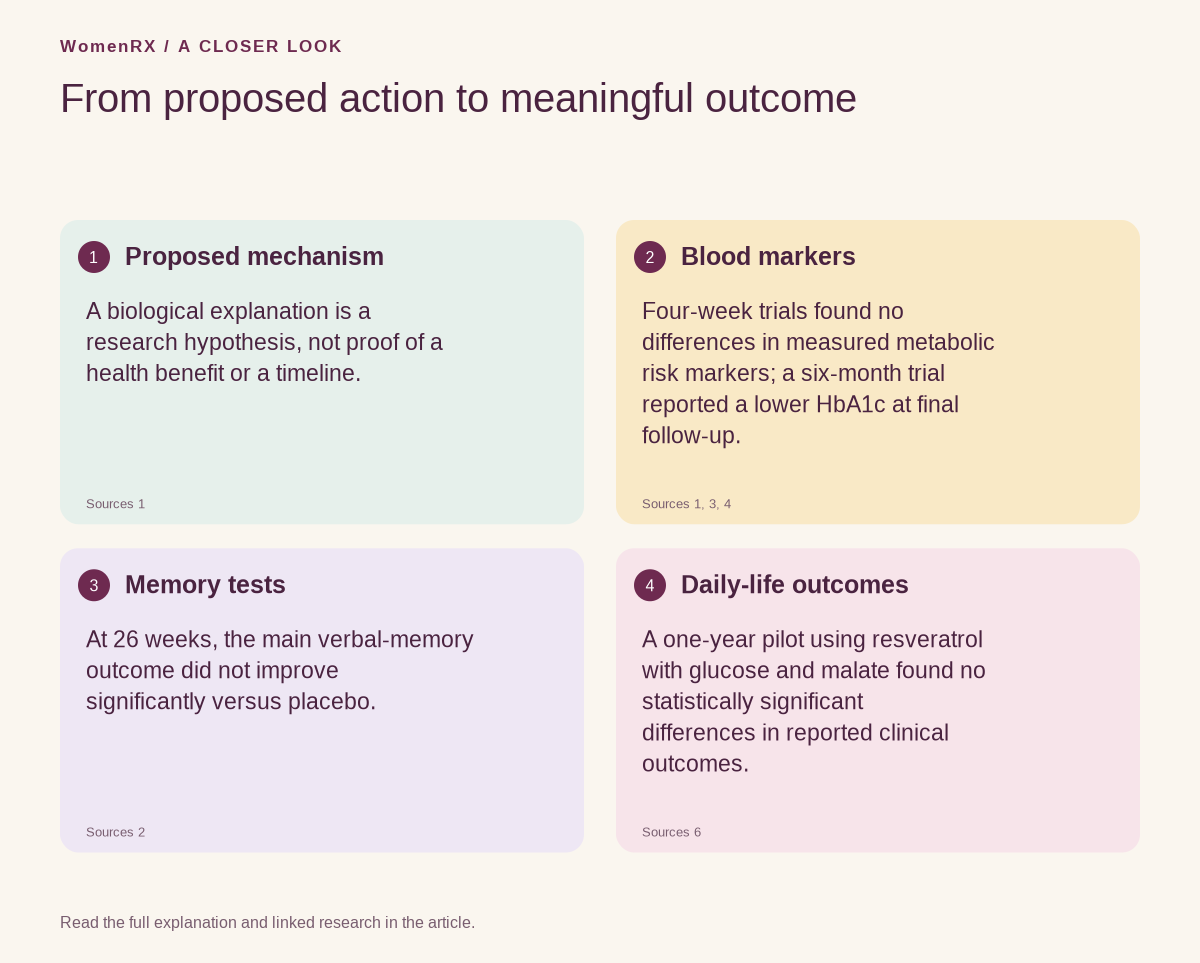
From proposed action to meaningful outcome
Proposed mechanism: A biological explanation is a research hypothesis, not proof of a health benefit or a timeline.1
Blood markers: Four-week trials found no differences in measured metabolic risk markers; a six-month trial reported a lower HbA1c at final follow-up.134
Memory tests: At 26 weeks, the main verbal-memory outcome did not improve significantly versus placebo.2
Daily-life outcomes: A one-year pilot using resveratrol with glucose and malate found no statistically significant differences in reported clinical outcomes.6
Read the figure as text
A study can measure a biological idea without showing a change that matters in daily life. These examples show where resveratrol timing claims meet the evidence.- Proposed mechanism: A biological explanation is a research hypothesis, not proof of a health benefit or a timeline.1
- Blood markers: Four-week trials found no differences in measured metabolic risk markers; a six-month trial reported a lower HbA1c at final follow-up.134
- Memory tests: At 26 weeks, the main verbal-memory outcome did not improve significantly versus placebo.2
- Daily-life outcomes: A one-year pilot using resveratrol with glucose and malate found no statistically significant differences in reported clinical outcomes.6
More questions, answered
Does a change in a blood marker mean I’ll feel different?
Not necessarily. A blood marker is a measurement, while feeling better is a patient-relevant outcome. In the six-month metabolic trial, HbA1c differed between groups at the final assessment, but the trial did not establish when that difference arose or that it meant a noticeable benefit. 1
Can I use a trial’s duration to decide how long to take my product?
Not reliably. Trials differ in the people studied, the product and outcome, and the follow-up period. The duration used in one trial doesn’t establish a useful personal assessment period for a different goal or supplement. 5
Sources you can check
- No effect of resveratrol supplementation after 6 months on insulin sensitivity in overweight adults: a randomized trial.de Ligt M, Bergman M, Fuentes RM, Essers H, Moonen-Kornips E, Havekes B, Schrauwen-Hinderling VB, Schrauwen P. · The American journal of clinical nutrition · 2020Return to first citation
- Effects of resveratrol on memory performance, hippocampus connectivity and microstructure in older adults - A randomized controlled trial.Huhn S, Beyer F, Zhang R, Lampe L, Grothe J, Kratzsch J, Willenberg A, Breitfeld J, Kovacs P, Stumvoll M, Trampel R, Bazin PL, Villringer A, Witte AV. · NeuroImage · 2018Return to first citation
- Resveratrol does not influence metabolic risk markers related to cardiovascular health in overweight and slightly obese subjects: a randomized, placebo-controlled crossover trial.van der Made SM, Plat J, Mensink RP. · PloS one · 2015Return to first citation
- High-dose resveratrol supplementation in obese men: an investigator-initiated, randomized, placebo-controlled clinical trial of substrate metabolism, insulin sensitivity, and body composition.Poulsen MM, Vestergaard PF, Clasen BF, Radko Y, Christensen LP, Stødkilde-Jørgensen H, Møller N, Jessen N, Pedersen SB, Jørgensen JO. · Diabetes · 2013Return to first citation
- Resveratrol for Weight Loss in Obesity: An Assessment of Randomized Control Trial Designs in ClinicalTrials.gov.Hillsley A, Chin V, Li A, McLachlan CS. · Nutrients · 2022Return to first citation
- A randomized, double-blind, placebo-controlled trial of resveratrol with glucose and malate (RGM) to slow the progression of Alzheimer's disease: A pilot study.Zhu CW, Grossman H, Neugroschl J, Parker S, Burden A, Luo X, Sano M. · Alzheimer's & dementia (New York, N. Y.) · 2018Return to first citation