Magnesium Glycinate: When Might You Notice an Effect?
There isn’t a dependable timeline for magnesium glycinate: studies have tested it for different outcomes, and their check-in dates don’t establish when you should expect a benefit.
Trials measuring depression symptoms or blood markers don’t establish a reliable timeline for magnesium glycinate for sleep, cramps, or general wellbeing. One small, nonrandomized study tested it alongside antidepressants and reported symptom-score improvement in the add-on group by day 14, but that can’t show when glycinate alone works. Another trial used it for 12 weeks while studying blood markers, not those symptoms. 2 3
The timeline depends on what you want it to do
“Magnesium glycinate” names a form of magnesium, not a single, well-studied treatment for every concern. A study measuring sleep, one measuring menstrual pain, and one measuring depression would be asking different questions. The date researchers checked for change is also not necessarily the date a person first noticed one.
For sleep or cramps, the studies summarized here don’t establish when magnesium glycinate begins to help. That’s not proof that no research exists; it means these findings can’t give you a reliable countdown for either symptom.
What the glycinate studies actually measured
A small clinical trial examined magnesium glycinate as an add-on for people taking antidepressants for depression. It was open-label and nonrandomized, so participants weren’t randomly assigned to treatment and the groups knew what they were receiving. The researchers assessed depression symptoms at days 14 and 28. The abstract reports symptom-score improvement in the add-on group by day 14, and greater improvement by day 28 than in the antidepressant-only group. Because magnesium was combined with antidepressants, the study can’t isolate the effect of glycinate. Its assessment dates don’t establish a general time to benefit, either. 3
A separate 12-week randomized trial included 78 women and men who were overweight or obese. It compared vitamin D plus magnesium glycinate with vitamin D alone and placebo, and measured bone-turnover and blood-sugar-related markers. The combined supplement did not produce differences between groups in those outcomes. This wasn’t a sleep, cramp, or symptom-relief trial, so its 12-week duration doesn’t tell you when glycinate might affect those concerns. 2
These examples show why a number of weeks in a study isn’t automatically a “time to work.” You need a study of the same form, the same concern, and an outcome that matters to you.
Magnesium research isn’t automatically glycinate research
Research about magnesium in general can’t always be applied to magnesium glycinate specifically. The NIH Office of Dietary Supplements notes that absorption varies among forms. It identifies aspartate, citrate, lactate, and chloride as forms that have been found more bioavailable than oxide and sulfate; this comparison does not establish that glycinate is absorbed better or works faster. 1
Nor does a study using another form, or a magnesium-containing product with other ingredients, automatically tell you what glycinate alone does. If you’re comparing claims, look for the exact form tested, the concern being treated, what it was compared with, and when researchers assessed that outcome.
What this means for women
The depression trial’s abstract does not report participants’ sex or provide results for women separately. The 12-week trial included women and men, but its reported outcomes were bone and blood-sugar markers, not menstrual cramps, sleep, pregnancy, or breastfeeding. 2 3
So these trials don’t establish a glycinate timeline for menstrual cramps or for people who are pregnant or breastfeeding. They also don’t show that a result in a mixed group applies specifically to women. For cramps in particular, evidence about a different concern or a different magnesium formulation would not answer whether glycinate helps period pain or when.
A practical way to judge a timing claim
When you see a promise that magnesium glycinate works “in a few days” or “within a month,” ask what outcome and study support that exact window. A trial that measures an outcome at two weeks can show what researchers observed at that visit; it does not prove that everyone should notice a change by then. And a trial that doesn’t study your concern can’t supply its timeline.
These studies don’t establish a well-supported number of days or weeks to expect for sleep, cramps, or other concerns from magnesium glycinate. The clearest next step is to separate evidence for magnesium generally from evidence for this specific form and outcome, rather than treating a study’s duration as a promise.
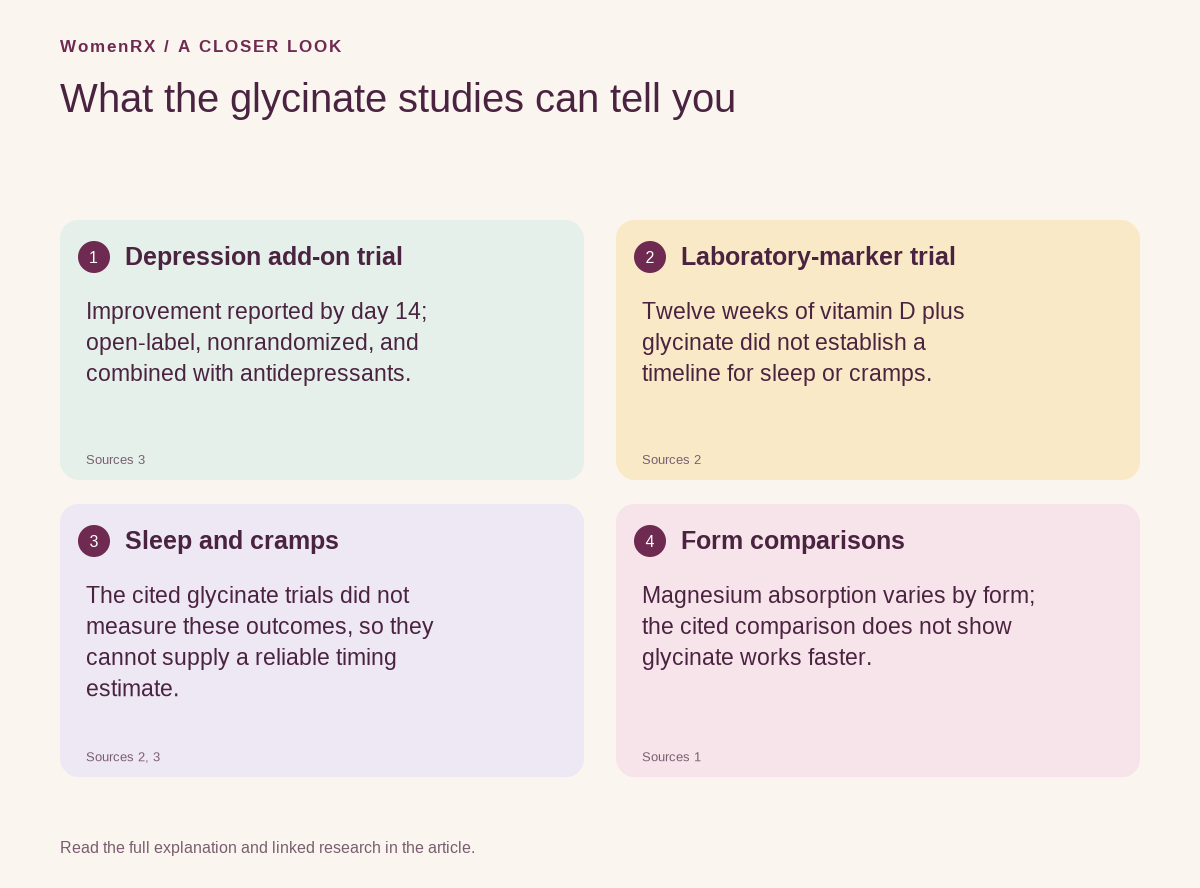
What the glycinate studies can tell you
Depression add-on trial: Improvement reported by day 14; open-label, nonrandomized, and combined with antidepressants.3
Laboratory-marker trial: Twelve weeks of vitamin D plus glycinate did not establish a timeline for sleep or cramps.2
Sleep and cramps: The cited glycinate trials did not measure these outcomes, so they cannot supply a reliable timing estimate.23
Form comparisons: Magnesium absorption varies by form; the cited comparison does not show glycinate works faster.1
Read the figure as text
The study outcome and design determine whether a finding can answer your question about timing.- Depression add-on trial: Improvement reported by day 14; open-label, nonrandomized, and combined with antidepressants.3
- Laboratory-marker trial: Twelve weeks of vitamin D plus glycinate did not establish a timeline for sleep or cramps.2
- Sleep and cramps: The cited glycinate trials did not measure these outcomes, so they cannot supply a reliable timing estimate.23
- Form comparisons: Magnesium absorption varies by form; the cited comparison does not show glycinate works faster.1
More questions, answered
Does a study measuring results after two weeks mean magnesium glycinate works in two weeks?
No. An open-label, nonrandomized trial of magnesium glycinate alongside antidepressants reported symptom-score improvement in the add-on group by day 14. Because the supplement was combined with antidepressants, that finding doesn’t establish when glycinate alone works, or a timeline for sleep or cramps. 3
Sources you can check
- Magnesium - Health Professional Fact SheetAccessed 2026-09-25Return to first citation
- Combined vitamin D and magnesium supplementation does not influence markers of bone turnover or glycemic control: A randomized controlled clinical trial.Dall RD, Cheung MM, Shewokis PA, Altasan A, Volpe SL, Amori R, Singh H, Sukumar D. · Nutrition research (New York, N.Y.) · 2023Return to first citation
- Clinical evaluation of adjunctive magnesium therapy in patients receiving antidepressants for depression-open label, nonrandomized clinical trial.Siddique A, Naeem U, Khokhar MM, Irshad M, Farooq T, Kanwal S. · Naunyn-Schmiedeberg's archives of pharmacology · 2026Return to first citation