L-Theanine: When Might You Notice an Effect?
In the trials discussed here, stress and sleep outcomes were assessed over days or weeks, while one attention study tested participants after a single dose; none establishes one time-to-effect.
A single-dose study found changes on certain attention and working-memory tests when participants were tested about 50 minutes later, but that doesn’t show when calming or sleep benefits begin. Stress and sleep were assessed after four weeks in one small trial, while another measured outcomes on days 14 and 28. Those study checkpoints aren’t proof that you’ll notice a benefit by then. 123
The clock depends on what you’re hoping to change
“Does it work quickly?” can mean a few different things: feeling less keyed up in the moment, concentrating better, or sleeping more soundly over time. L-theanine studies have looked at these outcomes on different schedules, using different measures. Their results don’t establish a single onset time that applies to all three.
The clearest short-term timing example is a small study of Japanese adults aged 50 to 69. Researchers tested attention and working memory after a single dose, starting the tests about 50 minutes later. Some test results improved, including reaction time on one attention task. That’s a finding about performance on specific tests, not evidence that people felt calmer or slept better within 50 minutes. 3
Stress was checked over days or weeks
In a 28-day placebo-controlled trial, 30 healthy adults with moderate stress took L-theanine or placebo. Researchers measured stress on days 14 and 28. Perceived stress scores fell in both groups, and by day 28 the reported decreases were similar: about 18% in each group. That makes it difficult to use the study to claim that L-theanine produces a noticeable stress benefit by day 14 or 28. 2
A separate crossover trial enrolled 30 healthy adults, including 21 women. Participants took L-theanine or placebo for four weeks, then crossed over to the other condition after a washout period. Researchers reported changes in several stress-related ratings after the four-week L-theanine period. The study is a useful clue about what researchers measured, but its small sample and four-week assessment do not tell us the exact day an effect might start. 1
Sleep outcomes need their own interpretation
In that same four-week crossover study, participants’ sleep-quality questionnaire scores and some sleep-related subscales changed after the L-theanine period. This is not the same as showing that L-theanine helps you fall asleep the first night you take it. The trial was small, and sleep was assessed after weeks of use rather than tracked as a clear night-by-night onset. 1
The 28-day trial also measured sleep at days 14 and 28. It reported less light sleep in the L-theanine group than in the placebo group at those checkpoints, but also less time asleep after 28 days. Those findings don’t add up to a simple promise of better sleep, and they don’t establish when someone might feel a difference. 2
What to take from the study timelines
A result measured after a single dose, two weeks, or four weeks tells you when researchers checked an outcome. It doesn’t necessarily tell you when a benefit began, whether it was noticeable in daily life, or whether it will happen for you. That distinction matters especially when studies use different products, participants, and measures.
The evidence in these trials also doesn’t establish a different timeline for women. One four-week study included more women than men but did not report separate results by sex. The 28-day trial excluded people who were pregnant or breastfeeding, so it can’t answer questions about use during pregnancy or breastfeeding. 12
If you’re judging whether a supplement is helping, keep the goal specific. Feeling more focused, feeling less stressed, and sleeping better are separate outcomes. A change in one doesn’t prove a change in the others, and a study’s scheduled measurement day isn’t a personal deadline for improvement.
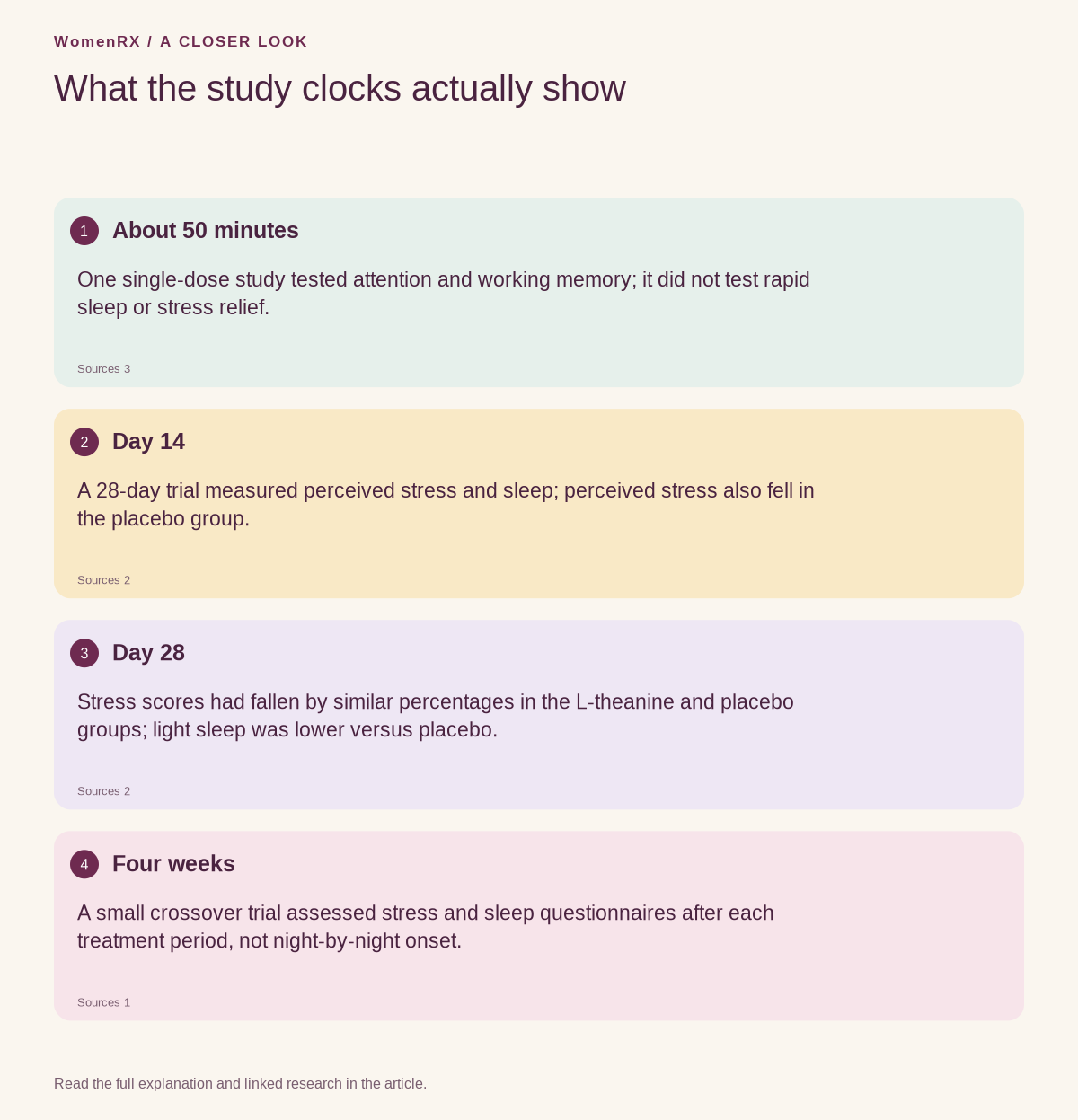
What the study clocks actually show
About 50 minutes: One single-dose study tested attention and working memory; it did not test rapid sleep or stress relief.3
Day 14: A 28-day trial measured perceived stress and sleep; perceived stress also fell in the placebo group.2
Day 28: Stress scores had fallen by similar percentages in the L-theanine and placebo groups; light sleep was lower versus placebo.2
Four weeks: A small crossover trial assessed stress and sleep questionnaires after each treatment period, not night-by-night onset.1
Read the figure as text
These are outcome measurement points in human trials, not promised deadlines for when you will feel a benefit.- About 50 minutes: One single-dose study tested attention and working memory; it did not test rapid sleep or stress relief.3
- Day 14: A 28-day trial measured perceived stress and sleep; perceived stress also fell in the placebo group.2
- Day 28: Stress scores had fallen by similar percentages in the L-theanine and placebo groups; light sleep was lower versus placebo.2
- Four weeks: A small crossover trial assessed stress and sleep questionnaires after each treatment period, not night-by-night onset.1
More questions, answered
Does a study showing an effect after one dose mean it works that fast for stress?
No. The single-dose study tested attention and working-memory tasks about 50 minutes after a dose. It does not establish that stress relief or improved sleep begins in that timeframe. 3
Do L-theanine studies show when it starts helping women?
Not specifically. A four-week trial included 21 women and nine men, but it did not report results separately by sex. The 28-day trial excluded participants who were pregnant or breastfeeding; the four-week trial excluded pregnant participants. These trials therefore don’t establish effects or safety during pregnancy or breastfeeding. 12
Sources you can check
- Effects of L-Theanine Administration on Stress-Related Symptoms and Cognitive Functions in Healthy Adults: A Randomized Controlled Trial.Hidese S, Ogawa S, Ota M, Ishida I, Yasukawa Z, Ozeki M, Kunugi H. · Nutrients · 2019Return to first citation
- Safety and Efficacy of AlphaWave® L-Theanine Supplementation for 28 Days in Healthy Adults with Moderate Stress: A Randomized, Double-Blind, Placebo-Controlled Trial.Moulin M, Crowley DC, Xiong L, Guthrie N, Lewis ED. · Neurology and therapy · 2024Return to first citation
- Effects of l-Theanine on Cognitive Function in Middle-Aged and Older Subjects: A Randomized Placebo-Controlled Study.Baba Y, Inagaki S, Nakagawa S, Kaneko T, Kobayashi M, Takihara T. · Journal of medicinal food · 2021Return to first citation