L-Theanine After 40: What the Evidence Actually Shows
L-theanine has been studied for attention, stress, and sleep in adults, but those findings don’t establish a special benefit after 40.
Being over 40 isn’t, by itself, an evidence-backed reason to take L-theanine. Studies report some effects on attention and sleep in adults, but the results discussed here don’t establish whether women over 40 benefit differently from younger adults, or whether L-theanine helps with menopause-related concerns. The answer depends more on your specific concern than on your birthday. 345
Age alone doesn’t establish a reason to take it
If you’re considering L-theanine because of a particular concern, the useful question is whether it has been studied for that concern in people like you. Turning 40, by itself, isn’t an evidence-backed reason to expect a different effect. Human trials and reviews have examined adult outcomes such as attention, perceived stress, and sleep. Those outcomes don’t establish that a special need begins at midlife, or that women over 40 respond differently. 345
That distinction matters: a study can include adults over 40 without showing whether their results differed from younger participants. For example, a 28-day trial enrolled 30 adults aged 18-65 with moderate stress. Its reported overall results don’t tell us whether participants over 40 responded differently. 5
What adult studies do, and don’t, suggest
For attention, a 2026 meta-analysis of 31 randomized trials involving 1,168 people reported improved choice reaction time after a single dose in healthy adults. Its results address short-term attention, not a lasting improvement in everyday focus or an age-specific benefit. A separate review of five randomized trials, with 148 healthy adults, found that results depended on the cognitive test: some visual-response measures improved, while simple reaction time and Stroop results did not show significant effects. Taken together, the findings are promising for some tasks, but they don’t establish a broad cognitive benefit after 40. 36
For stress, the age range in the small 28-day trial included people over 40, but the overall results don’t demonstrate a clear advantage over placebo on perceived stress. At day 28, scores fell by 17.98% in the L-theanine group and 17.88% in the placebo group. Those are changes within each group, not evidence that the supplement caused a greater improvement. The study was small, and its findings shouldn’t be treated as menopause-related evidence. 5
For sleep, a systematic review identified 13 adult trials, including 11 randomized trials. The review reported benefits on some measures, including perceived sleep satisfaction and sleep efficiency. Those adult findings don’t establish an effect for women over 40 specifically, clinical insomnia, or menopause-related sleep disruption. A change in a sleep measure isn’t the same as evidence that a supplement addresses hot-flash-related waking or another particular cause of poor sleep. 4
Match the evidence to your actual concern
If your interest is attention, stress, or sleep, ask what outcome you’re hoping to change. A brief laboratory attention task is not the same as feeling sharper throughout the day; perceived stress is not the same as treating an anxiety disorder; and a change in a sleep measure is not proof that a supplement addresses the cause of your sleep problem. The results above don’t show that being over 40 makes any of those effects more likely. 346
Also watch for evidence that changes the intervention. Matcha contains L-theanine along with caffeine and other compounds, so a matcha study can’t isolate L-theanine’s effect. A trial in adults aged 25-34 tested matcha, not an L-theanine supplement, and does not answer whether L-theanine works differently after 40. 2
What’s reasonable to conclude
L-theanine has been studied in adults for several outcomes, and some reviews report possible short-term effects. But these findings don’t establish a distinct benefit for women over 40 or show that L-theanine addresses perimenopause or menopause-related symptoms. If you’re weighing it for a specific concern, look for a finding that matches both what you want to change and the kind of product studied, rather than assuming midlife creates a special need. 2345
Short-term trial findings also can’t settle long-term safety. A review reported no serious adverse events across its included trials, while the small 28-day trial assessed a specific product in healthy adults with moderate stress. Those findings don’t establish long-term safety for every person or product. 35
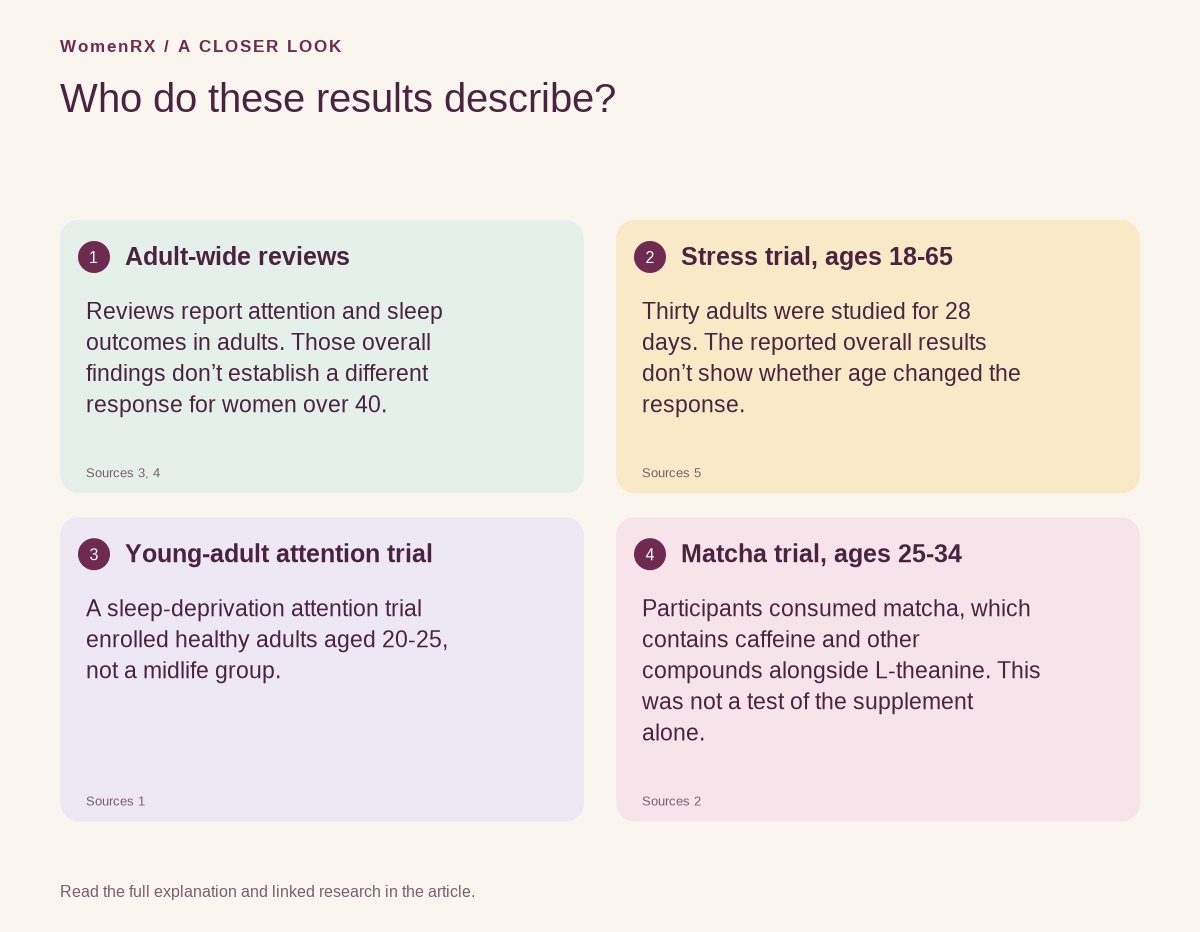
Who do these results describe?
Adult-wide reviews: Reviews report attention and sleep outcomes in adults. Those overall findings don’t establish a different response for women over 40.34
Stress trial, ages 18-65: Thirty adults were studied for 28 days. The reported overall results don’t show whether age changed the response.5
Young-adult attention trial: A sleep-deprivation attention trial enrolled healthy adults aged 20-25, not a midlife group.1
Matcha trial, ages 25-34: Participants consumed matcha, which contains caffeine and other compounds alongside L-theanine. This was not a test of the supplement alone.2
Read the figure as text
Compare the populations and interventions behind findings that might sound relevant to life after 40.- Adult-wide reviews: Reviews report attention and sleep outcomes in adults. Those overall findings don’t establish a different response for women over 40.34
- Stress trial, ages 18-65: Thirty adults were studied for 28 days. The reported overall results don’t show whether age changed the response.5
- Young-adult attention trial: A sleep-deprivation attention trial enrolled healthy adults aged 20-25, not a midlife group.1
- Matcha trial, ages 25-34: Participants consumed matcha, which contains caffeine and other compounds alongside L-theanine. This was not a test of the supplement alone.2
More questions, answered
Does matcha research show that L-theanine supplements work after 40?
No. Matcha contains caffeine and other compounds as well as L-theanine, so a matcha study can’t isolate the effect of L-theanine. The cited trial involved adults aged 25-34 and tested matcha, not an L-theanine supplement. 2
Sources you can check
- Effect of L-theanine on selective attention in a traffic-related reaction task in sleep-deprived young adults: a double-blind placebo-controlled, crossover study.Karunaratne UW, Dassanayake TL. · Nutritional neuroscience · 2025Return to first citation
- Matcha consumption maintains attentional function following a mild acute psychological stress without affecting a feeling of fatigue: A randomized placebo-controlled study in young adults.Baba Y, Kaneko T, Takihara T. · Nutrition research (New York, N.Y.) · 2021Return to first citation
- Cognitive and affective effects of L-Theanine: a systematic review and meta-analysis of 31 randomized trials.Gerolymos C, Saddier E, Boyer L, Fond G. · Molecular psychiatry · 2026Return to first citation
- Examining the effect of L-theanine on sleep: a systematic review of dietary supplementation trials.Cotter J, Caddick CE, Harper JL, Ebajemito JK. · Nutritional neuroscience · 2026Return to first citation
- Safety and Efficacy of AlphaWave® L-Theanine Supplementation for 28 Days in Healthy Adults with Moderate Stress: A Randomized, Double-Blind, Placebo-Controlled Trial.Moulin M, Crowley DC, Xiong L, Guthrie N, Lewis ED. · Neurology and therapy · 2024Return to first citation
- Promising, but Not Completely Conclusive-The Effect of l-Theanine on Cognitive Performance Based on the Systematic Review and Meta-Analysis of Randomized Placebo-Controlled Clinical Trials.Mátyus RO, Szikora Z, Bodó D, Vargáné Szabó B, Csupor É, Csupor D, Tóth B. · Journal of clinical medicine · 2025Return to first citation