L-Theanine and Weight: What the Evidence Actually Shows
Some diet experiments measured changes in weight gain, but those findings don’t establish an effect in people.
The diet experiments discussed here don’t establish whether L-theanine changes weight, appetite, or body composition in people. High-fat-diet experiments have reported less weight gain or fat accumulation, while a high-protein-diet rat study found more weight gain in some L-theanine-treated groups. Those findings come from different experimental settings, not evidence that the supplement causes weight loss or gain in women. 1 2 5
If you’re considering L-theanine for weight loss, weight gain, or appetite control, the diet experiments don’t establish what it would do to your weight. They tested specific diets and conditions, so their results shouldn’t be turned into a general promise about a supplement. 1 2 5 6
The weight findings come from diet experiments
In one 12-week high-fat-diet experiment, L-theanine-treated groups gained less weight and had less adipose tissue. A separate high-fat-diet study in mice also reported less weight gain and fat deposition. A rat study reported improvements in body weight and blood fats. These studies measured weight-related outcomes directly, rather than inferring them from another proposed benefit of L-theanine. 2 5 6
The findings also depend on the experimental setting. In a rat study focused on a high-protein diet and liver metabolism, weight gain was higher in some L-theanine-treated groups than in the untreated group eating the same high-protein diet. That contrast is a reason not to treat a result from one diet model as a universal weight effect. 1
Food intake isn’t the same as appetite
In the 12-week high-fat-diet experiment, L-theanine-treated groups had less weight gain and adipose tissue without a reported change in food intake. Measuring how much was eaten doesn’t directly measure how hungry the subjects felt. Nor does a change on the scale, by itself, tell you whether appetite or body fat changed. 2
Claims about relaxation or sleep, even if relevant to why someone takes L-theanine, don’t demonstrate a weight effect. To answer a weight question, a study needs to measure weight-related outcomes.
The EGCG study included L-theanine alone
One study in diet-induced obese mice tested L-theanine alone, EGCG alone, and the combination. The combination produced weight- and lipid-lowering effects, and the researchers reported that both ingredients contributed independently to those effects. The study included a comparison that helps distinguish the ingredients, but it doesn’t show that L-theanine alone produces the combination’s full result. 3
For women, these studies don’t provide human clinical findings showing a weight effect specific to women. A gestational-obesity study included microbiome observations from pregnant women, but tested L-theanine’s weight effects in mice, not in the women. It doesn’t establish an effect in pregnant women. 4
If you’re considering L-theanine specifically to change your weight or appetite, these findings don’t support relying on it for that purpose. Check whether a product contains L-theanine alone or a blend, too: even when a combination study includes an ingredient-only group, results from the combination shouldn’t be treated as proof that the single ingredient has the same effect. 3
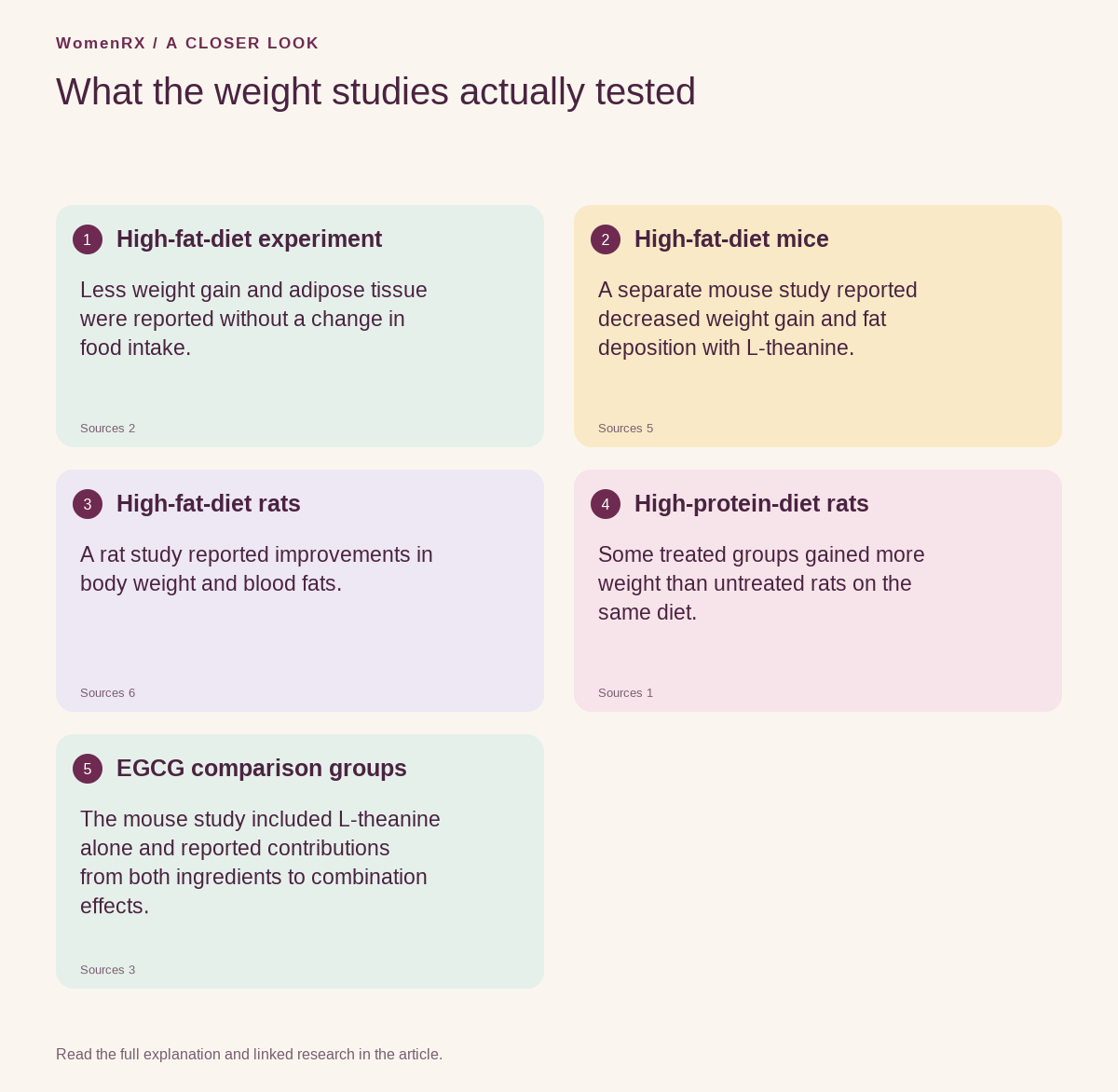
What the weight studies actually tested
High-fat-diet experiment: Less weight gain and adipose tissue were reported without a change in food intake.2
High-fat-diet mice: A separate mouse study reported decreased weight gain and fat deposition with L-theanine.5
High-fat-diet rats: A rat study reported improvements in body weight and blood fats.6
High-protein-diet rats: Some treated groups gained more weight than untreated rats on the same diet.1
EGCG comparison groups: The mouse study included L-theanine alone and reported contributions from both ingredients to combination effects.3
Read the figure as text
Diet and comparison groups matter when interpreting these directly measured weight outcomes.- High-fat-diet experiment: Less weight gain and adipose tissue were reported without a change in food intake.2
- High-fat-diet mice: A separate mouse study reported decreased weight gain and fat deposition with L-theanine.5
- High-fat-diet rats: A rat study reported improvements in body weight and blood fats.6
- High-protein-diet rats: Some treated groups gained more weight than untreated rats on the same diet.1
- EGCG comparison groups: The mouse study included L-theanine alone and reported contributions from both ingredients to combination effects.3
More questions, answered
Could L-theanine cause weight gain?
A high-protein-diet rat study found more weight gain in some L-theanine-treated groups than in untreated rats on the same diet. Other diet experiments reported less weight gain. Neither pattern establishes that L-theanine causes weight gain or loss in people. 1 2 5
Sources you can check
- L-Theanine ameliorates high-protein diet-associated hepatic glucose and lipid metabolic alterations by promoting fatty acid β-oxidation and suppressing lipid synthesis and gluconeogenesis in rats.Liu S, Li L, Yao K, He L, Yuan Y, Tan Y, Yin F, Gong Z, Xiao W. · Current research in food science · 2026Return to first citation
- L-Theanine Alleviates High-Fat Diet-Induced Obesity by Enhancing Hepatic Oxidative Phosphorylation and Remodeling Gut Microbiota to Augment Butyrate-Producing.Li L, Le J, Lu Y, Zhao Y, Jin Y. · Molecular nutrition & food research · 2025Return to first citation
- Low-dose epigallocatechin gallate combined with L-theanine effectively alleviate obesity and metabolic dysfunction-associated steatotic liver disease by remodeling gut homeostasis and avoiding its hepatotoxicity.Zuo G, Shen Y, Wang L, Gao Y, Luo C, Wen J, Li J, Huang JA, Liu Z, Lin Y. · Phytomedicine : international journal of phytotherapy and phytopharmacology · 2026Return to first citation
- L-Theanine Ameliorates Metabolic Dysregulation and Adverse Fetal Outcomes in a Mice Model of Gestational Obesity: Association with FXR/FGF15 Signaling.Huang L, Li H, Yang W, Huang L, Chen Q, Li S, Zou Z, Zhao L, Zeng Z. · Journal of microbiology and biotechnology · 2025Return to first citation
- L-Theanine Ameliorates Obesity-Related Complications Induced by High-Fat Diet in Mice: Insights from Transcriptomics and Metabolomics.Du Z, Wu G, Cheng H, Han T, Li D, Xie Z. · Foods (Basel, Switzerland) · 2024Return to first citation
- l-Theanine Prevents Colonic Damage via NF-κB/MAPK Signaling Pathways Induced by a High-Fat Diet in Rats.Fang C, Shen Y, Ma Z, Li Y, Zhang J, Liu C, Ye Y. · Molecular nutrition & food research · 2024Return to first citation