Does Spermidine Change Body Weight? What Studies Show
Weight changes have been measured in animal studies, but those results don’t establish what spermidine does to weight in people.
These weight findings come from animal studies, not evidence showing that spermidine changes people’s weight. In mice, results depended on the diet: some studies found lower weight, while others found no change. A rat study also reported less weight gain. None of these findings tells us whether supplementation affects women differently or has a reliable weight effect in humans. 2 3 5
Spermidine is sometimes discussed in connection with metabolism and obesity, but a change in a lab marker or a proposed biological mechanism isn’t the same as a measured change on the scale. The studies that directly measured body weight described here were done in animals. They can help researchers decide what to investigate next, but they don’t show that a supplement causes weight loss or gain in people.
What the animal studies measured
The results weren’t consistent across diets. In a 30-week study of male mice, spermidine was associated with lower body weight on a control diet and lower weight on a high-sucrose diet. On a high-fat diet, it didn’t change the diet-related increases in body weight or fat depots. The same study reported changes in some liver lipid measures, but those metabolic findings don’t establish a weight effect across diets. 2
Other mouse studies found no weight benefit in the conditions they tested. In mice with advanced fatty liver disease, 12 weeks of spermidine did not affect body weight, body composition, or adiposity. 3 In another study, it did not change high-fat-diet-related body weight after 30 weeks, even though some lung measurements changed. Those lung findings are not evidence of weight loss. 4
A six-week study in male rats fed a high-fat, high-fructose diet reported less weight gain and less visceral fat with spermidine. That is a direct animal weight finding, but it came from a specific diet and species, not from a human weight-loss trial. 5
Why a biomarker isn’t a weight result
Metabolic markers, fat in a particular organ, body composition, and total body weight answer different questions. A study can find a change in liver lipids or blood glucose without finding a change in body weight. And a change in an animal’s fat tissue doesn’t establish that a supplement will cause a meaningful or lasting change in a person’s weight. For context, body weight includes muscle, bone, fat, and water, so the number alone doesn’t describe every change in the body. 1 2
Study conditions matter, too. The mouse research compared different diets, and the rat study used a high-fat, high-fructose diet. Results from these controlled animal models can’t be assumed to apply to people eating varied diets or taking a retail supplement. Study duration also differed: the cited research ranged from six to 30 weeks. Those timeframes tell you how long the animals were studied, not whether any effect would occur or last in people. 2 3 4 5
What this means for women
The studies with explicitly reported sex in this group used male mice or male rats. The summaries don’t report weight outcomes separately for women, or across menstrual, pregnancy, postpartum, perimenopausal, or postmenopausal stages. So there’s no basis here for saying spermidine works differently for women, or for claiming a weight benefit at a particular life stage. 2 3 5
The practical takeaway is straightforward: animal studies offer mixed, diet-dependent weight findings, but they don’t establish spermidine as a weight-management supplement for people. If you see a claim based on improved metabolic markers or a proposed mechanism, check whether the study actually measured body weight in humans. That distinction is the difference between a possible research lead and evidence that a supplement changes your weight.
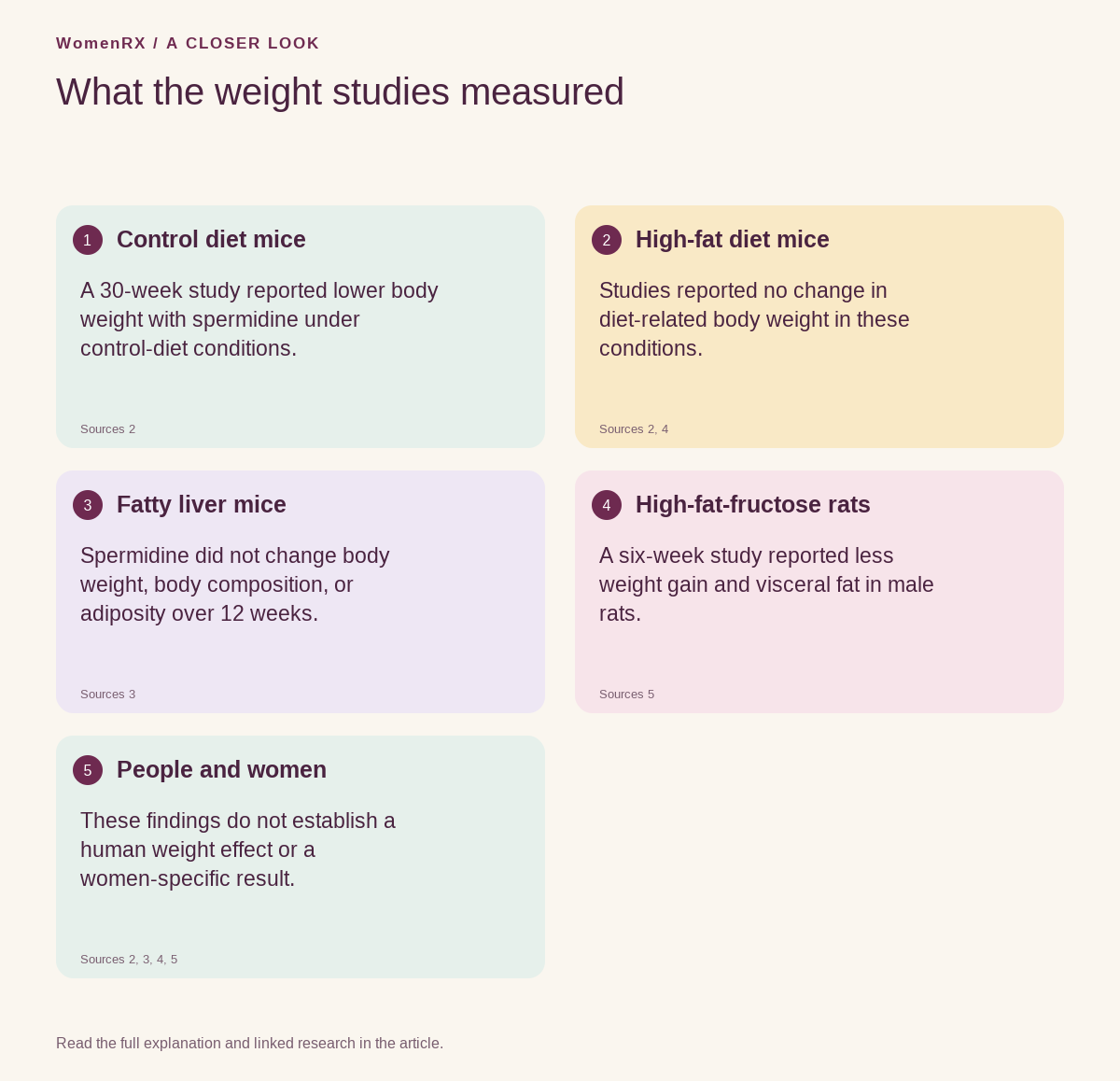
What the weight studies measured
Control diet mice: A 30-week study reported lower body weight with spermidine under control-diet conditions.2
High-fat diet mice: Studies reported no change in diet-related body weight in these conditions.24
Fatty liver mice: Spermidine did not change body weight, body composition, or adiposity over 12 weeks.3
High-fat-fructose rats: A six-week study reported less weight gain and visceral fat in male rats.5
People and women: These findings do not establish a human weight effect or a women-specific result.2345
Read the figure as text
These animal studies measured body weight directly, but their results varied by species, diet, and study conditions.- Control diet mice: A 30-week study reported lower body weight with spermidine under control-diet conditions.2
- High-fat diet mice: Studies reported no change in diet-related body weight in these conditions.24
- Fatty liver mice: Spermidine did not change body weight, body composition, or adiposity over 12 weeks.3
- High-fat-fructose rats: A six-week study reported less weight gain and visceral fat in male rats.5
- People and women: These findings do not establish a human weight effect or a women-specific result.2345
More questions, answered
Do improved metabolic markers mean spermidine causes weight loss?
No. A change in a marker such as liver lipids or blood glucose is not itself evidence of weight loss. In the mouse study, findings varied by diet, including no body-weight effect on the high-fat diet. 2
Sources you can check
- Body Weight: MedlinePlusAccessed 2026-09-25Return to first citation
- Oral Supplementation with the Polyamine Spermidine Affects Hepatic but Not Pulmonary Lipid Metabolism in Lean but Not Obese Mice.Pankoke S, Pfarrer C, Glage S, Mühlfeld C, Schipke J. · Nutrients · 2022Return to first citation
- Restoring polyamine levels by supplementation of spermidine modulates hepatic immune landscape in murine model of NASH.Szydlowska M, Lasky G, Oldham S, Rivera C, Ford M, Sellman BR, Rhodes CJ, Cohen TS. · Biochimica et biophysica acta. Molecular basis of disease · 2023Return to first citation
- Spermidine supplementation and voluntary activity differentially affect obesity-related structural changes in the mouse lung.Ahrendt N, Steingrüber T, Rajces A, Lopez-Rodriguez E, Eisenberg T, Magnes C, Madeo F, Sedej S, Schmiedl A, Ochs M, Mühlfeld C, Schipke J. · American journal of physiology. Lung cellular and molecular physiology · 2020Return to first citation
- Physiological responses and microbiota shifts after spermidine administration as a postbiotic on rodents fed a high-fat high-fructose diet.Melo NCO, Cuevas-Sierra A, Casillas-Fikentscher A, Arellano-Garcia L, Portillo MP, Milton-Laskibar I, Martinez JA. · Beneficial microbes · 2024Return to first citation