Spermidine Supplements: What Human Studies Actually Show
Spermidine has a role in cell biology, but the best longer-term memory trial did not find a benefit on its main measure.
Spermidine is a natural compound found in the body and in foods. Researchers are studying it partly because of its role in cellular maintenance, but that doesn’t mean a supplement slows aging. A small memory pilot looked promising; a larger, year-long trial found no significant benefit on its primary memory test. Human studies also leave long-term safety and women-specific effects unresolved. 124
Spermidine is a polyamine, a type of compound involved in normal cellular processes. It occurs in various foods, and the body handles it as part of its usual metabolism. Researchers are interested in its relationship with autophagy, a process cells use to break down and recycle components. That is a reason to test spermidine, not proof that swallowing more of it will keep you healthier or help you live longer. 123
Where spermidine appears in food
Spermidine is not only a supplement ingredient. A laboratory study of food composition identified wheat germ, soybeans, and mushrooms as dietary sources. The amounts varied across foods, and the researchers also found that cooking could change polyamine content. 8
That is a food-composition finding, not a demonstration that eating more of those foods extends life or prevents disease. It also does not make an ordinary food serving interchangeable with the concentrated wheat or rice germ extracts used in supplement trials. There is no dietary intake target established by this food analysis. 8
The memory trial that puts the early promise in context
The clearest test of a common supplement claim concerns memory. First, a three-month placebo-controlled pilot enrolled 30 cognitively intact adults ages 60 to 80 who reported subjective cognitive decline. A spermidine-rich plant extract produced an encouraging memory signal, although the reported between-group estimate was uncertain. The researchers called for a larger trial. 4
That follow-up matters more than the pilot when weighing a brain-health claim. The 12-month SmartAge trial randomly assigned 100 adults ages 60 to 90 with subjective cognitive decline to a wheat germ extract providing 0.9 mg of spermidine daily or placebo. It found no statistically significant difference on its primary memory task or its secondary outcomes. Exploratory analyses suggested possible effects on verbal memory and inflammation, but those findings need confirmation and do not change the main result. The trial tested people who had noticed cognitive changes, not whether spermidine prevents dementia or improves memory in every older adult. 2
What higher-amount studies can, and can’t, tell you
A product label may list far more spermidine than the SmartAge extract contained. That doesn’t make it a proven upgrade: studies using larger amounts have largely asked different questions.
In a placebo-controlled crossover study of 12 healthy volunteers, five days of 15 mg of oral spermidine daily did not increase measured plasma spermidine. It did increase plasma spermine, a related polyamine. The result offers a clue about how ingested spermidine is processed; blood levels of either compound are not a measure of whether someone ages more healthfully. 3
Another placebo-controlled trial studied high-purity spermidine trihydrochloride in 37 healthy men ages 50 to 70. Over periods of seven and 28 days at 40 mg daily, researchers reported no study-product-related adverse events or significant differences from placebo in the clinical laboratory measures they assessed. They also found no substantial change in serum or urine polyamine concentrations. Those are useful short-term findings for that preparation in healthy men, not a test of lasting benefit or long-term safety in women. 1
A separate 56-day pilot assigned 12 healthy men and women to either 1.5 mg or 3.3 mg of spermidine daily from rice germ extract. It reported changes from baseline in some blood biomarkers in the higher-amount group. With such a small study and no placebo group described, those changes cannot establish that spermidine caused a health improvement. A marker associated with autophagy is not, by itself, evidence of better day-to-day function or longer life. 7
Why other positive headlines need context
Human findings aren’t uniformly negative, but a result has to stay attached to the setting in which it was observed. In a randomized trial of 58 people receiving head and neck radiotherapy, fewer participants assigned oral spermidine had dry mouth three months after treatment than those assigned placebo: 48.28% versus 79.31%. The groups did not differ significantly on dry-mouth measures during treatment or immediately afterward. This finding concerns a specific complication of cancer treatment; it does not show that spermidine helps ordinary dry mouth or promotes healthy aging. 5
Likewise, a two-month trial reported changes in immune measures and a calculated “biological age” after participants took a blend containing spermidine, AM3, and hesperidin. It cannot separate spermidine’s effect from those of the other ingredients. A change in a calculated measure is not evidence that participants lived longer. 6
What the research says specifically about women
Women were included in SmartAge: 49 of its 100 participants were female. Its reported main finding is for the study group as a whole, not a separate treatment effect for women. The short-term 40 mg high-purity trial enrolled only men, while the tiny rice germ pilot included men and women without establishing a women-specific benefit. These results do not tell us whether effects differ during the cycling years, perimenopause, or postmenopause, or establish supplement safety during pregnancy or postpartum. 127
A practical comparison before buying
If you’re considering a product, start with its Supplement Facts serving size and the amount of spermidine that serving supplies. Then compare its claim with the actual human test:
- Form: Was the study of wheat germ extract, rice germ extract, or high-purity spermidine trihydrochloride? A result for one cannot automatically be assigned to another. 127
- People and duration: A year-long memory result in older adults answers a different question from a 28-day laboratory-safety result in men. 12
- Outcome: Was there a meaningful difference in memory or symptoms, or only a change in a blood compound or biomarker? 237
- Other ingredients: A blend study cannot establish what spermidine alone contributed. 6
You don’t need to find the largest milligram number to make a sound decision. For a general healthy-aging claim, the missing piece is a demonstrated benefit in people that matches the product and the outcome you care about. The studies above have not established one for longer life or prevention of age-related disease. 123
These human studies do not establish a best spermidine supplement for women. 127 If you are still weighing a product, bring its label to a clinician or pharmacist to discuss its form, amount, other ingredients, and safety questions relevant to you. 9
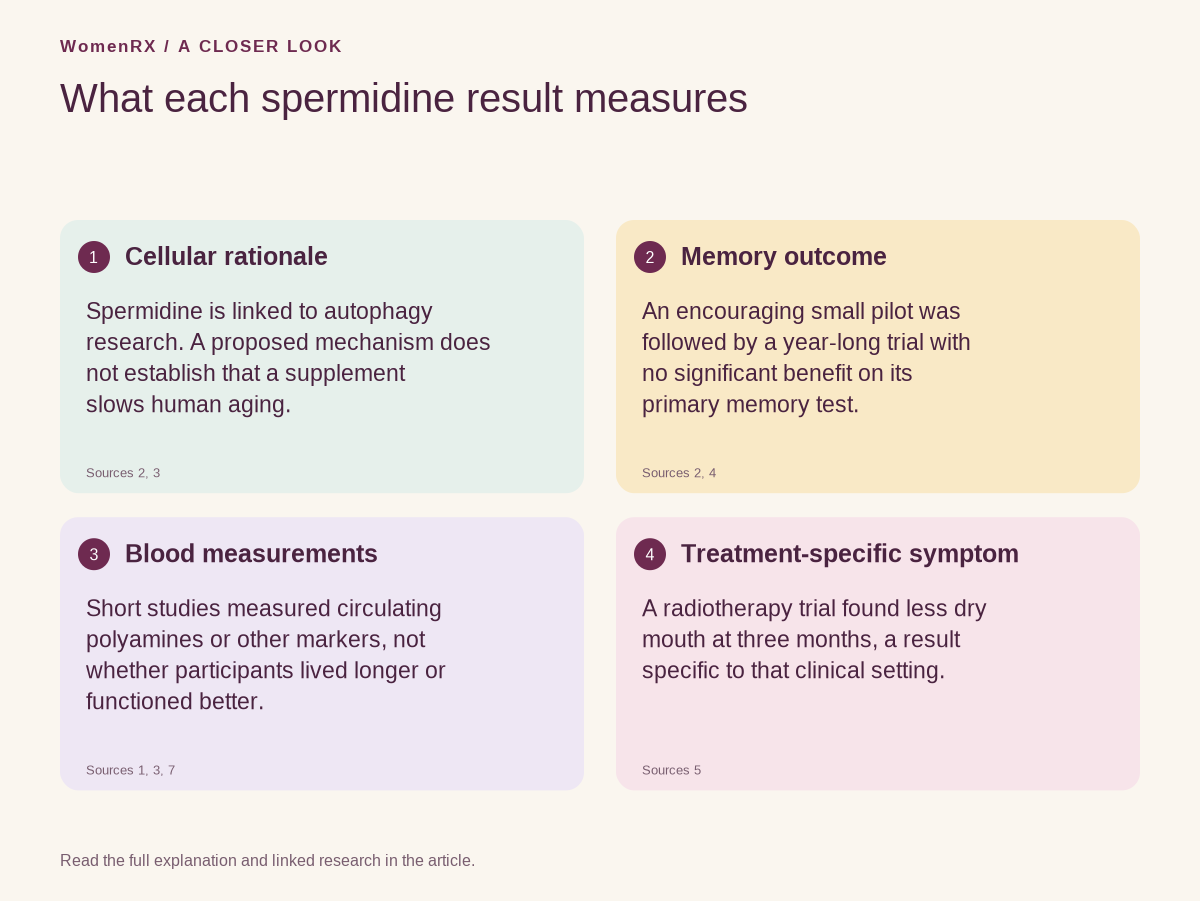
What each spermidine result measures
Cellular rationale: Spermidine is linked to autophagy research. A proposed mechanism does not establish that a supplement slows human aging.23
Memory outcome: An encouraging small pilot was followed by a year-long trial with no significant benefit on its primary memory test.24
Blood measurements: Short studies measured circulating polyamines or other markers, not whether participants lived longer or functioned better.137
Treatment-specific symptom: A radiotherapy trial found less dry mouth at three months, a result specific to that clinical setting.5
Read the figure as text
These findings answer different questions; moving from a cellular idea to a longer-life claim requires evidence of outcomes in people.- Cellular rationale: Spermidine is linked to autophagy research. A proposed mechanism does not establish that a supplement slows human aging.23
- Memory outcome: An encouraging small pilot was followed by a year-long trial with no significant benefit on its primary memory test.24
- Blood measurements: Short studies measured circulating polyamines or other markers, not whether participants lived longer or functioned better.137
- Treatment-specific symptom: A radiotherapy trial found less dry mouth at three months, a result specific to that clinical setting.5
More questions, answered
Is eating wheat germ equivalent to taking the extract studied for memory?
No equivalence has been established. The year-long memory trial used a spermidine-rich extract from wheat germ, not servings of wheat germ as food. Its findings cannot tell you how much of the food would provide the studied amount or whether eating it would produce the same result. 2
Sources you can check
- Supplementation of spermidine at 40 mg/day has minimal effects on circulating polyamines: An exploratory double-blind randomized controlled trial in older men.Keohane P, Everett JR, Pereira R, Cook CM, Blonquist TM, Mah E. · Nutrition research (New York, N.Y.) · 2024Return to first citation
- Effects of Spermidine Supplementation on Cognition and Biomarkers in Older Adults With Subjective Cognitive Decline: A Randomized Clinical Trial.Schwarz C, Benson GS, Horn N, Wurdack K, Grittner U, Schilling R, Märschenz S, Köbe T, Hofer SJ, Magnes C, Stekovic S, Eisenberg T, Sigrist SJ, Schmitz D, Wirth M, Madeo F, Flöel A... · JAMA network open · 2022Return to first citation
- High-Dose Spermidine Supplementation Does Not Increase Spermidine Levels in Blood Plasma and Saliva of Healthy Adults: A Randomized Placebo-Controlled Pharmacokinetic and Metabolomic Study.Senekowitsch S, Wietkamp E, Grimm M, Schmelter F, Schick P, Kordowski A, Sina C, Otzen H, Weitschies W, Smollich M. · Nutrients · 2023Return to first citation
- The effect of spermidine on memory performance in older adults at risk for dementia: A randomized controlled trial.Wirth M, Benson G, Schwarz C, Köbe T, Grittner U, Schmitz D, Sigrist SJ, Bohlken J, Stekovic S, Madeo F, Flöel A. · Cortex; a journal devoted to the study of the nervous system and behavior · 2018Return to first citation
- Oral Spermidine Supplementation Preserves Submandibular Gland Function After Radiotherapy: Mechanistic Insights and Use in a Phase II Randomized Clinical Trial.Min Y, Gao K, Liu Y, Dai L, Peng X. · MedComm · 2026Return to first citation
- Human Supplementation with AM3, Spermidine, and Hesperidin Enhances Immune Function, Decreases Biological Age, and Improves Oxidative-Inflammatory State: A Randomized Controlled Trial.Félix J, Díaz-Del Cerro E, Baca A, López-Ballesteros A, Gómez-Sánchez MJ, De la Fuente M. · Antioxidants (Basel, Switzerland) · 2024Return to first citation
- Effects of Spermidine-Rich Rice Germ Extract Supplement on Biomarkers of Healthy Aging and Autophagy-Proof-of-Concept Pilot Study.Bruno G, La Monica M, Ziegenfuss TN. · Alternative therapies in health and medicine · 2025Return to first citation
- Occurrence of Polyamines in Foods and the Influence of Cooking Processes2021Return to first citation
- Dietary Supplements: What You Need to KnowAccessed 2026-09-25Return to first citation