Spermidine Safety: What Human Studies Have Found
Small human studies have not identified a clear side-effect pattern, but the products, doses, and people studied differ, and important safety questions remain.
In the human trials available, researchers reported no product-related adverse events in a short study of spermidine capsules, and adverse events were balanced between groups in a 12-month trial of a low-dose wheat-germ extract. A very small pilot also described its extract as having a good safety profile. These findings are reassuring but don’t establish safety for every product or for pregnancy, breastfeeding, fertility, or medication combinations. 1 2 3
What participants reported
There isn’t a well-established list of side effects from human studies of spermidine supplements. That’s different from knowing that side effects never happen: the trials were relatively small, used different products, and weren’t designed to identify every uncommon or long-term problem.
The largest and longest trial here followed 100 adults aged 60 to 90 with subjective cognitive decline for 12 months. Participants took either a wheat-germ extract containing about 0.9 mg of spermidine daily or a placebo. Adverse events were balanced between the two groups. The study included 49 women, but the reported findings don’t provide a separate safety result for women. 3
A separate 56-day pilot included just 12 healthy men and women. It tested two amounts of spermidine from rice-germ extract and described the safety findings as good, but the abstract doesn’t give details of specific adverse events. 1 In another trial, 37 healthy men aged 50 to 70 took high-purity spermidine trihydrochloride or placebo for up to 28 days. The researchers reported no study-product-related adverse events. That short, all-male study can’t answer whether the same holds for women or for longer use. 2
Taken together, these studies haven’t established a common side-effect pattern. They also can’t rule out uncommon effects, effects that take longer to appear, or reactions to other ingredients in a particular supplement.
Why one product’s results may not apply to another
The trials tested different forms: spermidine in wheat-germ or rice-germ extracts, and a high-purity spermidine trihydrochloride product. The amounts and study lengths also differed. A result from one extract or formulation doesn’t automatically establish the safety of another product, especially if its label lists additional ingredients. 1 2 3
One 2026 trial tested a blend containing spermidine plus three other ingredients. It found no significant difference in adverse effects between the blend and placebo, but that result can’t show whether spermidine alone caused, prevented, or had nothing to do with any effect. 4
Situations where evidence is especially thin
The trials described here don’t establish safety during pregnancy or breastfeeding, while trying to conceive, or for people with hormone-sensitive conditions. They also don’t answer whether spermidine interacts with prescription medicines or other supplements. Missing evidence doesn’t mean spermidine is harmful in these situations, but it also isn’t reassurance that use is safe.
If one of these situations applies to you, or you take regular medicines, show a clinician or pharmacist the exact product label before deciding. The studies don’t identify a specific medication interaction to watch for, so don’t assume an interaction exists, or that none is possible. A pharmacist can review the full formula alongside your medication list.
A practical label-and-medication check
Before discussing a product, gather the bottle or a clear photo of its label. Note the form of spermidine, the amount listed, the source extract, and every other active ingredient. Then bring your prescription and nonprescription medication list, including other supplements. This helps a pharmacist distinguish the product you’re considering from the different formulations studied in trials.
Ask what is known about that particular formula, whether any ingredient needs checking against your medicines or health circumstances, and what symptoms should prompt you to stop and seek advice. The current human findings offer some short-term reassurance, but they aren’t a substitute for a product-specific review when your circumstances weren’t represented in the studies.
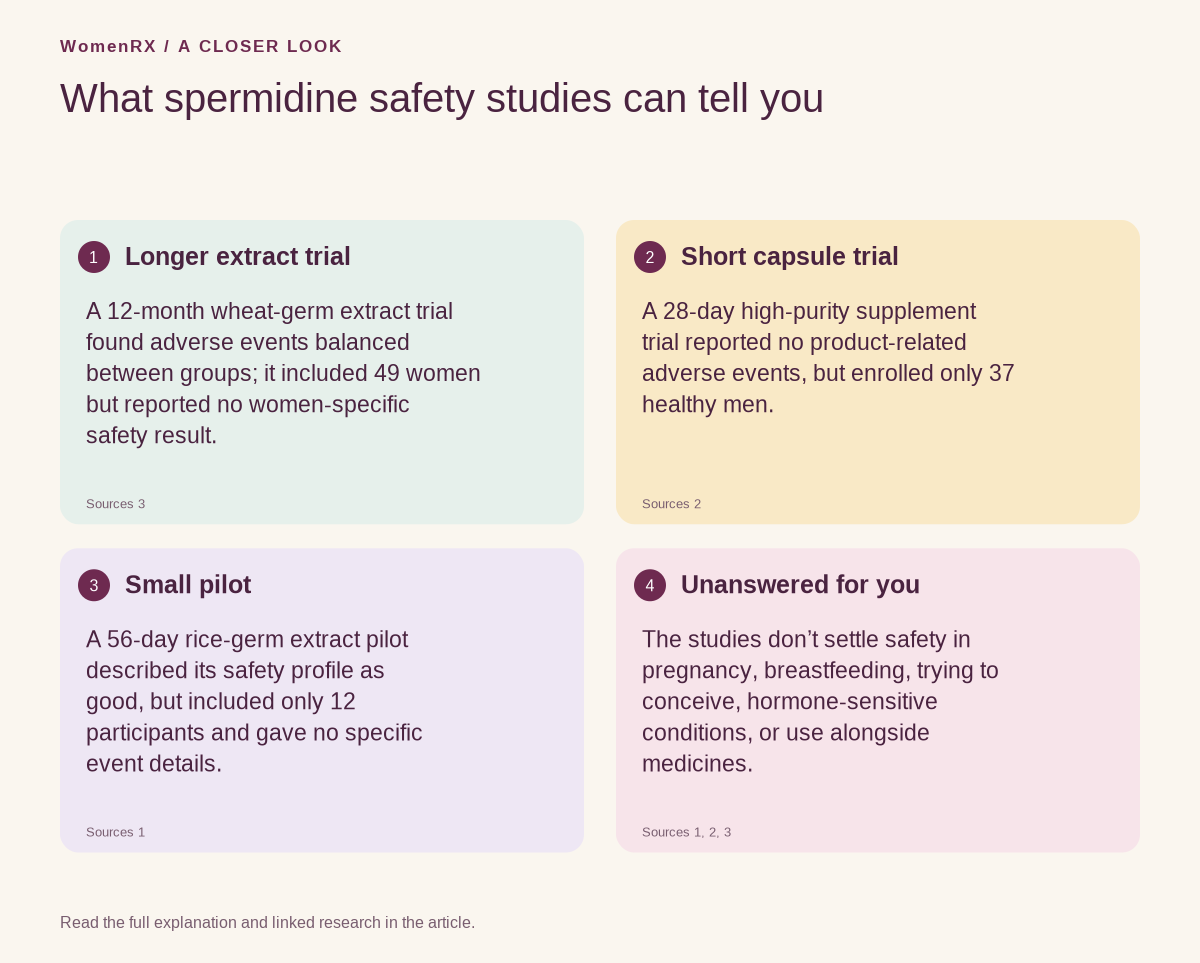
What spermidine safety studies can tell you
Longer extract trial: A 12-month wheat-germ extract trial found adverse events balanced between groups; it included 49 women but reported no women-specific safety result.3
Short capsule trial: A 28-day high-purity supplement trial reported no product-related adverse events, but enrolled only 37 healthy men.2
Small pilot: A 56-day rice-germ extract pilot described its safety profile as good, but included only 12 participants and gave no specific event details.1
Unanswered for you: The studies don’t settle safety in pregnancy, breastfeeding, trying to conceive, hormone-sensitive conditions, or use alongside medicines.123
Read the figure as text
Human findings offer limited reassurance for the specific products and participants studied, while several personal situations and product combinations remain unanswered.- Longer extract trial: A 12-month wheat-germ extract trial found adverse events balanced between groups; it included 49 women but reported no women-specific safety result.3
- Short capsule trial: A 28-day high-purity supplement trial reported no product-related adverse events, but enrolled only 37 healthy men.2
- Small pilot: A 56-day rice-germ extract pilot described its safety profile as good, but included only 12 participants and gave no specific event details.1
- Unanswered for you: The studies don’t settle safety in pregnancy, breastfeeding, trying to conceive, hormone-sensitive conditions, or use alongside medicines.123
More questions, answered
Were women included in spermidine safety studies?
Yes. A 12-month trial included 49 women among 100 participants, and a 56-day pilot included healthy men and women. However, the reported safety findings don’t give a separate result for women, and the 40 mg/day trial included only men. 1 2 3
Do the studies show that spermidine interacts with medicines?
The studies summarized here don’t establish a medication interaction, but they also don’t settle whether interactions are possible. If you take medicines, have a pharmacist review the full supplement label rather than relying on findings from a different spermidine product. 1 2 3
Sources you can check
- Effects of Spermidine-Rich Rice Germ Extract Supplement on Biomarkers of Healthy Aging and Autophagy-Proof-of-Concept Pilot Study.Bruno G, La Monica M, Ziegenfuss TN. · Alternative therapies in health and medicine · 2025Return to first citation
- Supplementation of spermidine at 40 mg/day has minimal effects on circulating polyamines: An exploratory double-blind randomized controlled trial in older men.Keohane P, Everett JR, Pereira R, Cook CM, Blonquist TM, Mah E. · Nutrition research (New York, N.Y.) · 2024Return to first citation
- Effects of Spermidine Supplementation on Cognition and Biomarkers in Older Adults With Subjective Cognitive Decline: A Randomized Clinical Trial.Schwarz C, Benson GS, Horn N, Wurdack K, Grittner U, Schilling R, Märschenz S, Köbe T, Hofer SJ, Magnes C, Stekovic S, Eisenberg T, Sigrist SJ, Schmitz D, Wirth M, Madeo F, Flöel A... · JAMA network open · 2022Return to first citation
- A novel fasting mimetic (Mimio) creates fasting-like benefits to hunger control, oxidative stress, and cardiometabolic health in humans.Grant AD, Erfe MCB, Kazaryan A, Oliver PL, Moos J, Luna V, Craft N, Rhodes CH. · Scientific reports · 2026Return to first citation