Is Spermidine Worth Considering After 40?
A small, short human study measured biomarkers, not whether spermidine helps women live longer or stay healthier.
There’s not enough human evidence to recommend spermidine for longevity after 40. A 2025 pilot included 12 healthy men and women and measured short-term biomarkers, but didn’t test outcomes such as disease prevention, daily function, or lifespan. It didn’t report how many participants were women or their menopause status. Fertility findings don’t fill that gap: supplementation was studied in mice, while the human study measured a marker rather than a supplement’s effects. 123
What the human study can, and can’t, tell you
A 2025 randomized pilot tested spermidine from rice germ extract for 56 days in 12 healthy men and women, whose average age was about 55. The study measured blood markers related to autophagy, neuroprotection, and cardiometabolic health. Its abstract doesn’t report how many participants were women or whether menopause status was recorded. 1
At the higher of the two amounts tested, some markers changed from participants’ starting levels. That’s a signal worth studying, not proof of a benefit you would notice in everyday life. The pilot didn’t establish that spermidine prevents disease, improves function, or extends life. With only 12 participants and eight weeks of follow-up, it also can’t tell us much about long-term effects. 1
This is the key distinction behind many “healthy aging” claims: a change in a lab marker may help researchers form a hypothesis, but it doesn’t by itself show that people feel better or have better health outcomes.
Fertility research is a different question
Spermidine has also been studied in connection with reproductive aging, but that work doesn’t establish a benefit from supplements for women. In aged mice, supplementation improved measures related to egg quality and reproduction. The researchers said human safety and effectiveness still need to be tested. 2
A prospective study of 61 women undergoing IVF measured spermidine in follicular fluid, the fluid around the developing egg. It did not give participants spermidine supplements. Spermidine alone did not significantly predict clinical pregnancy in the reported analysis. So this study can’t show that taking spermidine improves fertility. 3
Neither study shows that women need more spermidine after 40, or that it helps with menopause symptoms or general longevity. Animal findings and measurements taken during IVF shouldn’t be treated as evidence that a supplement works for those goals.
A buy-or-wait check
Before paying for a product, ask yourself:
- What specific outcome am I buying it for? “Aging support” is broad. The human pilot measured biomarkers, not a demonstrated improvement in health or lifespan. 1
- Were people like me studied? The pilot included men and women, but doesn’t report the number of women or their menopause status. 1
- Was this product or formulation tested? The pilot used spermidine from rice germ extract. Its results don’t establish that other products have the same effects. 1
- Does the study match the promise? A short study of lab markers can’t establish long-term benefit or safety. 1
- Does the recurring cost feel worthwhile given that uncertainty? If the goal is longevity, the available human study doesn’t show that spermidine delivers it.
If you don’t have a specific goal supported by human outcomes relevant to you, waiting is a reasonable choice. Being over 40, by itself, isn’t evidence that you need a spermidine supplement.
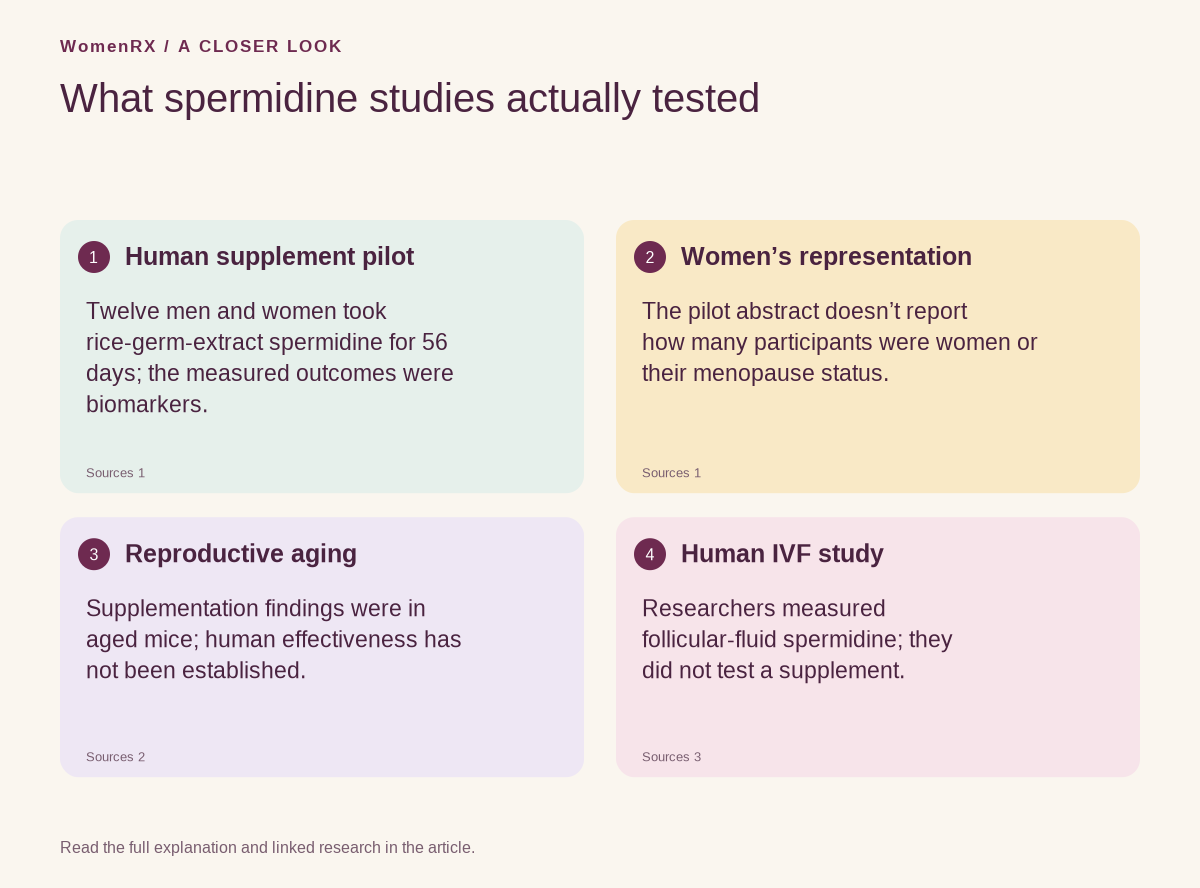
What spermidine studies actually tested
Human supplement pilot: Twelve men and women took rice-germ-extract spermidine for 56 days; the measured outcomes were biomarkers.1
Women’s representation: The pilot abstract doesn’t report how many participants were women or their menopause status.1
Reproductive aging: Supplementation findings were in aged mice; human effectiveness has not been established.2
Human IVF study: Researchers measured follicular-fluid spermidine; they did not test a supplement.3
Read the figure as text
These studies address different questions: one small human supplement pilot measured biomarkers, while reproductive-aging research came from mice or an observational IVF study.- Human supplement pilot: Twelve men and women took rice-germ-extract spermidine for 56 days; the measured outcomes were biomarkers.1
- Women’s representation: The pilot abstract doesn’t report how many participants were women or their menopause status.1
- Reproductive aging: Supplementation findings were in aged mice; human effectiveness has not been established.2
- Human IVF study: Researchers measured follicular-fluid spermidine; they did not test a supplement.3
More questions, answered
Does spermidine help with menopause symptoms?
The human supplement pilot measured biomarkers and didn’t report participants’ menopause status or test menopause symptoms. It can’t establish whether spermidine helps with them. 1
Is spermidine proven to improve fertility after 40?
No. The supplementation findings described here came from aged mice. The human IVF study measured follicular-fluid spermidine rather than testing a supplement. 23
Sources you can check
- Effects of Spermidine-Rich Rice Germ Extract Supplement on Biomarkers of Healthy Aging and Autophagy-Proof-of-Concept Pilot Study.Bruno G, La Monica M, Ziegenfuss TN. · Alternative therapies in health and medicine · 2025Return to first citation
- Polyamine metabolite spermidine rejuvenates oocyte quality by enhancing mitophagy during female reproductive aging.Zhang Y, Bai J, Cui Z, Li Y, Gao Q, Miao Y, Xiong B. · Nature aging · 2023Return to first citation
- Evaluation of Intrafollicular Syndecan 1, Glypican 3, and Spermidine Levels in Women with Diminished Ovarian Reserve.Gokce S, Herkiloglu D, Cevik O, Turan V. · Reproductive sciences (Thousand Oaks, Calif.) · 2023Return to first citation