Spermidine Supplements: What One Human Pilot Shows
A small human pilot assessed blood markers after eight weeks, but it did not establish when you should feel a benefit.
One small, eight-week pilot study measured blood markers, not whether participants felt younger, healthier, or different in daily life. It doesn’t establish when you might notice a benefit from spermidine. Its results don’t show that a particular benefit should appear by week eight, or that the findings apply to every product or to women specifically. 2
What an eight-week study actually tells us
The clearest timing information comes from a small pilot study of a spermidine-rich rice germ extract. It included 12 healthy men and women, with an average age of about 55. Participants were randomly assigned to one of two daily amounts of spermidine, and researchers assessed them at the start and after 56 days. 2
The researchers measured blood markers, including Beclin-1 and ULK1, which they described as biomarkers of autophagy, as well as BDNF and cardiometabolic markers. In the group receiving 3.3 mg daily, the study reported increases from baseline in some markers at the eight-week assessment. These were changes in measured markers, not a reported timeline for feeling a difference. 2
That distinction matters. A blood-marker change doesn’t automatically mean you’ll notice a change in energy, memory, skin, or how you feel. Nor does this study show that spermidine prevents aging or produces a health benefit you can expect. It was a small pilot, and the results were reported against participants’ own starting measurements; the abstract doesn’t describe a placebo comparison. The findings need confirmation in larger studies. 2
The proposed mechanism isn’t a countdown
Spermidine has cellular roles that include regulating autophagy. But a biological role doesn’t establish that taking a supplement changes autophagy in a way you can feel, or when. The human pilot measured markers associated with autophagy; it did not establish a felt benefit or a predictable onset. 1 2
So if you’ve just started taking spermidine, “I should feel it by week eight” isn’t a conclusion this research supports. Eight weeks was when this pilot took its follow-up measurements, not a proven waiting period or a recommended trial length.
What this means for women
The pilot included men and women, but its abstract doesn’t say how many participants were women or report results separately by sex. That means it can’t tell us whether the results differ for women. It also offers no specific evidence about spermidine during pregnancy or breastfeeding. 2
This is a limitation of what this particular study reports, not proof that no other relevant research exists. Still, its findings shouldn’t be treated as a women-specific result, and the trial doesn’t answer questions about pregnancy or breastfeeding.
A more useful way to reassess
Start with the reason you’re taking it. If you’re hoping for a noticeable change, identify the specific outcome you care about and how you’d recognize it. Then ask whether you’ve actually seen a meaningful change, rather than treating a supplement’s proposed mechanism or a study’s blood-marker results as a personal outcome.
If your hoped-for benefit is something you can’t readily observe, keep in mind that the human pilot doesn’t establish a timeline for it. Researchers assessed a small group after eight weeks, but this study did not establish when, or whether, participants felt a benefit. 2
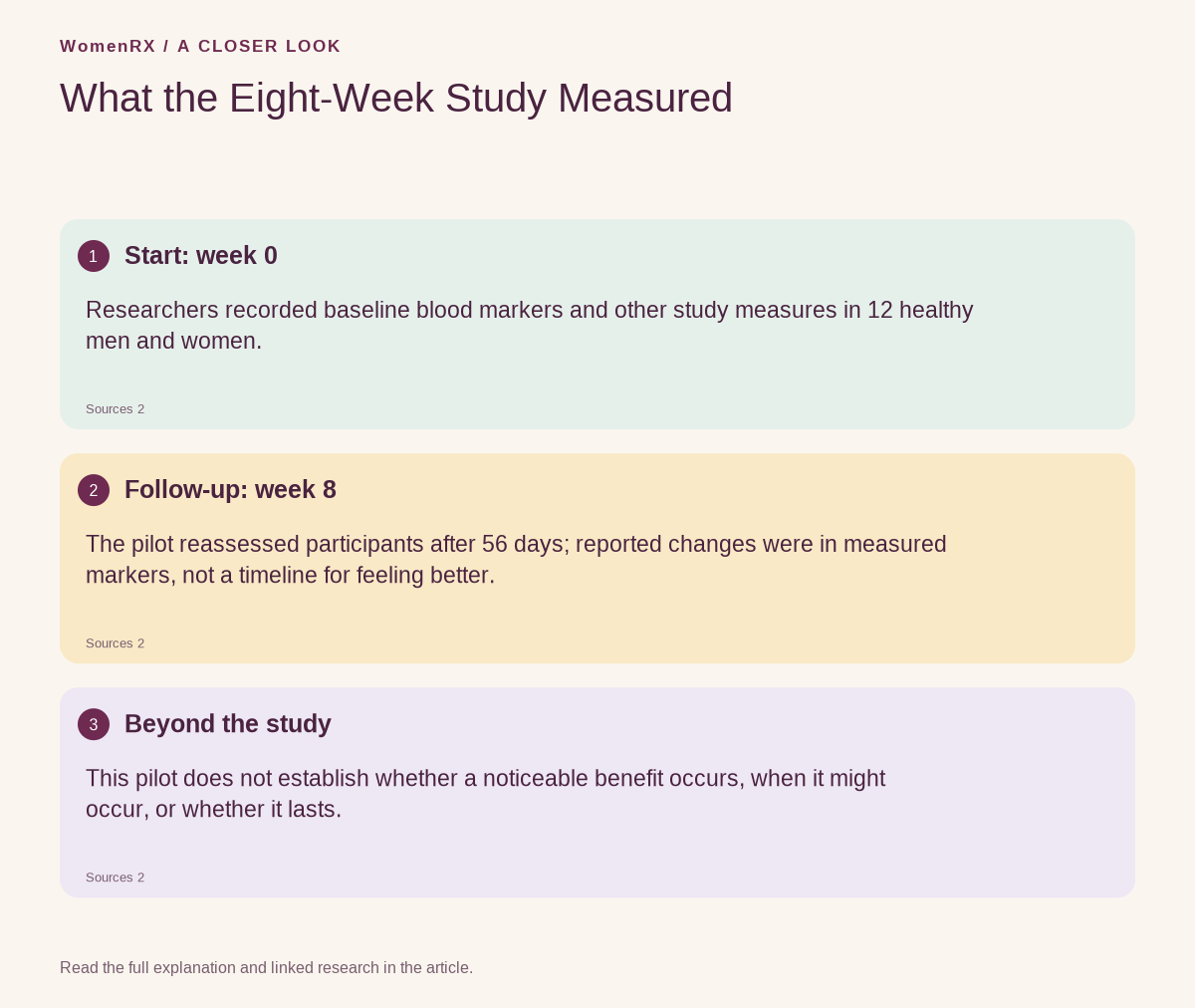
What the Eight-Week Study Measured
Start: week 0: Researchers recorded baseline blood markers and other study measures in 12 healthy men and women.2
Follow-up: week 8: The pilot reassessed participants after 56 days; reported changes were in measured markers, not a timeline for feeling better.2
Beyond the study: This pilot does not establish whether a noticeable benefit occurs, when it might occur, or whether it lasts.2
Read the figure as text
This timeline shows the pilot’s measurement points and why its follow-up date should not be mistaken for a proven onset of benefit.- Start: week 0: Researchers recorded baseline blood markers and other study measures in 12 healthy men and women.2
- Follow-up: week 8: The pilot reassessed participants after 56 days; reported changes were in measured markers, not a timeline for feeling better.2
- Beyond the study: This pilot does not establish whether a noticeable benefit occurs, when it might occur, or whether it lasts.2
Sources you can check
- Crystal structure of apo human spermidine synthase reveals dynamic rearrangement at the active site.Fagbohun OO, Canfield MA, Clinger JA. · Structural dynamics (Melville, N.Y.) · 2026Return to first citation
- Effects of Spermidine-Rich Rice Germ Extract Supplement on Biomarkers of Healthy Aging and Autophagy-Proof-of-Concept Pilot Study.Bruno G, La Monica M, Ziegenfuss TN. · Alternative therapies in health and medicine · 2025Return to first citation